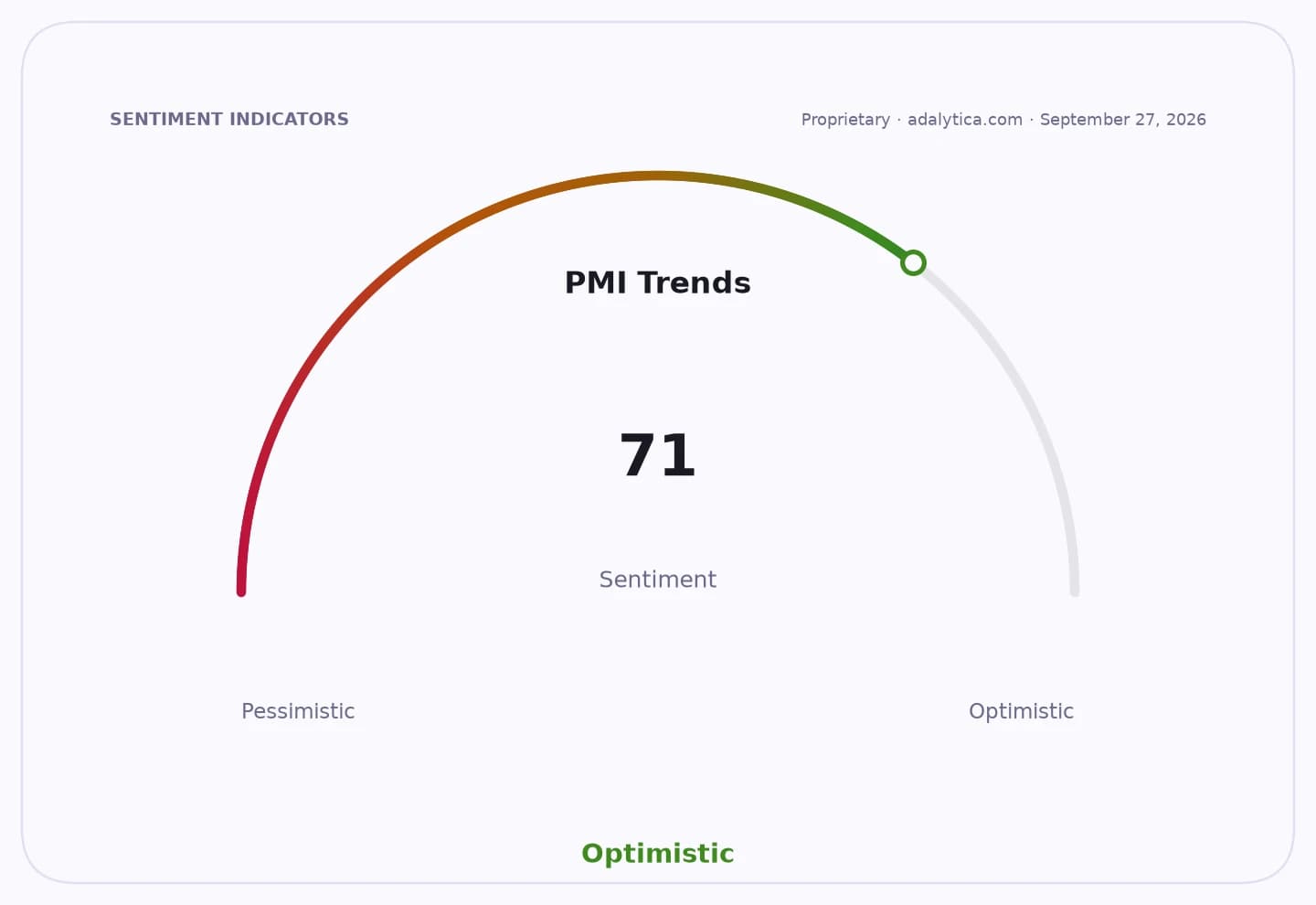
Eurozone business activity accelerated in September to its strongest pace since April 2023, sharpening the case that the European Central Bank may have to keep policy tighter for longer even as growth firms across the bloc.
Eurozone PMI Rises as Inflation Stays Elevated
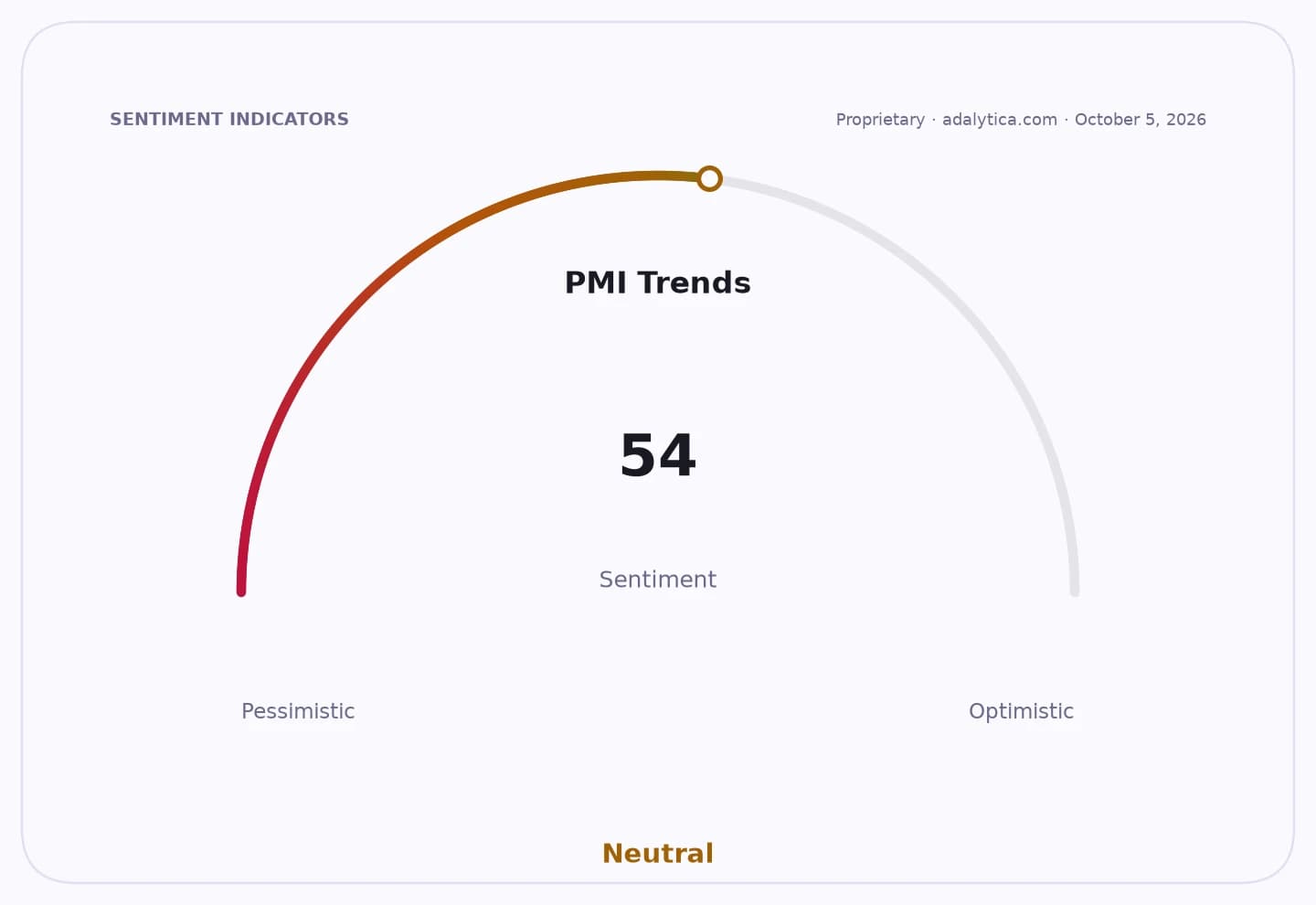
The composite purchasing managers’ index rose to 53.1 from 52.0 in August, according to HCOB and S&P Global, comfortably above the 50 mark that separates expansion from contraction. Services also improved, with the sector PMI climbing to 53.0 from 51.6, while new orders expanded at the fastest rate in more than three years and foreign demand turned positive for the first time in 39 months.
Sentiment IndicatorsⓘProprietary · adalytica.com · October 5, 2026
This is a snapshot — live sentiment, awareness and momentum for 130+ markets update continuously in the dashboard.Open AlphaPulse
That matters because the euro zone is showing a more durable growth pulse just as inflation re-accelerates. Consumer prices in the currency bloc picked up to 3.8% in September from 3.2% in August, driven by energy costs, and the survey showed companies facing their sharpest rise in input costs and output prices in four months. For the ECB, that combination of firmer activity and sticky price pressure makes any talk of quick easing look increasingly premature.
Investors should care because the data strengthen the “higher for longer” trade in Europe. Short-end sovereign yields have already moved higher on the prospect of additional tightening, and this report gives policymakers more cover to keep pressure on pricing expectations. Equities linked to domestic demand may welcome a better growth backdrop, but rate-sensitive sectors, highly leveraged balance sheets and bond proxies face a tougher path if borrowing costs remain elevated.
The details also show where the momentum is coming from. Germany, the bloc’s biggest economy, posted its fastest composite PMI in nearly a year at 53.8, while France returned to growth with a 51.1 reading after August’s weather-hit slowdown. Italy softened but stayed in expansion, and Spain remained the standout growth engine with a services PMI of 58.3, even as inflationary pressures intensified there too.
Our thesis is simple: the market is underestimating how long Europe’s inflation problem can coexist with improving activity. Services tied to information technology, business consulting and AI-related spending are becoming an increasingly important growth channel, which means the region is not just recovering — it is being reshaped by the same capex cycle driving U.S. tech and infrastructure. That is good for select equities, but less friendly to the broad bond market and to anyone betting on a swift policy pivot.
In practice, this favors European cyclicals, industrials, select banks and companies leveraged to digital investment over duration-heavy defensives. If the survey trend holds into the fourth quarter, the trade is not just that Europe is growing again — it is that the ECB may be forced to defend credibility before it can defend growth. Position accordingly.
| Entity | Gains | Losses |
|---|---|---|
| Eurozone cyclicals | ▲Better demand outlook | ▼ |
| ECB hawks | ▲More room to stay restrictive | ▼ECB doves |
| Banks | ▲Wider rate environment | ▼Duration-sensitive sectors |
| Bond investors | ▲ | ▼Higher yields, lower prices |