Ferrari’s latest move to weigh options in response to buyers points to a more important issue than one-off customer complaints: whether the luxury automaker can protect pricing power without damaging the scarcity and exclusivity that underpin its margins.
Ferrari’s Buyer Friction Tests Pricing Power
That matters because Ferrari sits at the top end of the global auto market, where valuation depends less on unit growth than on the durability of its brand, order book and ability to keep waitlists intact. Any sign that the company is being forced to reassess how it treats buyers, whether on product allocation, pricing, customization or delivery, raises questions about the balance between customer satisfaction and the disciplined supply that has long supported Ferrari’s economics.
Sentiment IndicatorsⓘProprietary · adalytica.com · July 28, 2026
This is a snapshot — live sentiment, awareness and momentum for 130+ markets update continuously in the dashboard.Open AlphaPulse
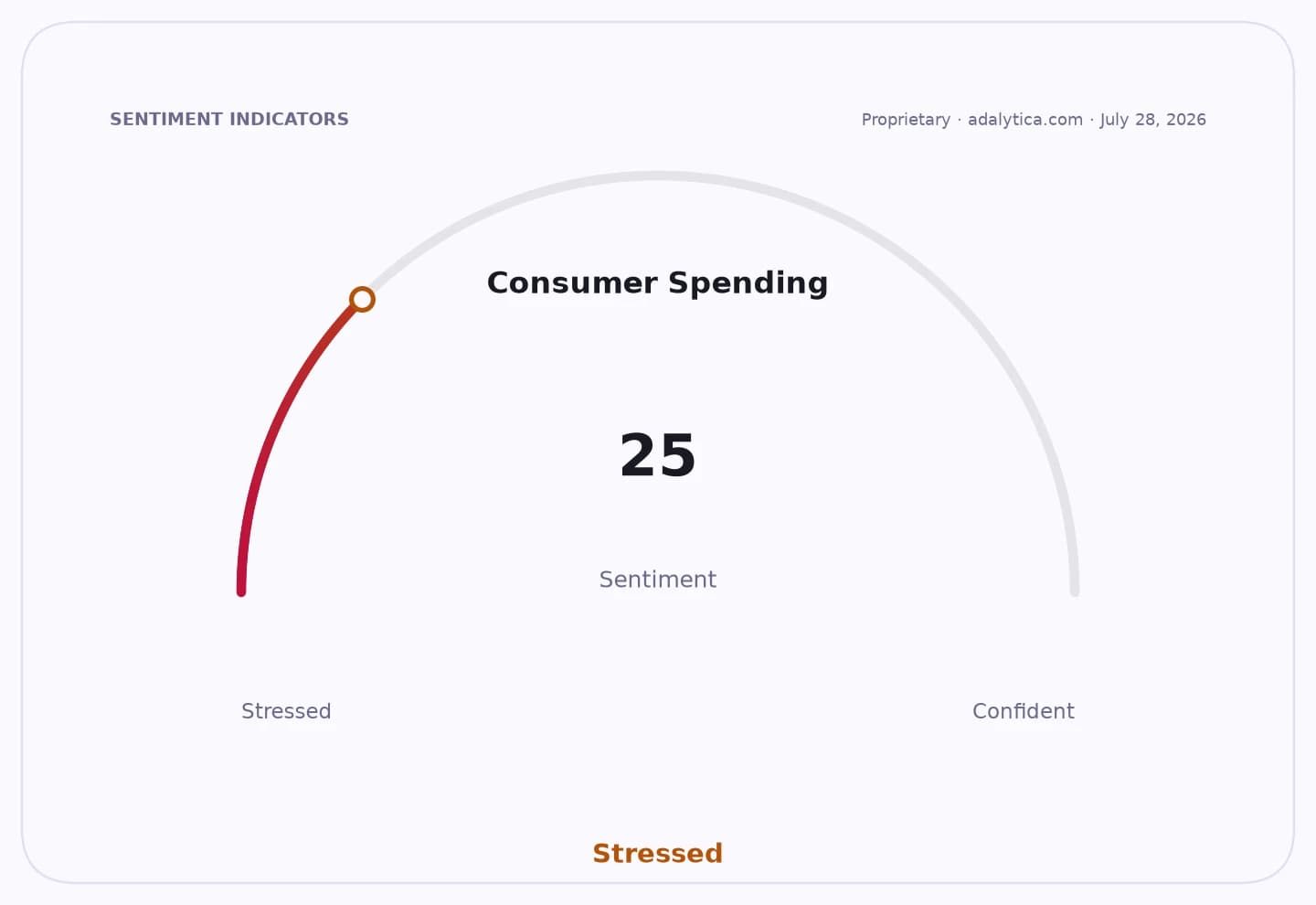
Investors tend to pay up for Ferrari on the assumption that demand will remain structurally stronger than at mass-market carmakers and that the company can defend returns even in a softer consumer environment. But the backdrop has become less forgiving. Adalytica’s consumer spending sentiment gauge is in “Fear,” while its awareness measure sits in “Extreme Fear,” a reminder that discretionary demand is fragile even before any company-specific friction is added. In that setting, Ferrari has less room than usual for missteps that could unsettle affluent buyers or invite more price resistance.
The stock’s recent action suggests the market is still willing to give Ferrari the benefit of the doubt, even after a volatile stretch in autos more broadly. Ferrari shares closed at 380.01 euros on July 27, well above the 50-day moving average of 358.54 euros and slightly above the 200-day average of 361.19 euros, indicating the shares have regained some technical footing. The move came with higher volume and an RSI reading of 45.8, pointing to a rebound from oversold conditions rather than a fully confirmed trend change.
That relative resilience also stands out against the broader auto tape. Tesla remains under heavy pressure, with its shares around 309.22 dollars on July 27 after a sharp selloff, and Porsche AG’s German-listed stock has been drifting below recent highs. Ferrari’s premium positioning is meant to insulate it from the kind of demand swings hitting the wider sector, but the company’s edge depends on buyers continuing to view it as aspirational rather than merely expensive.
The narrative is not that Ferrari suddenly faces a demand collapse. Rather, the company appears to be managing the consequences of strong brand power in a more strained consumer landscape. A tighter response to buyers can protect exclusivity and pricing, but if mishandled it risks alienating the very clientele that supports the franchise. The bull case is that Ferrari uses the episode to reinforce discipline and preserve margins; the bear case is that more buyer pushback signals the market for ultra-luxury cars is becoming less tolerant of the trade-offs that Ferrari traditionally imposes.
For investors, the key question is whether Ferrari’s representatives can find a customer-facing solution without diluting the operating model that makes the company rare in autos. How the company handles buyers will matter not just for sentiment, but for delivery cadence, order visibility and the multiple the market is willing to assign to one of the sector’s most expensive stocks.
| Entity | Gains | Losses |
|---|---|---|
| Ferrari | ▲protects scarcity and margins | ▼risks buyer backlash |
| Buyers | ▲potential concessions or fixes | ▼less leverage on terms |
| Long-term shareholders | ▲preserved pricing power | ▼execution risk if friction grows |
| Rival automakers | ▲little direct benefit | ▼Ferrari retains premium edge |