The FTSE 100 is holding above a cluster of chart support levels even as sterling and gold sit on their own technical fault lines, leaving investors focused on whether a broader shift in risk appetite can extend into year-end.
FTSE 100 Holds Above Support as Sterling Weakens

That matters because the three markets are carrying different messages about the same macro backdrop: UK equities are finding buyers after a pullback, the pound is still vulnerable after a steady August-to-September slide, and gold is trying to stabilise after retreating from record-rich territory. Together they point to a market still driven less by conviction than by positioning around rates, yields and the next policy move from the Federal Reserve.
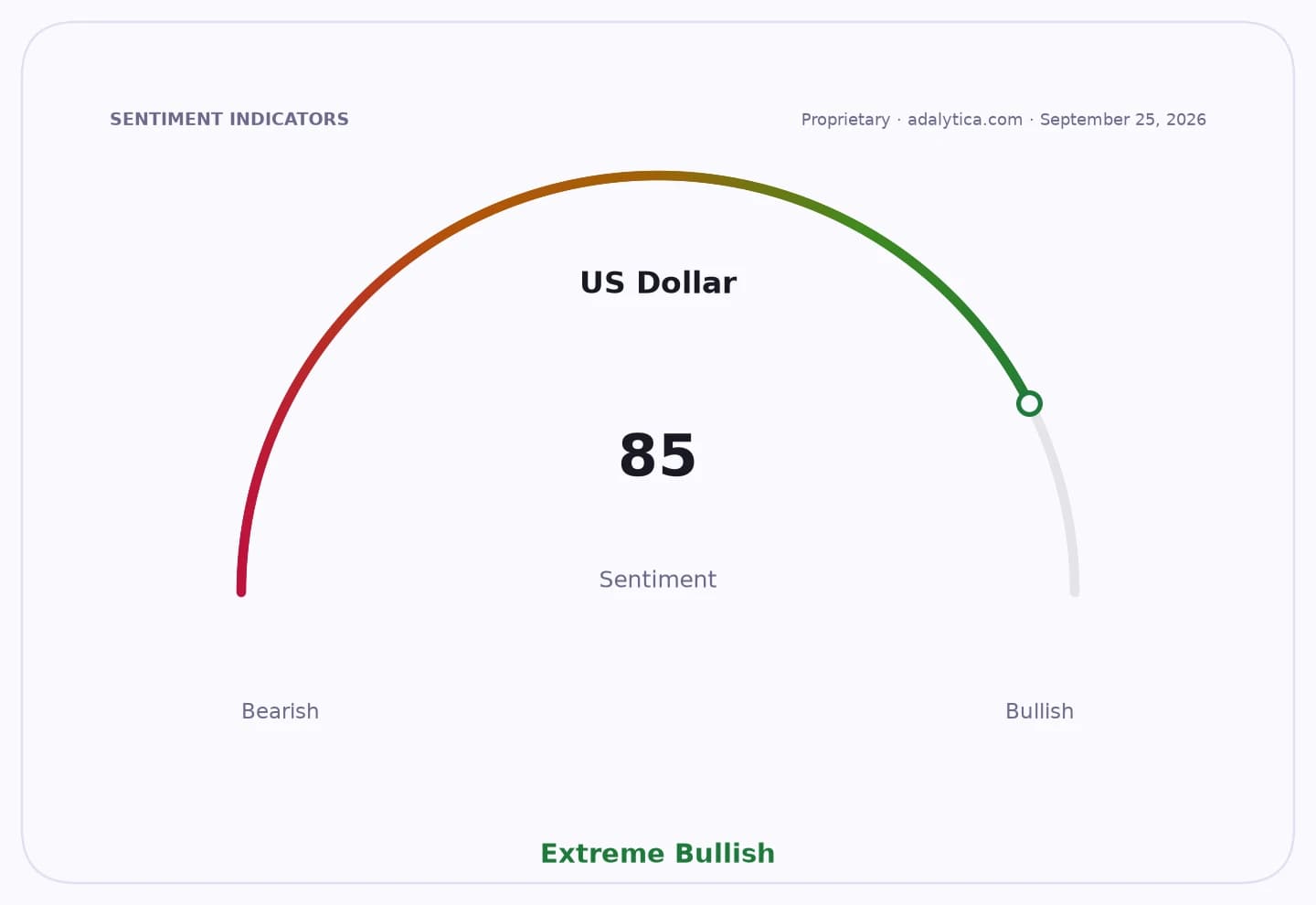
Sentiment IndicatorsⓘProprietary · adalytica.com · September 25, 2026
This is a snapshot — live sentiment, awareness and momentum for 130+ markets update continuously in the dashboard.Open AlphaPulse
For the FTSE 100, the key development is that the index remains above its March-to-September uptrend line near 10,610 and last week’s low at 10,583, keeping the medium-term trend intact for now. A break higher through 10,832 would bring the early-September peak at 10,868 back into view. The message from the chart is straightforward: dip buyers are still defending the index’s broader uptrend, but the rally needs fresh momentum to turn into a more decisive advance.
That resilience comes despite a less supportive global backdrop. US two-year Treasury yields have climbed to their highest since mid-2024 as markets price a meaningful chance of another Federal Reserve rate increase, while European bond markets are under strain from fiscal concerns and political risk in Germany and France. Higher yields typically weigh on gold and can pressure valuation-sensitive assets, but they can also support financials and other cyclical sectors that make up a meaningful share of the FTSE.
Sterling is in a weaker technical position. GBP/USD is hovering just above $1.3336, the recent low that now acts as the immediate line in the sand. A decisive break below that level would expose the $1.3306-to-$1.3274 zone, which captures several earlier lows and would reinforce the view that the pound’s August-to-September decline still has room to run. A recovery above $1.3398 would open a move toward the 200-day simple moving average near $1.3452, but for now the pair remains stuck in a neutral medium-term range between the March-to-September boundaries.
That weakness in the pound matters for UK investors because it affects the translation of overseas earnings for FTSE multinationals and can support the index on a relative basis when the currency softens. It also reinforces the idea that UK assets are still being priced in relation to the dollar, not solely domestic fundamentals. The dollar itself remains underpinned by elevated US yields, even if proprietary trade-signal snapshots show sentiment turning toward greed while awareness remains depressed, a combination that often leaves crowded positioning vulnerable to abrupt reversals.
Gold is the other major tell. Spot prices have pulled back from recent highs but remain above the $4,235.17 low that defines the short-term bullish case. The metal’s next resistance lies near $4,399.67, with the 200-day simple moving average and early-September high around $4,510.93 to $4,541.83 beyond that. Support sits in the $4,324.68 to $4,282.63 band. In plain terms, gold is still in a broader consolidation rather than a breakdown, but the metal’s inability to regain momentum while Treasury yields rise suggests investors are still using it as a hedge, not as a conviction long.
The economic narrative tying these moves together is a market caught between slowing growth worries, sticky yields and intermittent risk-off flows. Lower oil prices, helped by hopes of US-Iran diplomacy and improved Saudi supply, reduce one inflation pressure point. But the bigger force is still bond yields, which are shaping cross-asset behaviour from London to New York to the gold market.
For investors, the near-term implications are clear. A sustained FTSE 100 recovery would be more believable if global yields stop rising and if sterling remains subdued, supporting the index’s overseas earnings base. A pound break lower would further aid exporters and multinationals but would also reflect weaker confidence in UK assets. Gold, meanwhile, remains the clearest barometer of whether markets are buying the Fed’s hawkish message or preparing for another turn in the growth-and-rates cycle.
The next catalyst is less about any one market than about whether yields keep climbing. If they do, the pound’s support levels may give way and gold could test deeper retracement levels. If they do not, the FTSE 100 has room to extend its recovery and reclaim the highs just above 10,800.
| Entity | Gains | Losses |
|---|---|---|
| FTSE 100 exporters | ▲Weaker pound boosts foreign earnings | ▼Stronger sterling would cap returns |
| GBP bulls | ▲Rebound above $1.3398 | ▼Break below $1.3336 |
| Gold holders | ▲Haven demand on yield volatility | ▼Rising Treasury yields |
| UK financials | ▲Higher-rate backdrop supports margins | ▼Rate cut hopes or yield reversal |