GBP/AUD is being squeezed into a tight range because traders are waiting for the next macro shock: Wednesday’s US inflation data and Thursday’s UK growth numbers. Until those arrive, the cross looks like a classic holding pattern, with neither the pound nor the Australian dollar giving the market enough conviction to break higher or lower in a meaningful way.
GBP/AUD Range Ahead of UK GDP and US CPI

That matters because this is not just noise trading. The pair sits at the intersection of two different policy stories: the Bank of England’s growth problem and the Federal Reserve’s rate path, with the Australian dollar still tethered to global risk appetite and China-sensitive commodity demand. When a cross like GBP/AUD goes quiet ahead of top-tier data, it usually means investors are waiting to reprice one side of the equation sharply.
Sentiment IndicatorsⓘProprietary · adalytica.com · October 14, 2026
This is a snapshot — live sentiment, awareness and momentum for 130+ markets update continuously in the dashboard.Open AlphaPulse

On the UK side, economists expect August GDP to slip 0.1% after July’s 0.4% rebound, while manufacturing and industrial production will help determine whether the economy is simply wobbling or losing momentum again. A softer print would reinforce the view that the BoE cannot stay restrictive for long, even if inflation has not fully disappeared. That would cap sterling rallies, especially against currencies backed by cleaner growth narratives.
The dollar side of the equation is just as important. A hot US CPI reading would strengthen the greenback by pushing out the timing of Fed easing, and that typically pressures risk-sensitive currencies across the board. In that scenario, GBP/AUD could be pulled lower even if the pound remains structurally supported elsewhere. For investors, the key point is that this cross is more vulnerable to a surprise in US inflation than the market may assume, because it would reshape global rate expectations and spill directly into FX positioning.
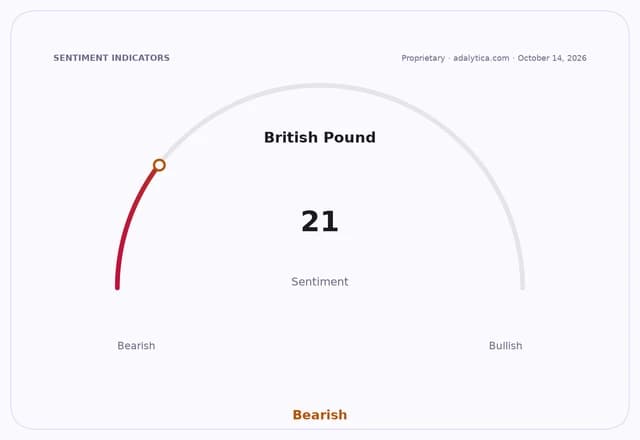
Technically, the pair has been trapped near the middle of its recent range, with resistance around 1.9018 and support near 1.8942 cited in the market. That lines up with the broader message from recent trading: the market is unwilling to commit until data provides direction. Adalytica’s British pound trade signals also show fear rather than enthusiasm, underscoring how fragile bullish conviction remains even with sterling’s recent strength against the euro.
The investment takeaway is straightforward: this is a catalyst-driven setup, not a trend-confirming one. If UK growth disappoints and US CPI runs hot, GBP/AUD can break lower quickly as rate expectations and risk sentiment move against sterling. If UK data surprises to the upside and US inflation cools, the cross could rebound, but for now the smartest stance is to treat range trading as the base case until the numbers force a repricing.
| Entity | Gains | Losses |
|---|---|---|
| GBP bulls | ▲UK data beat | ▼Growth scare |
| AUD bulls | ▲Risk-on calm | ▼Dollar strength |
| BoE doves | ▲Softer GDP | ▼Sticky inflation |
| FX volatility buyers | ▲Data surprise | ▼Quiet range trade |