Global stocks climbed Monday while oil retreated, as softer U.S. labor data and easing inflation worries pushed investors toward the view that the Federal Reserve may not need to raise rates again. That combination matters because it lowers the odds of another squeeze on growth, supports risk assets and eases pressure on companies and households already dealing with tighter financial conditions.
Global stocks rise as oil falls on Fed hopes

The market’s message is clear: weaker job creation is being read less as a recession warning and more as a reason for the Fed to stand pat. U.S. employers added just 29,000 jobs more than they cut last month, far below expectations and a sharp slowdown from August’s 133,000. Traders are now focused on a run of U.S. services, unemployment and consumer-confidence data for confirmation that the central bank can hold the line after its first rate hike in three years.
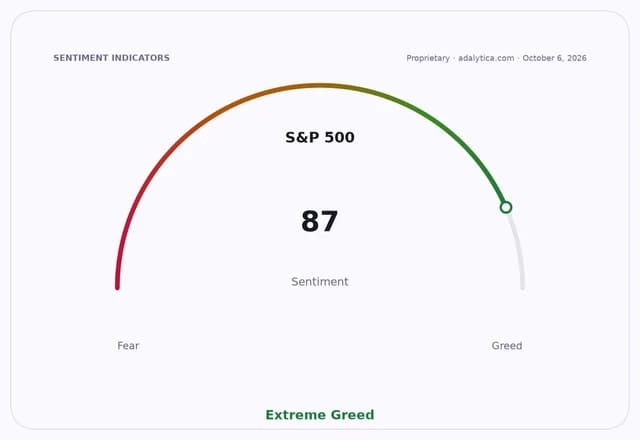
Sentiment IndicatorsⓘProprietary · adalytica.com · October 6, 2026
This is a snapshot — live sentiment, awareness and momentum for 130+ markets update continuously in the dashboard.Open AlphaPulse

That shift is helping equities even as moves remain measured. Japan’s Nikkei 225 rose 2.4% and briefly crossed 70,000 for the first time in three months, while Europe was mixed, with France’s CAC 40 down 1.1% and Britain’s FTSE 100 up 0.5%. Futures for the S&P 500 and Dow were slightly lower, but that followed Friday’s firm U.S. session, when the S&P 500 gained 0.7%, the Dow 0.5% and the Nasdaq 1.2%.
Investors are also leaning into the parts of the market most exposed to easier policy and stronger liquidity. In Asia, buying concentrated in artificial intelligence names, including Tokyo Electron, up 5.5%, SoftBank Group, up 3%, and Taiwan Semiconductor Manufacturing Co., up 3%. That is the playbook for a market that believes capital spending on AI infrastructure will keep outpacing the broader economy even if growth cools.
Oil’s decline is reinforcing that same narrative. U.S. crude fell 1.7% to $89.57 a barrel and Brent slipped 1.3% to $100.95, easing one of the biggest sources of inflation pressure. That matters for the Fed because energy costs feed quickly into transport, food and manufacturing inputs, and a calmer oil market gives policymakers more room to wait before tightening again.
For investors, the key takeaway is that the market is rotating toward a “good enough” growth backdrop: not strong enough to force the Fed to stay hawkish, but not weak enough to trigger a full risk-off move. That tends to favor broad equities, semiconductors, and select industrial and infrastructure names tied to AI investment, while weighing on energy producers if crude keeps drifting lower. The next catalyst is this week’s U.S. data; if it confirms cooling but not collapsing demand, the case for staying long risk assets improves.
| Entity | Gains | Losses |
|---|---|---|
| Global equities | ▲Easier policy expectations | ▼Recession fear |
| AI chipmakers | ▲Capital-spending tailwind | ▼Rate-hike pressure |
| Oil producers | ▲— | ▼Lower crude prices |
| Consumers and airlines | ▲Cheaper fuel costs | ▼— |