Gold prices reversed strongly on Nov. 2, with the global benchmark reclaiming the $3,900-an-ounce level and Vietnam’s domestic market following suit as local bars and rings jumped about 1 million dong a tael.
Gold Rebounds Above $3,900 After October Selloff
Gold
That matters because gold is trying to stabilize after a brutal October selloff that erased roughly 30% from its January peak and turned last month into the metal’s worst stretch since the collapse of Lehman Brothers. A sharp rebound after that kind of damage is not just a bounce — it is a test of whether strategic buyers, central banks and dip buyers see value again at lower levels, or whether the rally was simply overextended and vulnerable to more liquidation.
Sentiment Indicators
Spot gold rose $31 to $3,906 an ounce, while December futures on Comex were quoted near $3,898. In Vietnam, SJC bars in Hanoi, Da Nang and Ho Chi Minh City were at 137 million dong to buy and 140 million dong to sell, up 1 million dong on both sides from the prior close. Doji and PNJ showed similar pricing, while Bảo Tín Minh Châu lifted buy prices by 700,000 dong and selling prices by 1 million dong. Gold rings also advanced across major dealers, underscoring that the rebound was not limited to the flagship bar market.
The move comes after a washout that had pushed bullion into technically fragile territory. Saxo Bank’s Ole Sloth Hansen said gold’s close below a key $3,886 level left it exposed to further downside, and said the metal needs to recover above $4,000 to return the short-term outlook to something closer to neutral. That makes the Nov. 2 bounce important for traders: it is a relief rally, but one that still sits below the line where conviction returns.
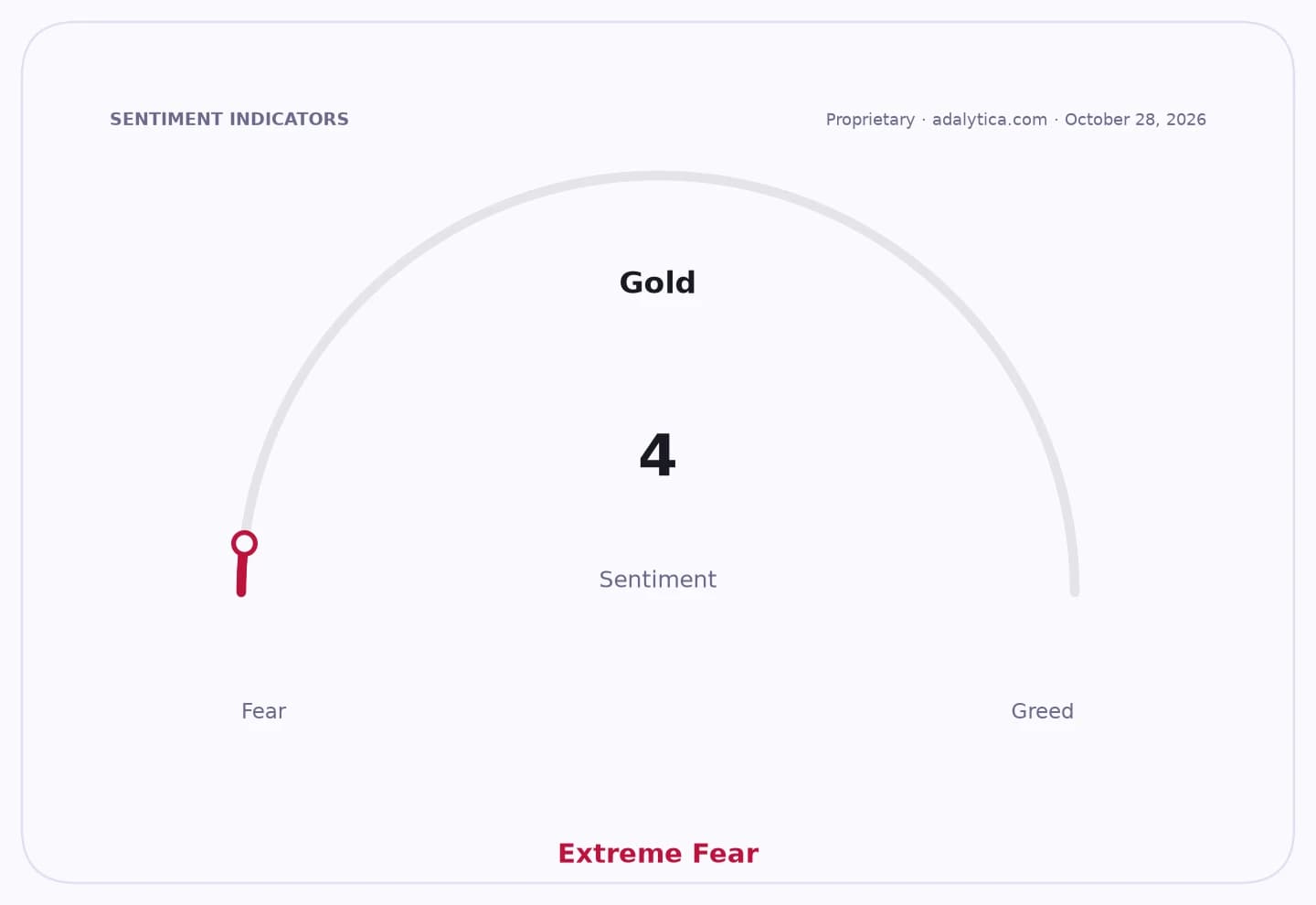
Macro conditions still argue for gold to remain in play. The U.S. 10-year Treasury yield is hovering near 4.95%, while the Federal Reserve funds rate is around 3.89%, leaving real-rate expectations and liquidity concerns central to the metal’s direction. At the same time, Adalytica’s Gold Fear & Greed Index showed “Extreme Fear” sentiment at 8 even as awareness hit 100, a sign that the crowd is still nervous but the market is impossible to ignore. That combination often sets up violent swings in both directions.
For investors, the bigger question is not whether gold can move higher for another session. It is whether this reset has finally flushed out enough weak hands to create a tradable floor. The price action in GLD and IAU shows the market has been oversold — both funds still trade well below their 50-day moving averages — but not yet repaired. Gold miners such as GOLD are also rebounding from depressed levels, which means the next sustained leg higher could reward patience far more than chasing the first bounce.
My view: the market is underestimating how quickly gold can reprice once $4,000 comes back into sight. If global yields soften, the dollar weakens further and central bank buying resumes, the metal’s correction could prove to be a reset rather than a top. Until then, the best opportunity is not in panic buying bullion, but in positioning for a volatility-driven recovery across gold, gold ETFs and quality miners while sentiment is still broken.
| Entity | Gains | Losses |
|---|---|---|
| Gold bulls | ▲Rebound potential | ▼Recent liquidation losses |
| Gold miners | ▲Higher bullion prices | ▼Margin pressure if rally fades |
| GLD and IAU holders | ▲Recovery leverage | ▼Continued technical weakness |
| Short-term sellers | ▲Quick profits if volatility persists | ▼Squeeze risk on more buying |