Gold is losing altitude as rising Treasury yields and higher energy prices push up the real-world costs of owning a non-yielding asset.
Gold Falls on Higher Yields and Energy Prices

That is the central message from Bank of America’s latest warning, which argues the metal’s recent correction is more than a pause in a strong rally. The bank does not see an immediate collapse to $3,500 an ounce as the base case, but it now flags $3,750 in the fourth quarter as a more plausible downside target if energy-driven inflation and tighter monetary policy keep sovereign borrowing costs elevated. A move toward $5,000, it said, would require a fresh surge in investment demand and fund inflows.
Sentiment IndicatorsⓘProprietary · adalytica.com · October 4, 2026
This is a snapshot — live sentiment, awareness and momentum for 130+ markets update continuously in the dashboard.Open AlphaPulse

The economic logic is straightforward. Higher oil prices filter through to broader inflation, making it harder for central banks to loosen policy and easier for rates to stay restrictive for longer. That keeps bond yields high, which in turn raises the opportunity cost of holding gold, an asset that pays no coupon or dividend. The pressure is visible in the US rates market: the 10-year Treasury yield is around 5.3%, while the 2-year sits near 4.8%, levels that leave bullion competing with income-producing assets at a time when inflation risks are still alive.
Geopolitics is feeding that backdrop. Bank of America said renewed Middle East tensions could, in an extreme scenario, lift oil to as much as $150 a barrel. Even if that outcome does not materialize, the threat of more expensive energy is enough to keep investors pricing a stickier inflation path and a less accommodative Federal Reserve. That combination has historically been hostile to gold, even when the metal retains its appeal as a hedge against policy error or geopolitical stress.
The market is already showing the strain. The GLD gold ETF closed at $380.14 on Oct. 2, below its 50-day moving average of $396.29 and its 200-day average of $416.16. Its RSI reading of 38.4 suggests the fund is approaching oversold territory, while the MACD remains negative. The weakness has spread to miners: the GDX ETF closed at $87.78, also under both its 50-day and 200-day averages, while Newmont and other large producers have come off recent peaks. That is significant because miners often act as a leveraged bet on the metal, so a pullback in shares typically reflects concern that bullion prices may not be able to sustain their momentum.
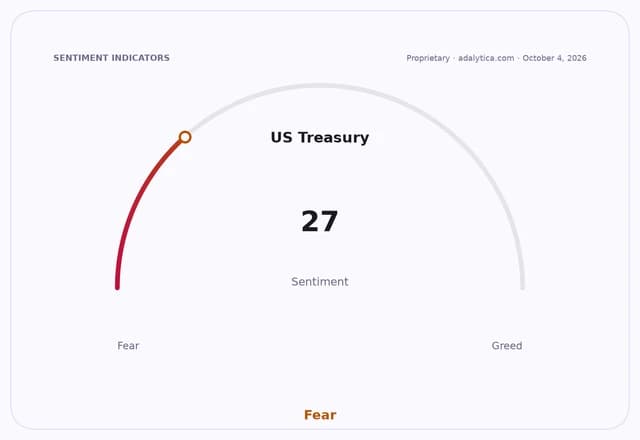
The longer-term bull case has not disappeared. Central-bank buying, portfolio hedging and any renewed break in real yields could still support gold. But the near-term balance has shifted toward caution. Adalytica’s Treasury-bond trade signal shows fear in the bond market, while its US dollar signal remains in extreme fear territory, underscoring the instability around rates and currencies that can whipsaw precious metals. For now, the market is treating gold less like an unstoppable inflation trade and more like a crowded position vulnerable to every uptick in yields and energy.
For investors, that means the next leg in gold is likely to be driven less by the metal’s safe-haven appeal than by whether oil cools, bond yields retreat and central banks regain room to ease. Until then, rallies may struggle to hold and the path of least resistance could stay lower.
| Entity | Gains | Losses |
|---|---|---|
| Bond yields | ▲Income investors | ▼Gold holders |
| Energy producers | ▲Higher revenue | ▼Importing economies |
| Central banks | ▲Policy flexibility if inflation eases | ▼Policy makers facing stubborn inflation |
| Gold miners | ▲Better if bullion re-rates higher | ▼Margin pressure if gold keeps falling |