Healthcare is back in favor, and that matters because investors are finally getting a reminder that long-term growth does not belong only to the mega-cap technology names.
Healthcare Stocks Gain as VHT and XLV Rise

The latest move in the market shows the broad health-care ETF VHT near $334.46, just above its 50-day moving average of $320.99 and well ahead of its 200-day average of $294.22, while XLV sits near $179.72, also comfortably above both its 50-day and 200-day moving averages. That kind of strength suggests this is not just a brief defensive trade. It is a rotation with enough momentum to matter for portfolios that want growth, cash flow and diversification without paying the richest prices in the market.
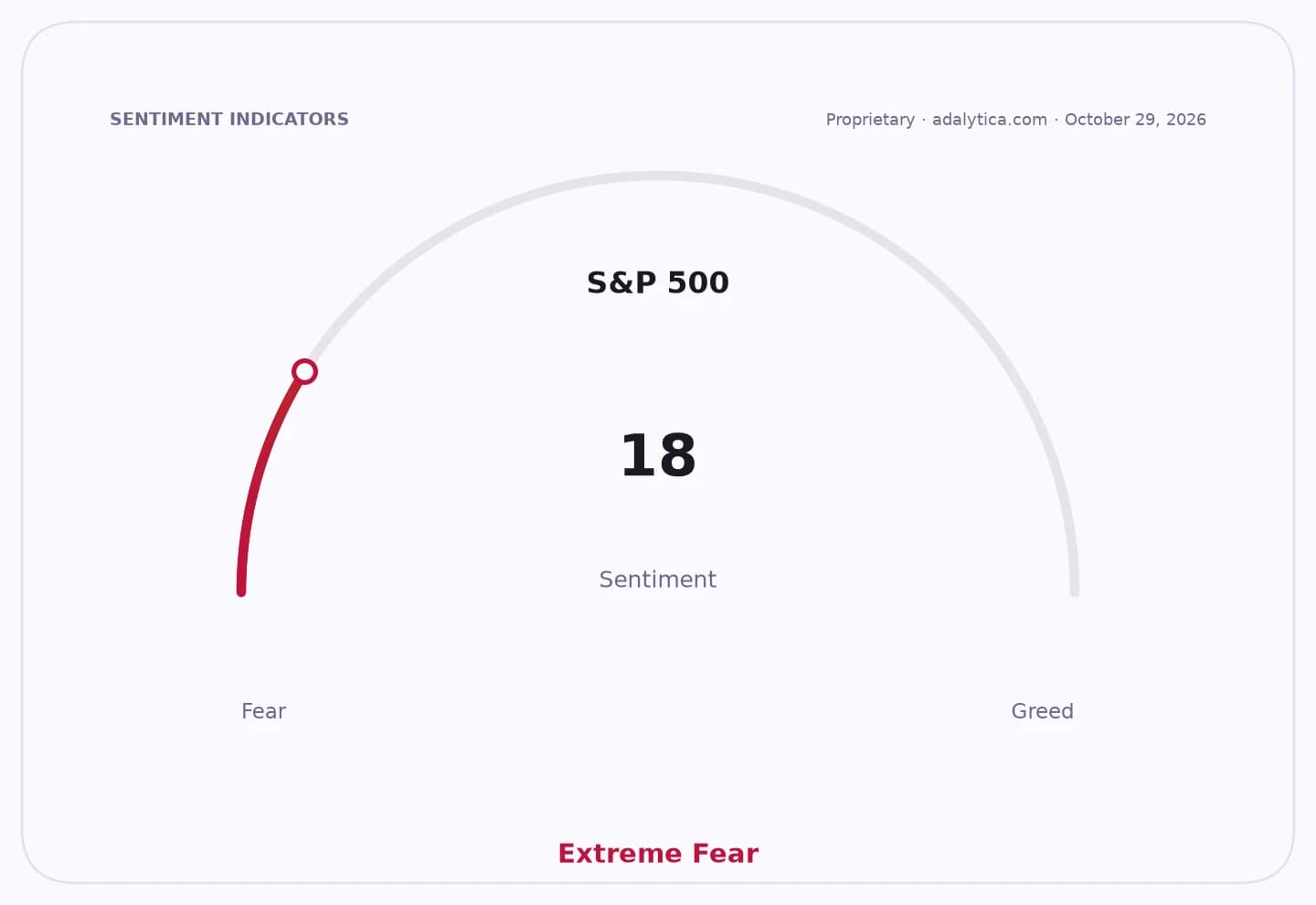
Sentiment Indicators
For investors, the appeal is simple: healthcare gives you multiple ways to win. You can own a managed-care giant like UnitedHealth Group, a blockbuster-drug leader like Eli Lilly, a surgical robotics platform like Intuitive Surgical, a diversification story like Vertex Pharmaceuticals, or a tollbooth business like Thermo Fisher Scientific. These are not the same kind of companies, but they share one important trait — durable demand that can compound for years if execution stays intact.
UnitedHealth is the clearest example of why investors are looking past headlines and toward earnings power. The company reported third-quarter adjusted profit of $4.69 a share on revenue of about $112.7 billion and lifted full-year adjusted EPS guidance to at least $20.50. Membership slipped to 48.3 million as the company trimmed weaker plans, but that is exactly the kind of discipline that can support margins over time. The stock has already gained roughly 24% to 29% this year, yet the valuation still looks more reasonable than earlier in the cycle, with a trailing multiple around 25x to 27x and a forward multiple near 18x to 20x. The long-term case hinges on whether UnitedHealthcare and Optum can keep improving cost control while using data and AI to run the business more efficiently.
Eli Lilly remains the most explosive growth story in the group, and investors know it. Second-quarter revenue jumped 48% to $23 billion, led by Mounjaro and Zepbound, which together accounted for about two-thirds of sales. Lilly raised its 2026 sales outlook to $85 billion to $87 billion as its oral GLP-1 Foundayo begins rolling out. That kind of growth justifies a premium valuation, but it also leaves little room for disappointment. The shares already trade at about 42x to 43x trailing earnings and 32x to 33x forward earnings. For long-term investors, the question is not whether the metabolic opportunity is real — it clearly is — but how long Lilly can keep converting demand into growth before pricing pressure and competition from Novo Nordisk narrow the runway.
Intuitive Surgical looks different, and that is exactly why it belongs on the list. The stock has fallen roughly 22% to 25% this year even as revenue rose 19% in the second quarter to $2.89 billion and worldwide procedures increased 16%. The installed base reached 11,710 da Vinci systems, giving the company a huge recurring revenue stream from instruments, accessories and service. When a business gets about 85% of sales from recurring revenue, investors should care less about the latest quarter’s stock chart and more about the size of the installed base and the pace of procedure growth. The valuation is still rich, but the reset leaves room for recovery if the newer da Vinci 5 platform keeps broadening use across more surgeries.
Vertex is the quiet compounding story. It still depends heavily on cystic-fibrosis drugs, but the company is making real progress beyond that single franchise. Second-quarter revenue rose 12% to $3.33 billion, and management lifted full-year guidance to $13.1 billion to $13.2 billion, including at least $500 million from non-cystic-fibrosis products. Casgevy and Journavx are starting to matter, and the next major catalyst is the kidney pipeline, including the Nov. 30 PDUFA date for povetacicept in IgA nephropathy. Vertex does not need a huge new market to work for investors; it simply needs to keep turning a concentrated cash machine into a broader biotech franchise.
Thermo Fisher Scientific offers a different kind of healthcare exposure, one tied to the tools and services that make drug development and diagnostics possible. Second-quarter revenue rose 10% to $11.99 billion, adjusted earnings climbed 13% to $6.03 a share, and management raised full-year guidance to $47.4 billion to $48.1 billion in revenue and $24.93 to $25.33 in adjusted EPS. This is not the flashiest business in the group, but it is one of the most important. Research spending, biopharma production and laboratory demand all feed the company’s long-term growth, and that makes it a steadier way to play the healthcare buildout.
That broader buildout matters because healthcare is not just about drug launches and hospital procedures. It is also about policy, capital spending and the ability of companies to translate innovation into cash flow. Even the macro backdrop helps the case: with the 10-year Treasury near 4.94% to 5.00% and the federal funds rate forecast around 3.73%, investors are still living in a world where quality earnings and pricing power matter more than cheap money. In that kind of environment, businesses with recurring revenue, strong margins and clear secular demand tend to hold up better than names dependent on hope alone.
| Entity | Gains | Losses |
|---|---|---|
| Healthcare stocks | ▲Rotation inflows | ▼Tech-only portfolios |
| UnitedHealth, Vertex, Thermo Fisher | ▲Steadier compounding | ▼Investors chasing only momentum |
| Eli Lilly, Intuitive Surgical | ▲Secular growth catalysts | ▼Buyers needing low valuations |
| Big Tech leaders | ▲Less relative attention | ▼Some investor capital in rotation |