Health care stocks climbed to fresh record highs even as the broader market showed signs of strain, with the sector's resilience contrasting sharply with General Motors' nearly 8% drop and a still-fragile risk backdrop across U.S. equities.
Health care stocks hit record highs as GM falls
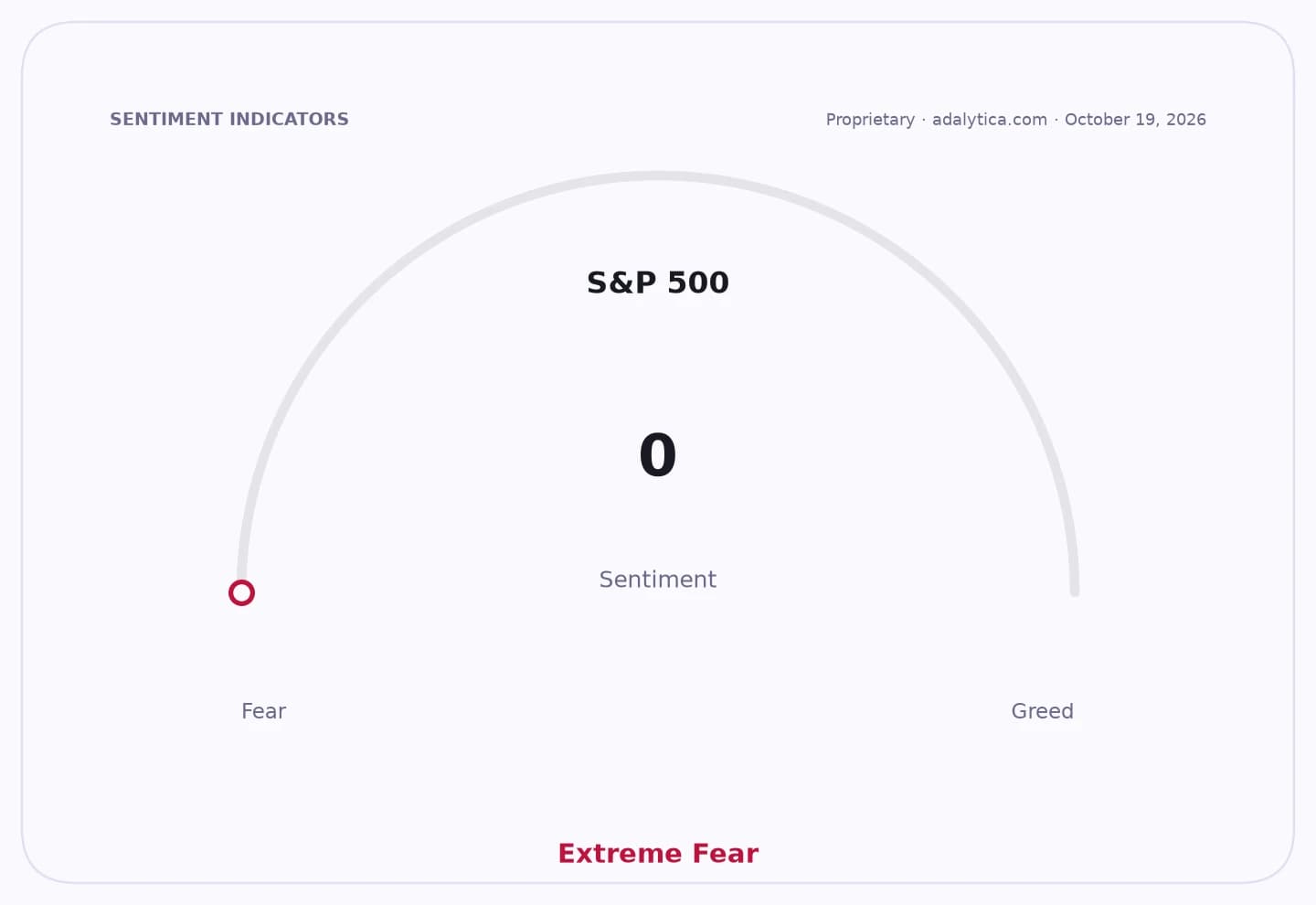
The move underscores a familiar defensive rotation: investors are seeking earnings visibility, lower cyclical exposure and relative shelter as sentiment on the S&P 500 remains in “Extreme Fear,” according to Adalytica.com’s trade signals. Health care has been one of the clearest beneficiaries. The Health Care Select Sector SPDR Fund, XLV, recently pushed to 179.28 after touching an intraday high of 182.25, leaving it well above its 50-day and 200-day moving averages and close to its upper Bollinger Band. Momentum remains elevated, though the RSI has cooled from overbought territory above 78 to 71.8, suggesting the advance is still strong but no longer stretched to the same degree.
Sentiment IndicatorsⓘProprietary · adalytica.com · October 25, 2026
This is a snapshot — live sentiment, awareness and momentum for 130+ markets update continuously in the dashboard.Open AlphaPulse

For investors, the sector’s strength matters because it reflects more than simple risk aversion. Health care is often treated as a quasi-bond proxy when growth expectations wobble, but the latest move also points to confidence in the sector’s cash flows, pricing power and policy insulation relative to more cyclical industries. Pharmaceutical names in particular have tended to attract capital when traders are rotating out of economically sensitive shares. That stance has been reinforced by a series of policy developments and industry discussions abroad that highlight continued support for health investment and access, including a broader push to liberalize some medicine pricing and encourage pharmaceutical cooperation.
GM's decline tells the other side of the story. The stock fell to $75.92, extending a slide that has pushed it below its 50-day moving average and toward its 200-day average around $80.32. The selloff in an automaker is a reminder that investors are still punishing consumer cyclicals and capital-intensive businesses when the macro picture looks uncertain. General Motors has also been vulnerable to shifts in financing conditions, tariff and trade concerns, and the market's sensitivity to margins in a slowing demand environment. A weak session in GM, alongside softness in the Russell 2000 and a cautious tone in Treasury and dollar signals, suggests investors remain reluctant to price in a clean economic re-acceleration.
The market backdrop is therefore doing most of the work. The S&P 500's sentiment reading at 12.0 indicates extreme fear, while Treasury signals show stronger demand for duration even as the dollar has firmed. That combination tends to favor defensive sectors and penalize stocks tied to manufacturing, discretionary spending and industrial demand. Health care’s record run is not just a sector story; it is a vote on where investors think earnings durability still exists.
The next test is whether the rotation broadens or fades. If fear persists, health care could continue to command a premium, especially if earnings revisions remain steadier than in cyclical sectors. If risk appetite returns, however, some of the recent outperformance may prove tactical rather than structural. For now, the market is saying that in a fragile tape, stability is worth paying for.
| Entity | Gains | Losses |
|---|---|---|
| Health care stocks | ▲Defensive inflows | ▼Cyclical rivals |
| XLV ETF | ▲Record highs | ▼Short-term overbought risk |
| General Motors | ▲— | ▼Risk-off selling |
| Small-cap/cyclical stocks | ▲— | ▼Rotation out of cyclicals |