Apple, Walmart and Coca-Cola are among nine Dow Jones Industrial Average names drawing bullish buying as investors rotate out of high-growth and AI-heavy winners and into defensive stocks.
Dow defensive stocks gain as investors rotate
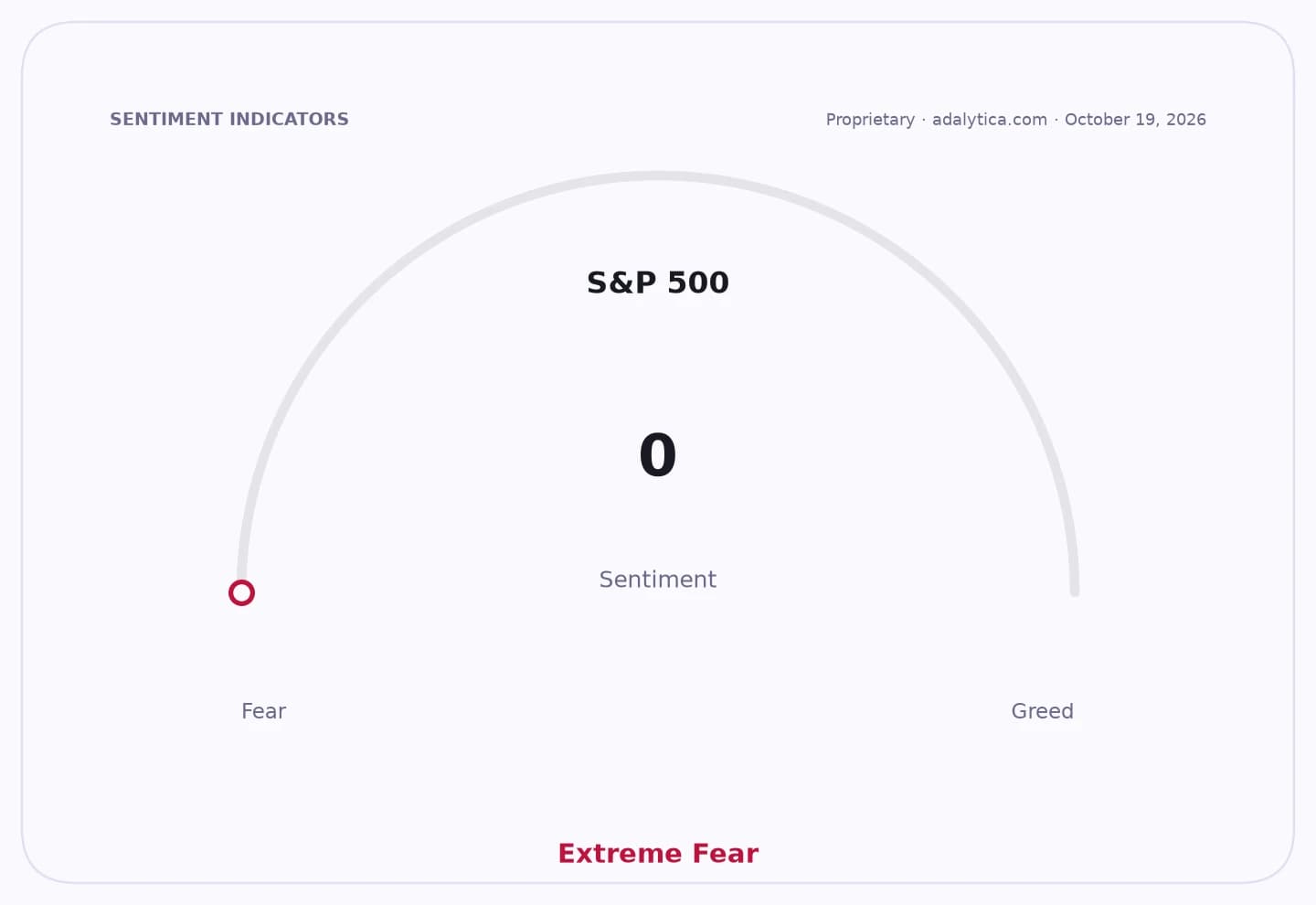
The move matters because it shows money is shifting toward large-cap companies with steady cash flow, pricing power and lower earnings volatility at a moment when broader market sentiment has turned sharply risk-off. Adalytica’s S&P 500 trade signals show “Extreme Fear,” while U.S. Treasury bond sentiment has jumped to “Extreme Greed,” underscoring a classic safety bid.
Sentiment IndicatorsⓘProprietary · adalytica.com · October 19, 2026
This is a snapshot — live sentiment, awareness and momentum for 130+ markets update continuously in the dashboard.Open AlphaPulse
Apple (AAPL) has been one of the standout Dow names, with shares recently regaining momentum after a sharp pullback and trading back near technical resistance. The stock closed at 253.79 on Oct. 19, below its 50-day moving average of 264.83 but still well above its 200-day average of 242.55, with RSI at 37.4 and the MACD still negative — signs of a stock trying to stabilize after the selloff.
Procter & Gamble (PG) is also attracting buyers as a traditional defensive hold. Shares ended at 157.69, above both the 50-day and 200-day moving averages, while RSI at 70.4 and a positive MACD suggest the name has already re-rated into the rotation.
Coca-Cola (KO) continues to benefit from the same theme. The stock closed at 93.42, near its recent highs and above both major moving averages, with RSI at 79.0 and a rising MACD, reflecting strong demand for consumer staples as investors seek earnings visibility.
The rotation is not just about food and beverages. Johnson & Johnson (JNJ) and Amgen (AMGN) are also among the Dow stocks with bullish setups, along with Travelers (TRV), as healthcare, insurance and staples draw interest when risk appetite fades. Walmart (WMT) fits the same pattern, with retailers that can hold traffic and defend margins favored over names tied more closely to cyclical spending.
The shift is economically significant because it suggests investors are increasingly skeptical of paying up for momentum names, especially after the AI trade has become crowded. Defensive sectors typically outperform when growth expectations cool, bond demand rises and portfolio managers cut exposure to volatility.
That has implications for the Dow itself. The index is more tilted than the Nasdaq toward mature companies with dividends and stable earnings, so a defensive rotation can support the benchmark even as broader market breadth weakens.
For investors, the key question is whether this is a brief pause in risk assets or the start of a more durable repositioning into quality and income. Upcoming earnings, Treasury yields and any further deterioration in market sentiment will determine whether the Dow’s defensive leaders keep attracting flows or give back gains.
| Entity | Gains | Losses |
|---|---|---|
| Defensive Dow stocks | ▲Fresh inflows, relative outperformance | ▼— |
| AI and high-growth stocks | ▲— | ▼Profit-taking, lower momentum support |
| Bond market/TLT | ▲Higher demand for safety assets | ▼— |
| S&P 500 risk assets | ▲— | ▼Weak breadth, rising volatility |