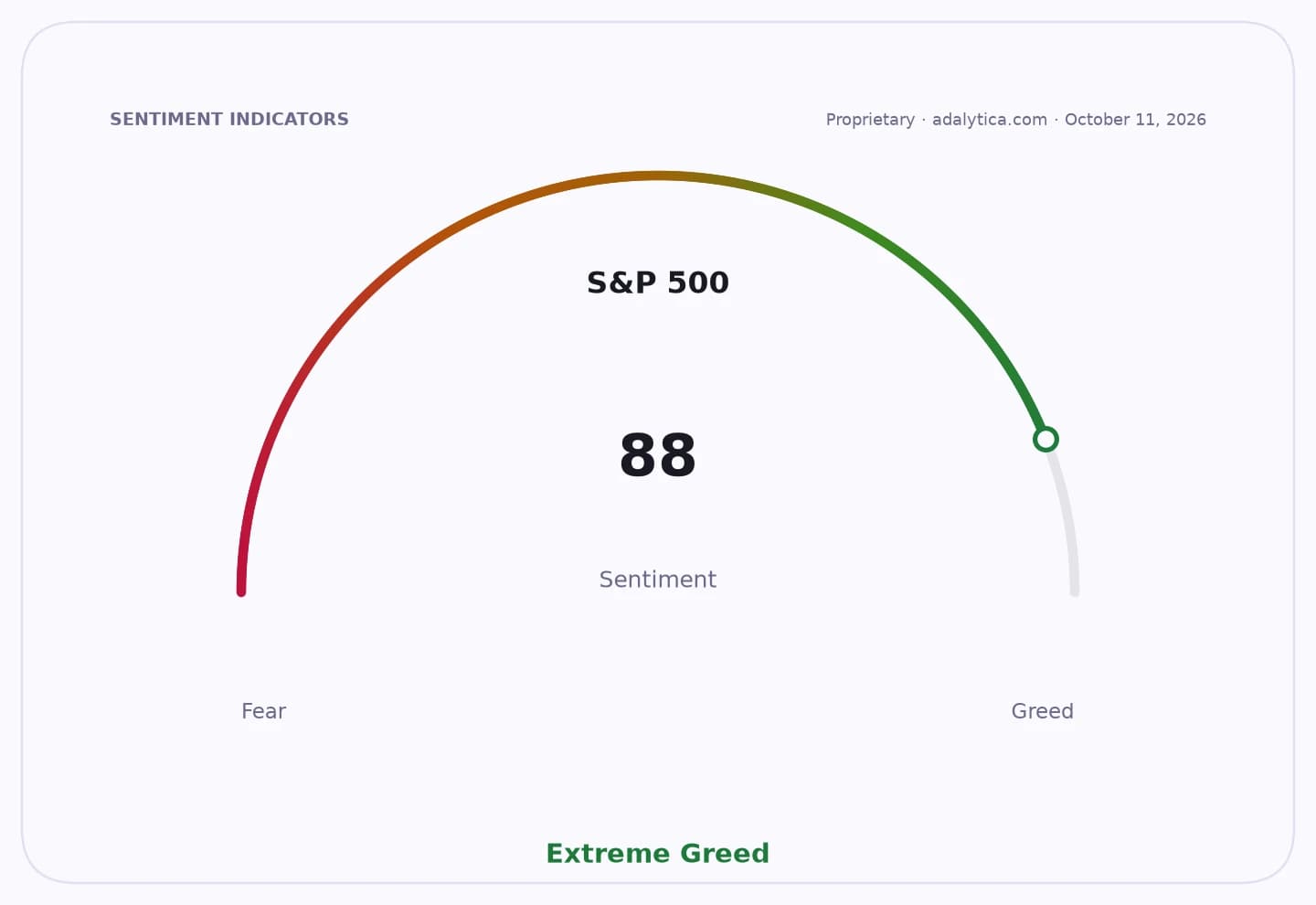
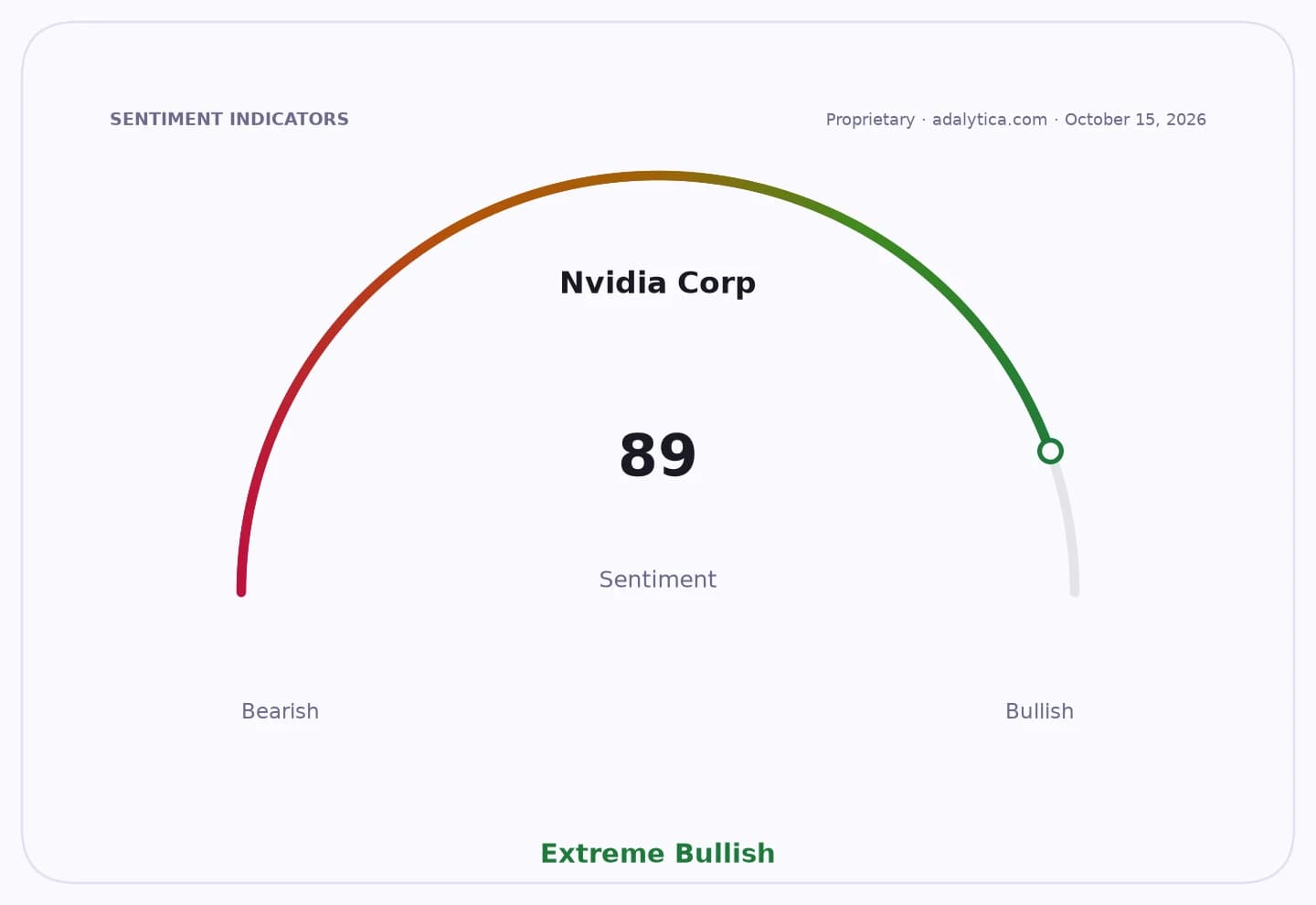
The U.S. stock market shook off an early selloff and staged a broad rebound even as investors kept trimming exposure to AI leaders Nvidia and TSMC, a sign that the rally’s next leg may depend less on the hottest chip names and more on defensive sectors and lower-rate winners.
U.S. Stocks Rebound as AI Leaders Lag
The S&P 500 rose 0.3%, the Dow Jones Industrial Average jumped 556 points, or 1.1%, and the Nasdaq composite added just 0.1% after all three gauges recovered from opening losses. That turnaround matters because it shows the market still has buyers beneath the surface even after a run-up that left the S&P 500 near its record high and trading around 19 times expected earnings, close to its lowest valuation since 2023. In other words, investors are no longer paying up blindly for AI growth, but they are still willing to buy earnings resilience.
Sentiment IndicatorsⓘProprietary · adalytica.com · October 18, 2026
This is a snapshot — live sentiment, awareness and momentum for 130+ markets update continuously in the dashboard.Open AlphaPulse
That rotation was visible in the day’s winners. Eli Lilly, UnitedHealth and Walmart all advanced after Deutsche Bank upgrades and were among the biggest contributors to the S&P 500’s gain. Marsh & McLennan, Kimberly-Clark and Bank of New York Mellon also posted solid gains after better-than-expected results. Healthcare led sector performance, while materials also climbed, helping offset weakness in technology.
The message for markets is straightforward: the index can keep rising even if the AI trade pauses, but the leadership has to broaden. Nvidia fell 1.8% after TSMC struck a cautious note on 2027 even while reporting a sixth straight record quarterly profit on AI demand. TSMC slipped after that warning, and the Philadelphia semiconductor index dropped 0.9% for a seventh consecutive session. Dell and Hewlett Packard Enterprise also fell sharply as investors questioned the durability of AI-related borrowing and spending. That is the kind of pullback that can compress valuations in the most crowded names without necessarily breaking the wider bull market.
This is why the rebound matters economically. Equity gains are still being powered by a U.S. economy that does not look broken: consumer sentiment is expected to rebound modestly, unemployment is forecast near 4.1%, and the market is behaving as if growth is slowing only enough to keep the Federal Reserve in a supportive posture, not enough to trigger a recession. That backdrop favors profit-heavy defensives and cash-generative large caps over capital-intensive AI infrastructure plays that depend on cheap financing and uninterrupted demand growth.
For investors, the opportunity is increasingly in the second derivative trades. If the market is moving from a narrow AI sprint to a broader earnings climb, the winners are likely to include healthcare, insurers, staples, diversified financials and select industrial beneficiaries rather than only chipmakers and server vendors. Nvidia and TSMC remain core long-term beneficiaries of the compute buildout, but near-term price action suggests the market wants proof that the payoff justifies the capex. Until then, the stronger risk-reward may sit in companies with earnings momentum, lower leverage and less dependence on the interest-rate cycle.
The setup now is a classic late-cycle rotation with a still-intact bull market: the megacap AI trade is under pressure, yet the broader tape is absorbing the blow. If that continues, the next leg higher may be driven less by the most obvious winners and more by the market’s overlooked stabilizers.
| Entity | Gains | Losses |
|---|---|---|
| Healthcare, staples, insurers | ▲Defensive earnings support | ▼Less participation in AI upswing |
| Nvidia, TSMC, semis | ▲Long-term AI demand | ▼Near-term valuation de-rating |
| Dow components / value stocks | ▲Leadership in rotation | ▼Lagging growth premium |
| AI infrastructure borrowers | ▲Demand tailwind | ▼Higher-rate financing pressure |