Hungary’s central bank has lowered its medium-term inflation target to 2.5% from 3% starting in January 2028, a move that could help anchor prices and borrowing costs if households and companies accept the new regime.
Hungary central bank lowers inflation target to 2.5%

The Magyar Nemzeti Bank kept the tolerance band at plus or minus 1 percentage point, but said the cut reflects a decade of real convergence toward the eurozone and a cooler inflation backdrop that has already pushed consumer-price growth to the bottom of, or below, that range since early 2026.
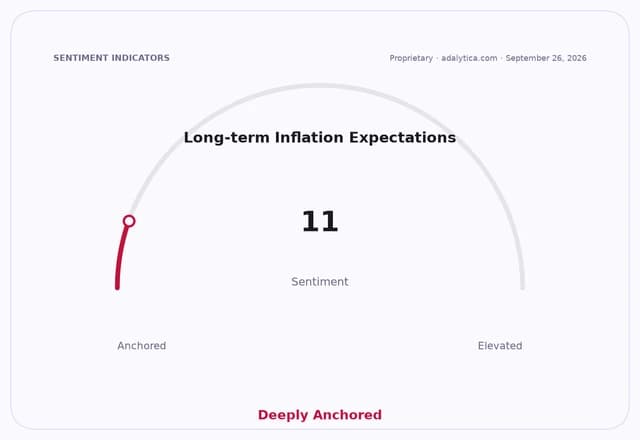
Sentiment IndicatorsⓘProprietary · adalytica.com · September 26, 2026
This is a snapshot — live sentiment, awareness and momentum for 130+ markets update continuously in the dashboard.Open AlphaPulse
For investors, the change matters because a lower target usually implies lower inflation premia in long-term rates, tighter wage and pricing behavior and, eventually, a more stable forint. It also moves Hungary closer to the 2% goal used by the European Central Bank and to the 2.5% targets already in place in Poland and Romania.
The central bank framed the step as a way to reduce financing costs over time. Higher inflation targets tend to feed through into higher nominal interest rates, which make debt more expensive for the state, corporates and households. A lower target can support purchasing power, protect savings and improve the case for investment by reducing uncertainty about future pricing.
Timing also matters. The MNB said inflation has been at or below the lower edge of its tolerance band since early 2026 and that inflation expectations among households and companies have eased. That gives the bank more room to try to reset price-setting behavior before higher inflation is embedded in wages and contracts.
The adjustment is not cost-free. The MNB said it may take one-and-a-half to two years for the economy to adapt, and the transition could temporarily shave growth if firms and workers adjust slowly to the new benchmark. That makes the next phase of inflation data crucial, especially as policymakers balance disinflation against still-fragile growth.
The decision also lands against Hungary’s longer-term euro ambition. Budapest wants to meet euro adoption criteria by 2030, and a 2.5% target brings Hungary closer to the price-stability standards that would be tested in any future entry process.
Adalytica’s long-term inflation expectations gauge remains in “Extreme Fear,” showing how sensitive markets still are to price-risk shifts despite the improved headline inflation backdrop. Investors will now watch whether the new target starts to pull down longer-dated breakeven expectations, support local bonds and keep the forint steadier as the MNB tries to lock in disinflation without derailing activity.
| Entity | Gains | Losses |
|---|---|---|
| Hungarian bondholders | ▲Lower inflation risk | ▼Less room for price surprises |
| Forint | ▲Stronger credibility | ▼Pressure if growth slows |
| Households and savers | ▲Better real returns | ▼Slower nominal income growth |
| Exporters and borrowers | ▲More predictable financing | ▼Tighter pricing and wage discipline |