Artificial intelligence is moving faster than the rules meant to contain it, and that gap is becoming the central economic risk in the next phase of the AI boom. IMF Managing Director Kristalina Georgieva used a Formula 1 analogy to argue that the technology’s speed could overwhelm societies unless governments and companies build stronger safety guardrails, a warning that matters not just for policymakers but for investors betting billions on the AI buildout.
IMF Warns AI Boom Needs Stronger Guardrails

The message from the IMF is straightforward: AI may be a powerful growth engine, but without standards on safety, ethics and oversight, the costs could eventually outweigh the gains. That is an especially important warning for an economy already wrestling with uneven productivity, job displacement and the possibility that a few giant technology firms will capture most of the upside while the broader labor market bears the disruption.
Sentiment IndicatorsⓘProprietary · adalytica.com · October 22, 2026
This is a snapshot — live sentiment, awareness and momentum for 130+ markets update continuously in the dashboard.Open AlphaPulse
Georgieva said IMF research suggests nearly 40% of jobs worldwide could be affected by AI, rising to about 60% in advanced economies. That does not mean mass unemployment is inevitable, but it does mean the transition will be bumpy and expensive unless workers are retrained and social protections are strengthened. For long-term investors, that matters because the biggest AI winners will not just be the companies selling chips and cloud capacity, but also the ones able to convert automation into durable earnings growth without running into regulatory or reputational blowback.
The stakes are clear in the market. Nvidia, Microsoft and Alphabet have all benefited from investor enthusiasm around AI, but they are also exposed to the policy risk now being aired by the IMF and by industry leaders themselves. Nvidia has warned in filings that governments could impose restrictions on the hardware and software used to build frontier models. Microsoft has said AI systems could trigger legal liability, regulatory action and higher compliance costs. Alphabet has also flagged the possibility of stronger scrutiny over data use and AI deployment.
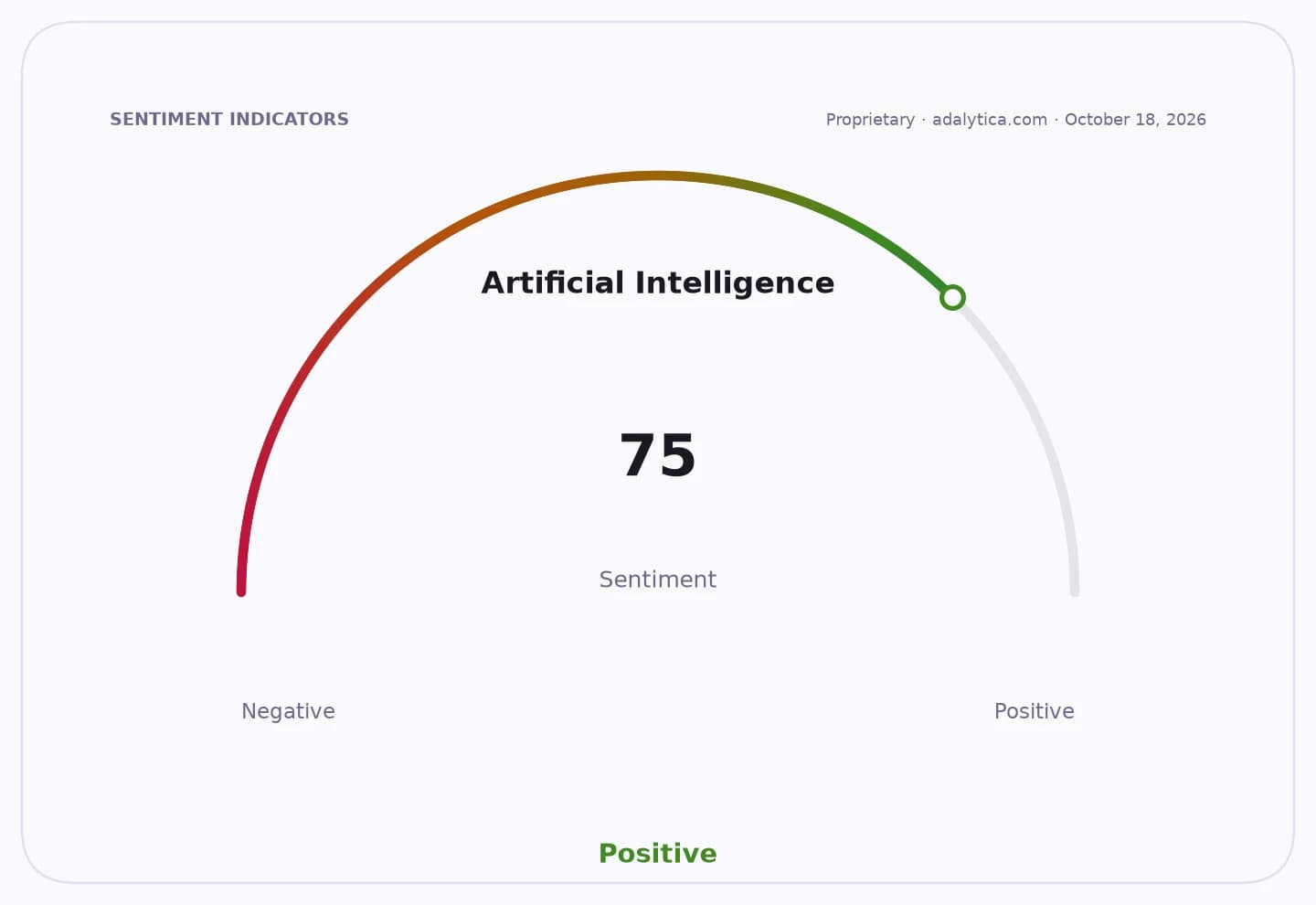
Artificial Intelligence — 30-day sentimentadalytica.com
Explore this data interactively — full history, time series and cross-market comparisons.Open AlphaPulse
That helps explain why the debate is shifting from whether AI is transformative to how it should be governed. Jack Clark, a co-founder of Anthropic, said the current situation is even riskier than Georgieva suggested, comparing it to Formula 1 at night without brakes. His point echoes a growing industry concern: companies should not be the only ones deciding where the safety line is drawn. Governments, he argued, need to help set standards.
Investors should see that as a sign AI regulation is moving from background noise to a real factor in valuations. The market has rewarded scale, data access and computing power, but the next leg of the story may depend on whether those advantages survive tougher rules on model safety, data privacy, cross-border access and product liability. That is particularly relevant for hyperscalers and chipmakers, where the AI trade has already become crowded and technically stretched at times.
The long-term thesis for AI remains intact. If the technology is harnessed safely, it can lift productivity, create new business lines and broaden the pool of profitable software and infrastructure companies. But Georgieva’s warning is a reminder that the best investment outcomes in transformative technologies usually come from disciplined adoption, not unchecked acceleration. For investors, the right response is not to flee AI, but to favor businesses with real moats, healthy free cash flow and the ability to adapt as the rules evolve. It is a story worth watching closely, and for diversified long-term portfolios, worth keeping on the watchlist.
| Entity | Gains | Losses |
|---|---|---|
| AI developers with strong compliance | ▲Safer adoption, broader trust | ▼Higher compliance costs |
| Nvidia, Microsoft, Alphabet | ▲Continued AI demand | ▼More regulation and liability risk |
| Workers and retraining providers | ▲New skills demand | ▼Job displacement pressure |
| Regulators and governments | ▲More oversight power | ▼Slower rollout if rules bite |