Fresh money is starting to look better in large caps than in India’s overheated small- and mid-cap corner, and that shift could matter more for long-term returns than the latest chase for momentum. With small- and mid-cap funds drawing record inflows even as valuations stretch, investors are being asked a simple question: do you want to pay up for perfection, or buy the market’s blue-chip leaders while they still look relatively reasonable?
India Large Caps Look Better Than Small Caps

That matters because valuation is the one thing investors can control. According to data from the Association of Mutual Funds in India, small- and mid-cap funds took in Rs.16,874 crore in September, the highest on record, while large-cap funds attracted just Rs.859 crore. That kind of crowding is rarely a great sign for future returns. It usually means expectations are already high, which leaves less room for error if growth cools or earnings disappoint.
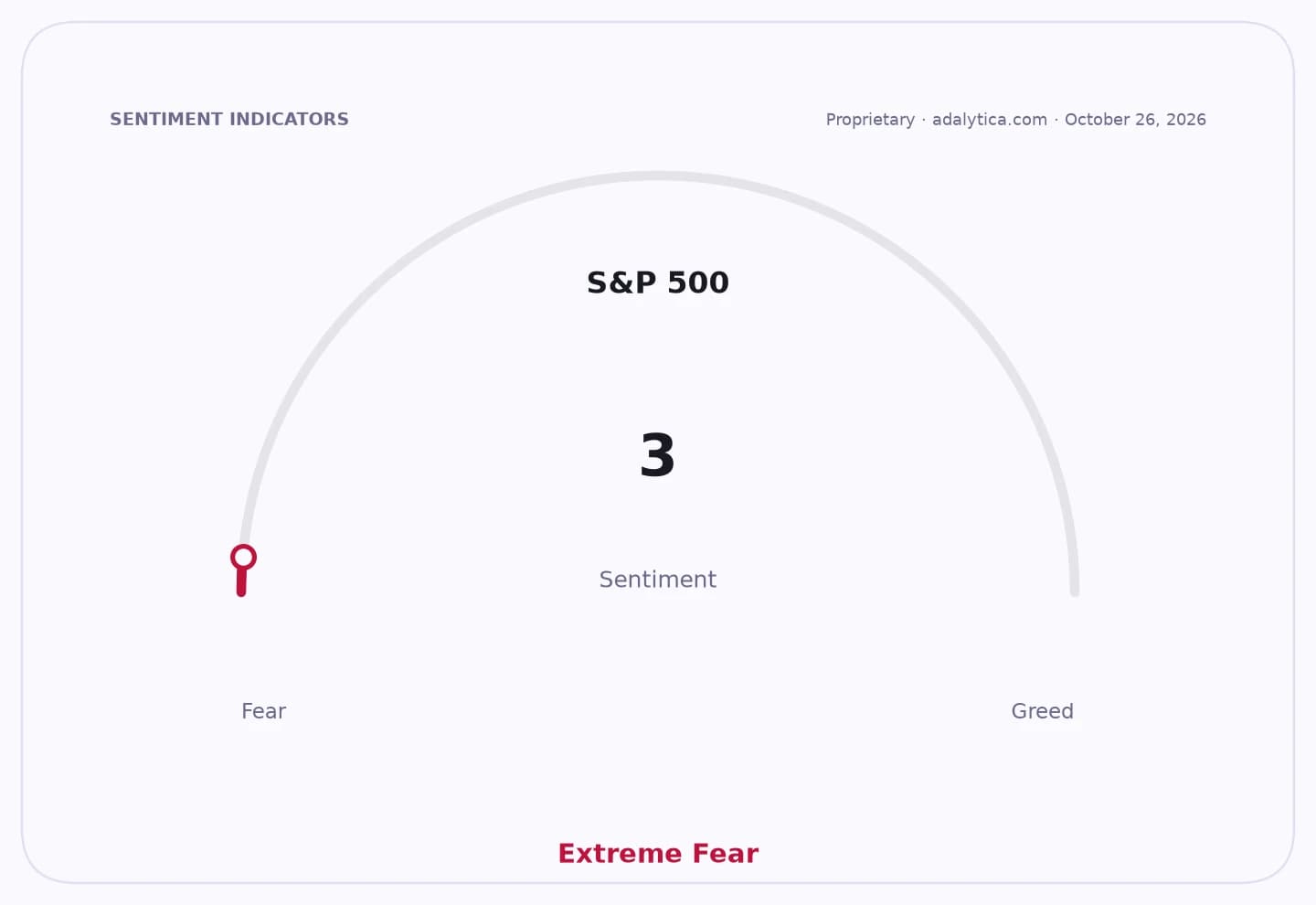
Sentiment IndicatorsⓘProprietary · adalytica.com · October 25, 2026
This is a snapshot — live sentiment, awareness and momentum for 130+ markets update continuously in the dashboard.Open AlphaPulse

The valuation gap is now wide enough to change portfolio behaviour. A DSP Mutual Fund report said small- and mid-cap indices are trading roughly 72% and 56% above their historical relative-price medians versus the Sensex, both near three standard deviations above long-term averages. In plain English, the smaller stocks are no longer cheap by any reasonable historical measure. Large caps, by contrast, have been left behind for long enough that several now trade near decade-low relative valuations.
That is the key investment argument here. The past few years rewarded investors for owning the parts of the market tied to India’s domestic growth themes — manufacturing, capital goods, defence, healthcare and consumption — many of which sit in the mid- and small-cap universe. The outperformance was real, but it was also highly concentrated. A 3P Investment Managers analysis found that from May 2022 through September 2026, the Nifty MidSmallcap 400 returned 99%, versus 35% for the Nifty 100. But most of the excess returns came from just 16 stocks, or 4% of the universe, that rose more than 1,000%.
That concentration is exactly why investors should be cautious about treating the entire small- and mid-cap segment as a one-way bet. When a rally is driven by a handful of winners, the category average can look healthier than the underlying stock selection really is. If those leaders stumble, or if earnings upgrades stop arriving, the valuation premium can unwind fast. Kotak Institutional Equities has already noted that the strongest mid- and small-cap performers were helped by both earnings upgrades and rerating — a combination that is much harder to repeat from such elevated starting points.
Large caps now offer a far more forgiving setup. DSP Mutual Fund said the Nifty 100’s current five-year CAGR is about 7.6%, near the bottom 12% of its historical distribution, while mid caps and small caps are at 15.4% and 15.0%. That matters because markets tend to do better from low expectations than from hot ones. Elara Securities says the Nifty trades at 17.1 times one-year forward earnings, below its 10-year average of 18.9 times, while the Nifty Smallcap 100 sits at 23.8 times, around 34% above its 10-year average. That leaves far more cushion in large caps if the macro backdrop worsens.
And the macro backdrop is not exactly supportive of speculative risk-taking. Inflation, elevated crude, higher bond yields, a firmer rate cycle and foreign selling all argue for balance sheets, cash flow and pricing power. Smaller companies are generally more exposed to funding costs and demand swings, while the biggest firms usually have better access to capital and more resilience when growth slows. That is why fresh money may be better directed toward large-cap, flexi-cap or large-cap-biased strategies rather than chasing what has already run hard.
For investors, the lesson is not to abandon small caps entirely. It is to rebalance intelligently. If your portfolio has drifted far beyond your intended allocation because of recent outperformance, trimming back makes sense. If you are deploying new savings, large caps now offer a better mix of valuation, visibility and downside protection. Over a three- to five-year horizon, that is often the kind of setup that quietly compounds wealth while the crowd chases yesterday’s winners.
The smartest move now may be patience, not urgency: keep a long-term allocation to smaller companies, but let fresh capital work harder in large caps until valuations and expectations become more even again.
| Entity | Gains | Losses |
|---|---|---|
| Large-cap funds | ▲cheaper valuations | ▼lower recent inflows |
| Small- and mid-cap funds | ▲recent momentum | ▼valuation cushion |
| Fresh investors | ▲better entry points | ▼paying peak multiples |
| Existing small-cap holders | ▲prior gains | ▼rerating risk |