The stock market is advancing again, but the real story is that leadership is narrowing back toward the biggest companies in America.
S&P 500 Rises as Small Caps Lag

That matters because when the S&P 500 rises on the strength of large caps instead of a broad base of stocks, it usually says more about investor preference than about the health of the whole market. In this stretch, the index has kept climbing even as small caps lagged, reinforcing a familiar pattern: investors are still willing to pay up for scale, durability and earnings power, but they are less enthusiastic about the more cyclical, rate-sensitive corners of the market.

The divergence is easy to see in the numbers. The SPDR S&P 500 ETF Trust rose to 769.66 on Oct. 27 from 759.97 on Oct. 23, while the Invesco QQQ Trust, which tracks the Nasdaq-100, recovered to 721.25 from 704.4 after a sharp pullback. The iShares Russell 2000 ETF, by contrast, climbed only to 280.18 from 275.75 and remains well below its 50-day moving average, a sign that small caps are still struggling to regain traction. The S&P 500 is hovering back near its 50-day moving average, while its longer-term trend remains intact above the 200-day line.
For investors, that shift in leadership is important because it can change how portfolios behave even when headline indexes look healthy. Large-cap technology, communication services and other cash-generating giants tend to benefit when growth is scarce, margins matter and capital is expensive. Smaller companies, which often rely more heavily on refinancing and future growth, typically need friendlier credit conditions to really shine. With the 10-year Treasury yield near 5% and the Fed funds rate still forecast around 3.7%, the market is not exactly handing out free money to weaker balance sheets.
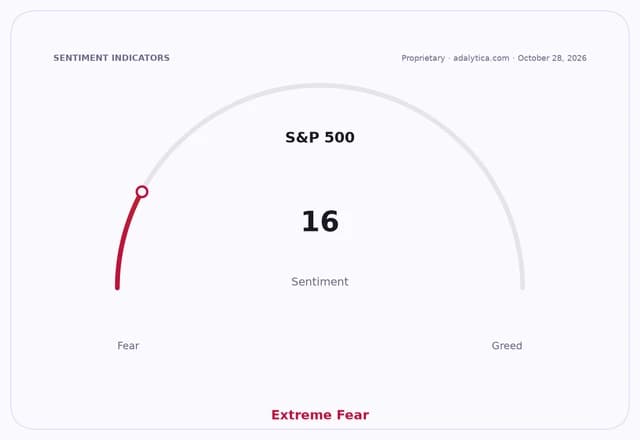
That backdrop helps explain why the market can rise and still feel selective. Adalytica’s S&P 500 trade signals show extreme awareness but fear-level sentiment, a combination that often appears when investors are chasing a handful of leaders while staying cautious underneath the surface. That kind of market can keep rewarding the largest companies, but it also leaves less room for broad-based participation until earnings broaden out or borrowing costs ease further.
There is a long-term lesson here for investors: market leadership does not stay in one place forever. Big caps can dominate for long stretches because they have the best balance sheets, the strongest free cash flow and the clearest paths to compounding. But eventually, if rates drift lower and the economy stabilizes, smaller companies can catch up fast. For now, though, the message is clear: this is still a market that prefers quality and scale over speculation. Long-term investors should keep that tilt in mind, stay diversified, and focus on businesses that can keep growing even when the broad market’s leadership changes. Worth watching, and worth owning selectively.
| Entity | Gains | Losses |
|---|---|---|
| Large-cap stocks | ▲Better capital inflows | ▼Less valuation pressure |
| Small-cap stocks | ▲Select opportunities only | ▼Lags in leadership |
| Big Tech / Nasdaq | ▲Momentum revival | ▼Broader participation |
| Investors in quality names | ▲Stronger relative returns | ▼Missed rebound in cyclicals |