The Dow Jones and Germany’s DAX are trying to build a rally without a full-strength tech sector, and that is exactly why the next few sessions matter for investors.
QQQ Falls Below 50-Day as Dow and DAX Hold Up

Fresh selling in US technology and semiconductor shares helped knock the Nasdaq-focused QQQ back toward its 50-day moving average, while Apple and Microsoft lost some of their recent momentum on Friday. QQQ fell to 704.47 on Oct. 22, leaving it below its 50-day average of 725.98 and flashing an RSI reading of 28.5, a level that often reflects stretched downside pressure rather than durable weakness. That matters because the market’s biggest gains in recent months have come from a very narrow group of stocks, and when those leaders wobble, the whole rally gets more fragile.
Sentiment IndicatorsⓘProprietary · adalytica.com · October 23, 2026
This is a snapshot — live sentiment, awareness and momentum for 130+ markets update continuously in the dashboard.Open AlphaPulse
At the same time, the Dow has been showing relative strength. The index closed at 52,002 last week, up 0.7%, while the DAX advanced 2.13% to 25,623. In both markets, investors saw a rotation into “old economy” and defensive names as worries over higher oil prices, inflation and funding stress at datacenter operator CoreWeave pressured semiconductor stocks. The DAX’s biggest weekly winners included Rheinmetall, Scout24 and Symrise, while Infineon was one of the main laggards, a reminder that even in a strong index move, leadership remains uneven.
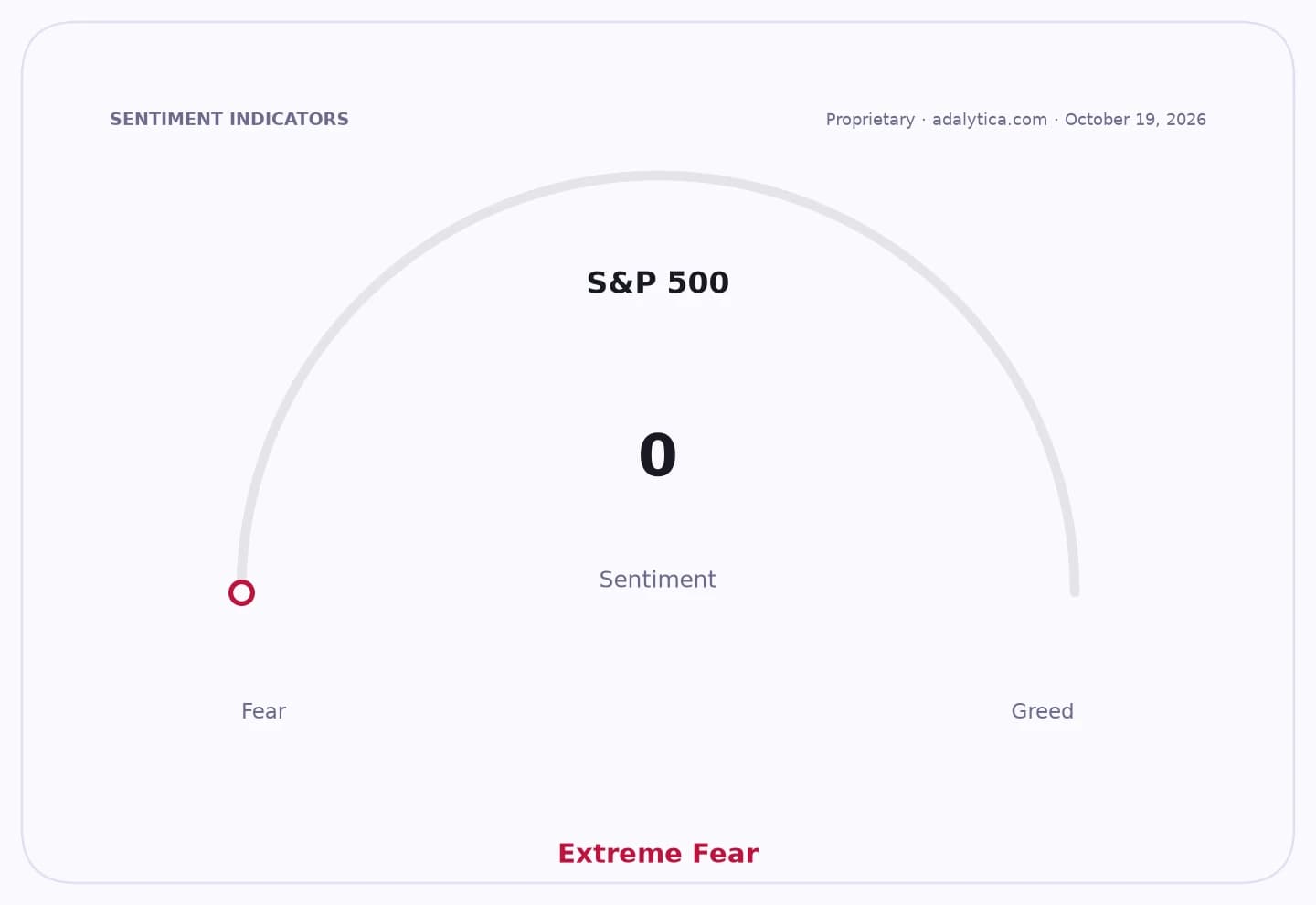
That imbalance is the core investment issue. A lasting rally in the Dow or the DAX is much easier to sustain if technology joins the move, because tech still drives a large share of global index earnings growth and investor confidence. Without that participation, advances can quickly turn into short-lived tactical rebounds. The German market’s recent strength has come even as risk appetite remains jumpy, and in the US, the S&P 500 trade signals from Adalytica.com still point to “Extreme Fear” even though awareness remains at “Extreme Greed” — a combination that usually marks a market trying to decide whether to extend or retreat.
For long-term investors, this is less about chasing a fast breakout than about asking whether the recent consolidation is healthy. Apple is still holding well above its 200-day moving average and ended at 348.22, while Microsoft finished at 521.08, also above its long-term trend. Those are not the signs of broken secular winners. But QQQ’s drop back under its 50-day average shows how quickly sentiment can cool when megacap tech stops carrying the tape.
That is why the coming rebound attempt matters. If tech stabilizes and semiconductors recover, the Dow’s move higher could broaden into something sturdier, and the DAX could keep benefiting from a more balanced global risk tone. If tech only bounces weakly, the market may be left with a technical recovery rather than a genuine new leg up. For investors with a multi-year horizon, the lesson is simple: broad diversification still wins, and pullbacks in high-quality growth franchises are often where the next compounding opportunity begins. This is a market worth watching, not panicking over.
| Entity | Gains | Losses |
|---|---|---|
| Dow Jones | ▲Broadening rally | ▼Tech-only leadership |
| DAX | ▲Rotation into industrials and defense | ▼Weak semis and cyclicals |
| Apple, Microsoft | ▲Long-term trend support | ▼Short-term momentum traders |
| QQQ / Nasdaq tech | ▲Potential rebound on oversold signals | ▼Sellers if tech stays weak |