The U.S. market is not moving as one trade anymore, and that split is where the biggest opportunity now sits. While the S&P 500 and Nasdaq 100 hover near record territory, small caps have been crushed, leaving an “invisible” crash in parts of the market that is creating deep value, but also signaling that investors are paying a premium for the wrong businesses.
SPY QQQ and IWM Divergence Widens

That divergence matters because it says far more about the economy and capital flows than a headline index ever can. The S&P 500’s SPY closed at 771.79 on Oct. 15, above its 200-day moving average of 721.47, while QQQ ended at 728.0, also well above its 200-day line of 673.2. Both remain elevated enough to suggest the large-cap, AI-heavy leaders are still carrying the market. But the small-cap IWM ETF tells a different story: it finished at 275.08, barely above its 200-day average of 276.42 and far below its recent highs, after a year that has seen violent swings and repeated breakdowns.
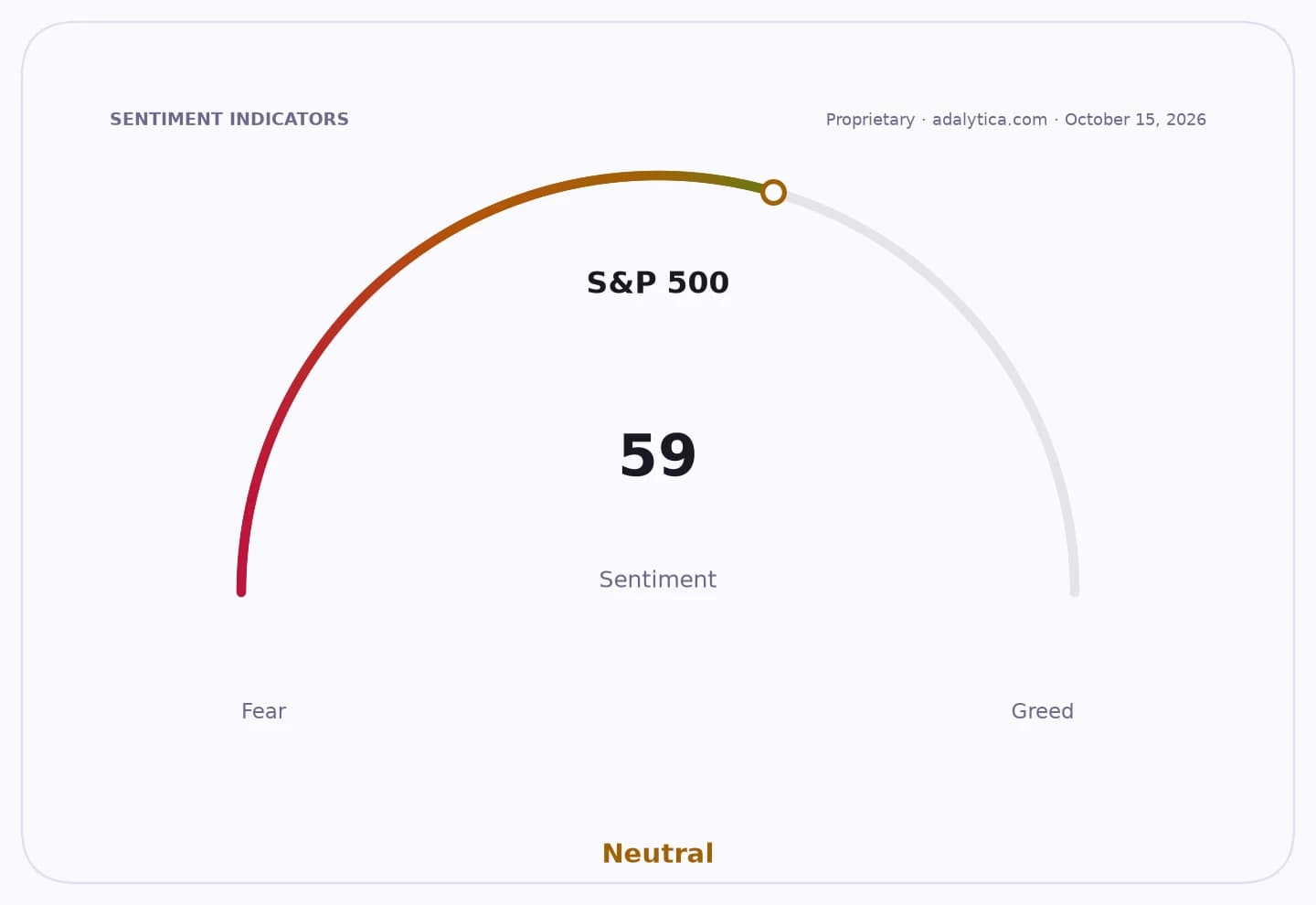
Sentiment IndicatorsⓘProprietary · adalytica.com · October 16, 2026
This is a snapshot — live sentiment, awareness and momentum for 130+ markets update continuously in the dashboard.Open AlphaPulse
This is the classic late-cycle market split: the biggest, most liquid names are acting like a momentum trade, while the rest of the equity market is pricing in slower growth, tighter financial conditions and weaker earnings power. The technical picture reinforces that gap. SPY and QQQ still hold above their long-term trend lines, even if near-term momentum has cooled, but IWM has been much weaker, with its 50-day average still higher than spot and its RSI reading of 37.7 showing a market closer to oversold than overbought. In plain English, the index story looks healthy; the breadth story does not.
For investors, that creates an asymmetric setup. The market is still rewarding scale, pricing power and balance-sheet strength — the kind of businesses that dominate the major benchmarks and can keep funding AI capex, cloud buildouts and shareholder returns. But the selloff beneath the surface is flushing out companies tied to domestic growth, cyclicals and financing conditions, which is exactly where future alpha can be found once the panic subsides. If the large-cap winners are the toll roads of the AI economy, the neglected names in the broader market are the optionality trade.
That is why the crash beneath the surface matters more than the indexes suggest. When only a narrow group of stocks can hold the tape, it usually means investors are hiding in quality, not embracing growth. It also means valuation dislocations widen fast outside the megacap universe. For disciplined buyers, that is the moment to start screening for businesses with durable cash flow, low leverage and earnings that do not depend on a perfect macro landing.
Adalytica’s S&P 500 trade snapshot captures the contradiction well: sentiment sits at 67, neutral, but awareness is flagged at “Extreme Fear.” That combination is what often appears when the market is calm on the surface and fragile underneath. The next catalyst will likely be earnings guidance, not macro rhetoric. If results stabilize and credit conditions stop tightening, the lagging half of the market could rebound sharply. If not, the crash hidden inside the averages will keep spreading.
The key takeaway is simple: the market is not one trade, and the gap between SPY, QQQ and IWM is the opportunity. Stay with the leaders for momentum, but start building a list of beaten-down small caps and cyclicals with real earnings power before the rest of Wall Street notices the invisible crash has already created the next rally.
| Entity | Gains | Losses |
|---|---|---|
| Large-cap AI leaders | ▲Index support, capital inflows | ▼Valuation scrutiny |
| Small-cap value buyers | ▲Deep discounts, rebound potential | ▼Near-term volatility |
| IWM constituents | ▲Mean-reversion upside | ▼Growth and financing pressure |
| Index-heavy passive holders | ▲Benchmark stability | ▼Narrow breadth risk |