Beginner investors often make the costliest mistake in the market: they sell during volatility, locking in losses or missing rebounds that can add up to thousands of dollars over time.
S&P 500 Investors Urged Not to Sell Volatility

That matters because the latest market swings have come amid a still-resilient U.S. economy, strong S&P 500 earnings and a year-to-date gain of about 12% for the broad index, even after sharp drawdowns earlier in the period. For investors buying broad-market funds such as the SPDR S&P 500 ETF Trust and Invesco QQQ Trust, the lesson is simple: short-term turbulence has often had little to do with long-term business fundamentals.
The backdrop has been unusually noisy. Since the pandemic, the S&P 500 has seen a 20% drop in 2022, periods of rapid recoveries and renewed concern around the artificial intelligence trade, with some strategists even floating the idea of a “lost decade” for stocks. That environment can tempt newer investors to trade on headlines and emotion, especially now that commission-free apps make it easier than ever to buy and sell from a phone.
Morningstar’s analysis of January through April 10 found S&P 500 volatility ran at about 15% annualized, a level that the firm said is roughly the market’s century-long average. The point is not that volatility is harmless, but that it often feels worse in the moment than it is in historical context.
For investors, the risk is timing, not just exposure. Selling after a stock or index falls 5% to 10%, or after a quick gain, can turn a temporary move into a permanent mistake if the underlying thesis remains intact. History suggests patience has been rewarded: the S&P 500 has averaged about 10% annual gains since 1957, and the longer investors stay in, the less likely they are to lose money.
That does not mean every selloff is a buying opportunity. If a company falls 20% to 30% after an earnings report because its moat is eroding or its business model is changing, selling can make sense. But when market declines are driven by macro shocks or geopolitics rather than fundamentals, the bigger danger for beginners is reacting too fast and missing the recovery.
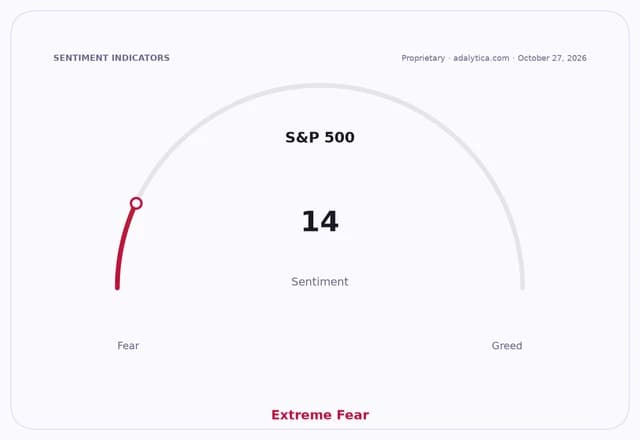
Technical signals in the major index ETFs also show the market has been choppy rather than broken. SPY recently traded near its 50-day moving average of about 766.7 and above its 200-day moving average of 724.8, while QQQ has held above its 200-day average of 677.1 even after a sharp pullback. Adalytica’s S&P 500 trade signals also show a split backdrop, with sentiment at 14.0 labeled “Extreme Fear” even as awareness sits at 99.0, underscoring how attention remains high despite cautious positioning.
The bottom line for retail investors is that volatility alone is not a reason to sell. The bigger test is whether the long-term thesis has changed, and for broad index investors, history says patience has usually won out.
| Entity | Gains | Losses |
|---|---|---|
| Long-term S&P 500 investors | ▲Compounding through rebounds | ▼Emotional selling |
| Beginner retail traders | ▲Discipline and patience | ▼Panic-driven losses |
| Broad index funds like SPY and VTI holders | ▲Market recovery participation | ▼Short-term timing mistakes |
| Active traders chasing headlines | ▲Quick moves only | ▼Larger drawdown risk |