Small-cap stocks are gaining the upper hand as the market’s rally finally starts to look less dependent on a handful of megacap technology names. That matters because a broader advance usually points to healthier underlying risk appetite, and it can unlock a second leg for the equity market if investors begin rotating out of the narrow AI trade and into economically sensitive shares.
Russell 2000 Outperforms as Market Breadth Improves
The Russell 2000 has been outperforming the mega-cap led Nasdaq 100, while the equal-weight S&P 500 ETF is also beating the capitalization-weighted benchmark, a sign that gains are spreading beyond the biggest winners. That shift is important economically because small caps are far more exposed to domestic growth, credit conditions and borrowing costs. When they catch a bid, it often reflects a more confident view of the U.S. economy and easier financing conditions ahead.
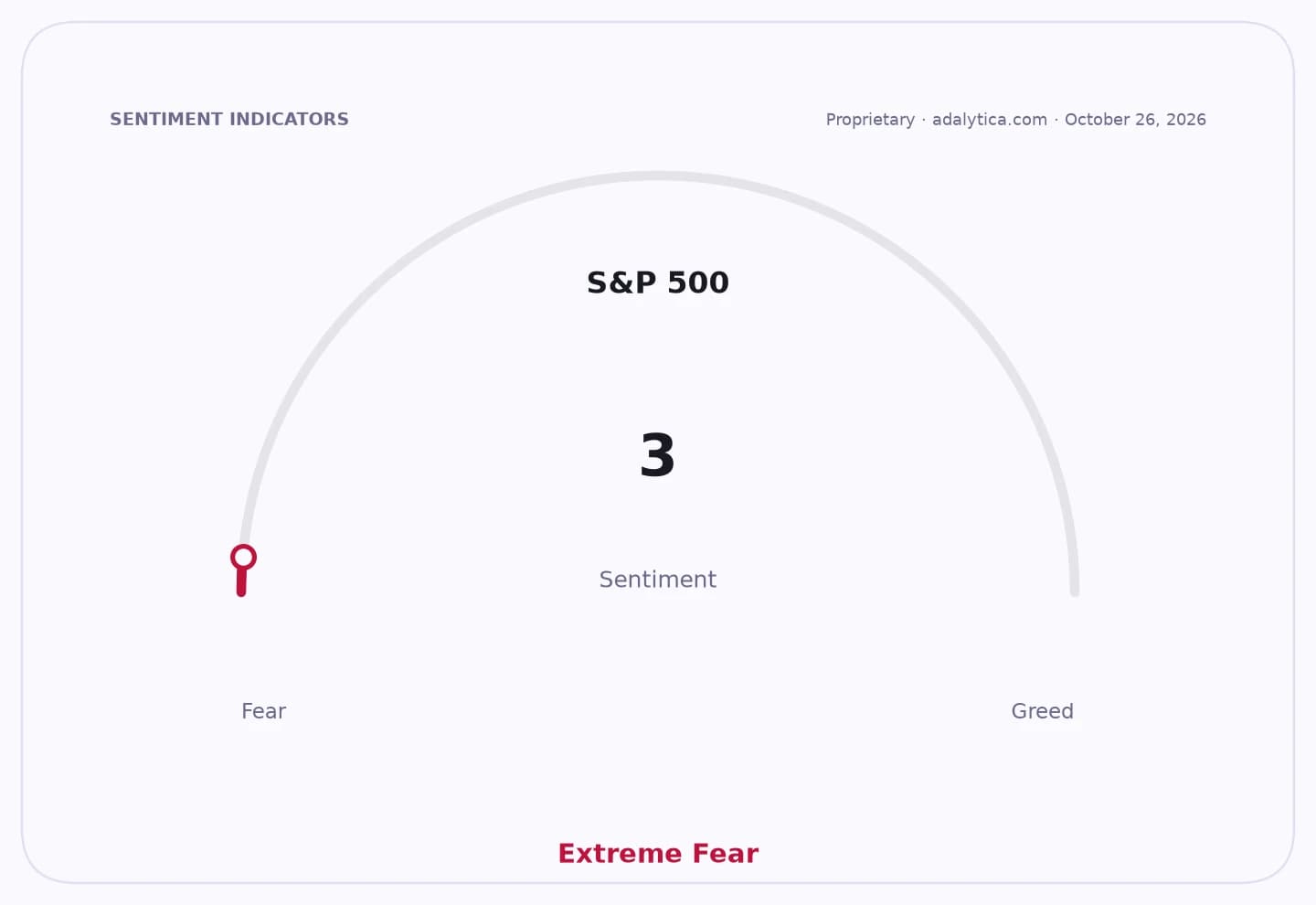
Sentiment IndicatorsⓘProprietary · adalytica.com · October 25, 2026
This is a snapshot — live sentiment, awareness and momentum for 130+ markets update continuously in the dashboard.Open AlphaPulse
The setup is especially notable with the two-year Treasury yield around 4.65% and the 10-year near 4.96%, levels that still keep pressure on balance sheets but are no longer rising aggressively. If rates stabilize, the market’s most rate-sensitive corners can catch up fast. Small caps also tend to benefit disproportionately when investors anticipate a softer landing, improving earnings breadth and stronger merger activity.
Technically, the picture is beginning to improve for the Russell 2000 even after a choppy stretch. The ETF is trading above its 200-day moving average, and recent rebounds have come alongside an improvement in relative momentum, even as the 50-day line remains a ceiling to clear. By contrast, the Nasdaq 100 has been under more pressure, with its recent slide pulling the index further below its own 50-day average and showing that the market’s leadership is no longer as one-way as it was during the AI surge.
That is why this matters for investors: breadth expansions are how bull markets mature. When participation widens, the opportunity set broadens too. The obvious winners are small-cap ETFs such as IWM and equal-weight exposure through RSP, but the real trade is in the second-order beneficiaries — regional banks, industrials, transport names, builders and domestically focused cyclicals that gain the most when capital stops clustering in a few mega caps.
The market is also telling us something through positioning. Adalytica’s S&P 500 trade signals show extreme fear in the benchmark despite the rally elsewhere, a classic backdrop for rotation rather than collapse. Investors should not chase the same narrow leaders and assume the trade is over. If breadth keeps improving, the biggest upside may now belong to the market segments most people left behind.
| Entity | Gains | Losses |
|---|---|---|
| Russell 2000 / IWM | ▲Rotation into small caps | ▼Big Tech concentration |
| Equal-weight S&P / RSP | ▲Broader participation | ▼Cap-weighted index dominance |
| Domestic cyclicals | ▲Better growth sensitivity | ▼Rate-sensitive mega-cap defensives |
| Nasdaq 100 / QQQ | ▲— | ▼Narrow leadership unwinds |