India’s stock market is splitting in two, with largecaps lagging badly as domestic investors keep buying smaller companies and foreign funds pull money out of blue chips.
India stocks split: smallcaps lead, largecaps lag
That divide is now the dominant force shaping returns in India. In the first half of FY27, the Nifty50 rose just 1.3%, while the Nifty Smallcap 250 jumped 24.6%, according to Shriram AMC senior fund manager Prateek Nigudkar, underscoring how capital flows, not just earnings, are driving the market’s latest rotation.
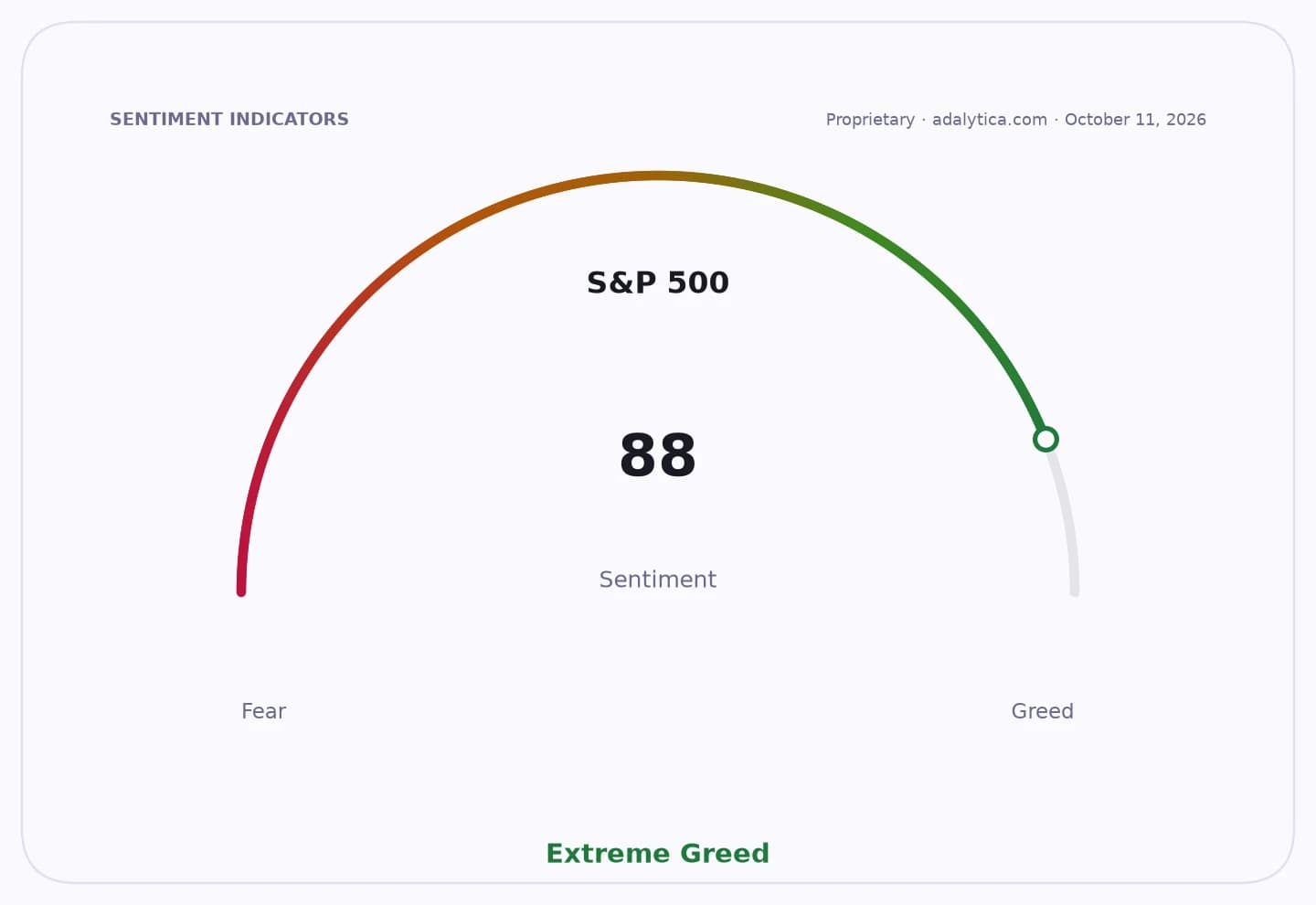
Sentiment IndicatorsⓘProprietary · adalytica.com · October 16, 2026
This is a snapshot — live sentiment, awareness and momentum for 130+ markets update continuously in the dashboard.Open AlphaPulse
Foreign investors, who own a bigger slice of India’s largest companies, have been selling largecaps as global bond yields climbed, the rupee weakened and oil prices rose. Domestic institutions, backed by steady systematic investment plan inflows, have kept directing fresh money into mid- and smallcap stocks, cushioning the smaller end of the market.
That matters economically because it changes where capital is going inside one of the world’s fastest-growing equity markets. It also matters to investors because the performance gap is no longer small: largecaps are carrying valuation comfort after underperforming, while mid- and smallcaps are priced for continued earnings delivery.
Midcaps have emerged as the market’s middle ground, offering more growth than mature blue chips but less survival risk than smaller companies. Fund managers say that mix has made them attractive for long-term wealth creation, especially because they are less heavily covered by analysts and can still trade at reasonable valuations before institutions crowd in.
Smallcaps, meanwhile, are increasingly being treated as the purest play on India’s domestic economy. Carnelian Capital said 59% of smallcap profits come from India’s domestic non-financial economy, compared with 32% for largecaps, while the segment has heavier exposure to healthcare, industrials, consumer discretionary and materials tied to manufacturing and consumption.
The earnings data supports the case for selective exposure. Carnelian said 279 smallcaps compounded profits at more than 20% annually over FY16-FY26, versus 13 largecaps, and 354 smallcaps have more than tripled in value since April 2023 even as 171 have lost money, showing the segment has become a stock-picker’s market rather than a broad trade.
Valuations, however, are flashing caution. Axis Mutual Fund said midcap valuations ended September at a 52% premium to the Nifty, versus a long-term average of 27%, while the smallcap premium hit a record 30%. Motilal Oswal’s data shows the Nifty 50’s one-year forward price-to-earnings ratio at 17.2 times, an 18% discount to its long-term average, while smallcaps still trade at 23.2 times, about 33% above their historical average.
The message for investors is that the old liquidity-led rally is fading. Returns are increasingly likely to depend on earnings growth, business quality and the price paid for that growth, with largecaps offering relative valuation support and smaller companies offering faster domestic exposure but less room for disappointment.
The question now is whether profits can catch up with the premiums already embedded in parts of the broader market. If earnings keep accelerating in domestic-facing sectors, the smallcap and midcap rotation can extend; if not, the valuation gap leaves the segment vulnerable to a sharper reset.
| Entity | Gains | Losses |
|---|---|---|
| Domestic institutions | ▲Broader small/midcap exposure | ▼Blue-chip underweights |
| Foreign investors | ▲Largecap valuation entry points | ▼Indian blue-chip holdings |
| Smallcaps | ▲Domestic growth premium | ▼If earnings miss expectations |
| Largecaps | ▲Cheaper valuations | ▼Relative performance and flows |