India is acting less like a regional economy and more like a standalone force in global markets, even as India-focused exchange-traded funds trade below recent highs and technical indicators show a market still searching for conviction.
India ETFs Trade Below Key Moving Averages
That disconnect is exactly where the opportunity lies. The market is still pricing India like a story of steady domestic growth and occasional geopolitics, but the bigger narrative is that India is becoming a structural beneficiary of supply-chain reordering, capital diversion from China, and a rising need for non-China exposure in global portfolios. When the world’s second-largest emerging market looks trapped in “extreme fear” on Adalytica’s China growth gauge, investors should be asking who captures the manufacturing, trade, and strategic share that China is losing. India is near the top of that list.
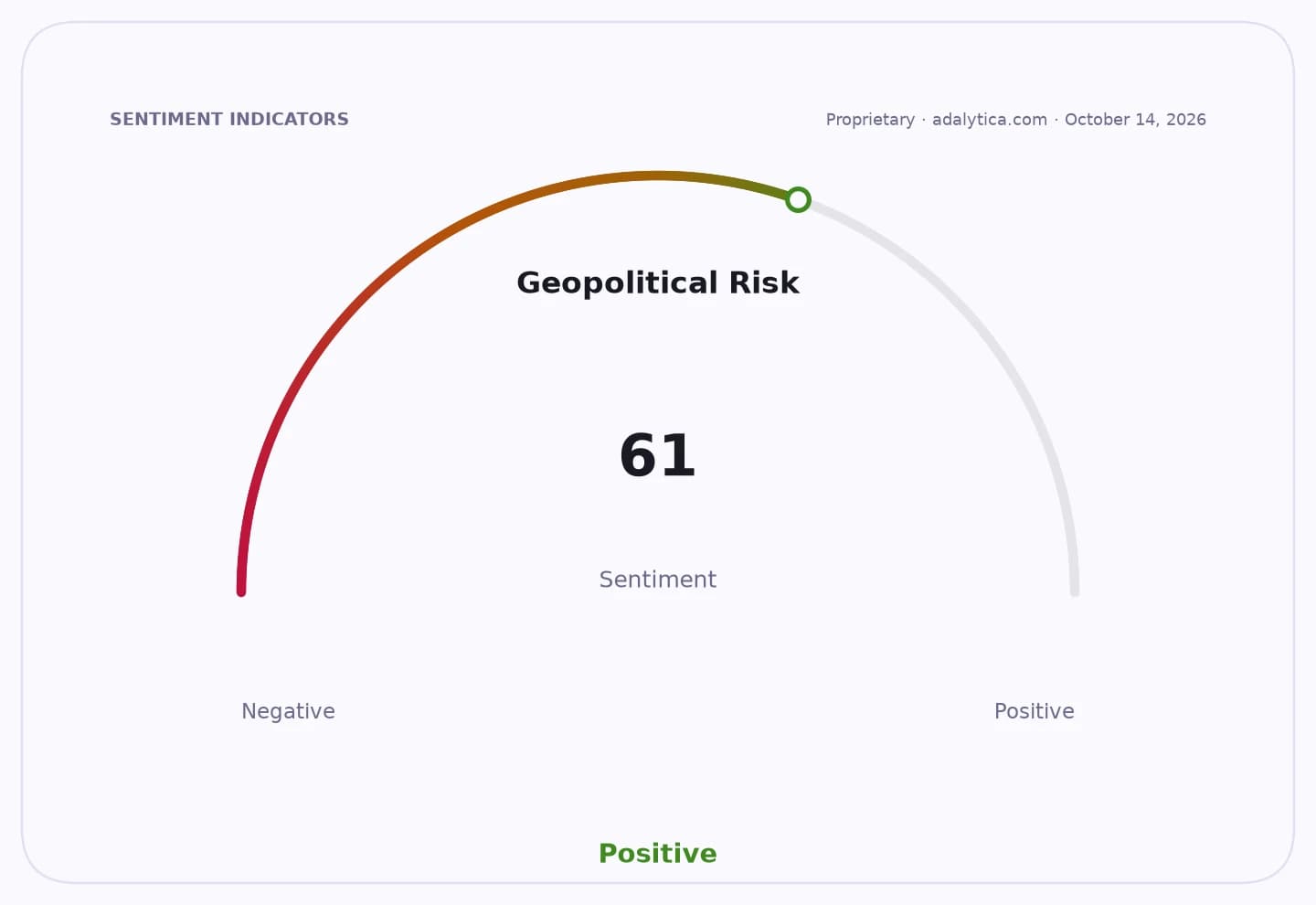
Sentiment IndicatorsⓘProprietary · adalytica.com · October 15, 2026
This is a snapshot — live sentiment, awareness and momentum for 130+ markets update continuously in the dashboard.Open AlphaPulse
The trade is not showing that confidence yet. The iShares MSCI India ETF, INDA, closed at $47.04 on Oct. 14, below its 50-day moving average of $48.51 and its 200-day average of $49.56, with the relative strength index at 45.0. That is not the chart of a market already pricing in an India breakout. EPI, another India-focused fund, was even weaker at $40.80, also below both its 50-day and 200-day averages. In other words, India’s equity market is still trading like a cyclical emerging-market exposure, not like an asset class tied to a secular geopolitical realignment.
That mismatch matters because India’s investment case is increasingly about power, not just growth. “Power” here means bargaining leverage in a fragmented world: the ability to attract supply chains, win defense partnerships, scale domestic champions, and become a destination for capital seeking a hedge against China concentration. For investors, that has second-order effects across infrastructure, banks, industrials, energy, and defense. You do not need India to replace China. You need it to absorb even a fraction of the capital, production, and strategic importance that multinational companies are reallocating.
The same dynamic is visible in individual stocks. ICICI Bank, trading at $28.27, sits just under its 50-day average but above its 200-day average, suggesting a market that still sees India’s banking system as a direct proxy for domestic expansion rather than a beneficiary of a bigger structural rerating. When credit demand, formalization, and industrial capex accelerate, banks become the toll roads on the India theme. That is why financials often become the first place global investors look when a domestic-growth story turns into a national-power story.
The risk is that investors remain stuck in an old framework: India as a “middle power” that participates in global growth but does not shape it. That view underestimates how much leverage comes from neutrality, scale, and diversification at a time when the rest of the world is fragmenting. China growth sentiment has collapsed to 4 on Adalytica’s gauge, an “Extreme Fear” reading, and while that does not automatically make India a winner, it does sharpen the relative-value case. If capital is looking for the next large, investable, policy-backed alternative in Asia, India is the obvious landing zone.
For portfolio positioning, the cleanest expression is still through broad India ETFs such as INDA and EPI, but the higher-conviction upside likely sits one layer deeper in banks, industrials, logistics, power, and defense supply chains. Those are the businesses that benefit when India is treated not as a trade but as a platform. The next catalyst is not a slogan from New Delhi; it is continued evidence that global capital, production, and strategic partnerships are moving India’s way. If that trend persists, today’s muted technical picture may look less like weakness and more like the base of a long rerating.
| Entity | Gains | Losses |
|---|---|---|
| India | ▲Capital inflows, strategic leverage | ▼“Middle power” label |
| INDA/EPI holders | ▲Early rerating upside | ▼Skeptical benchmark allocators |
| Banks/industrials | ▲Credit growth, capex cycle | ▼Passive exporters to China |
| China-linked assets | ▲— | ▼Share of global supply chains |