Indonesia’s equity market is struggling to reflect the country’s economic growth story as investors confront two external risks at once: a hawkish Federal Reserve backdrop that keeps U.S. yields elevated and an MSCI review that could reshape capital flows into the archipelago.
Indonesia equities face Fed and MSCI headwinds
The squeeze matters because Indonesia is unusually dependent on foreign portfolio money to support a market that is already trading well below its longer-term trend. The iShares MSCI Indonesia ETF, EIDO, has fallen to $10.07 from $16.94 in late January, while the benchmark IDX has dropped to 8.89 from 16.94 over the same period, leaving both well under their 50-day and 200-day moving averages. That weakness suggests investors are demanding a higher risk premium for Indonesian assets even before any index-provider decision.
Sentiment Indicators
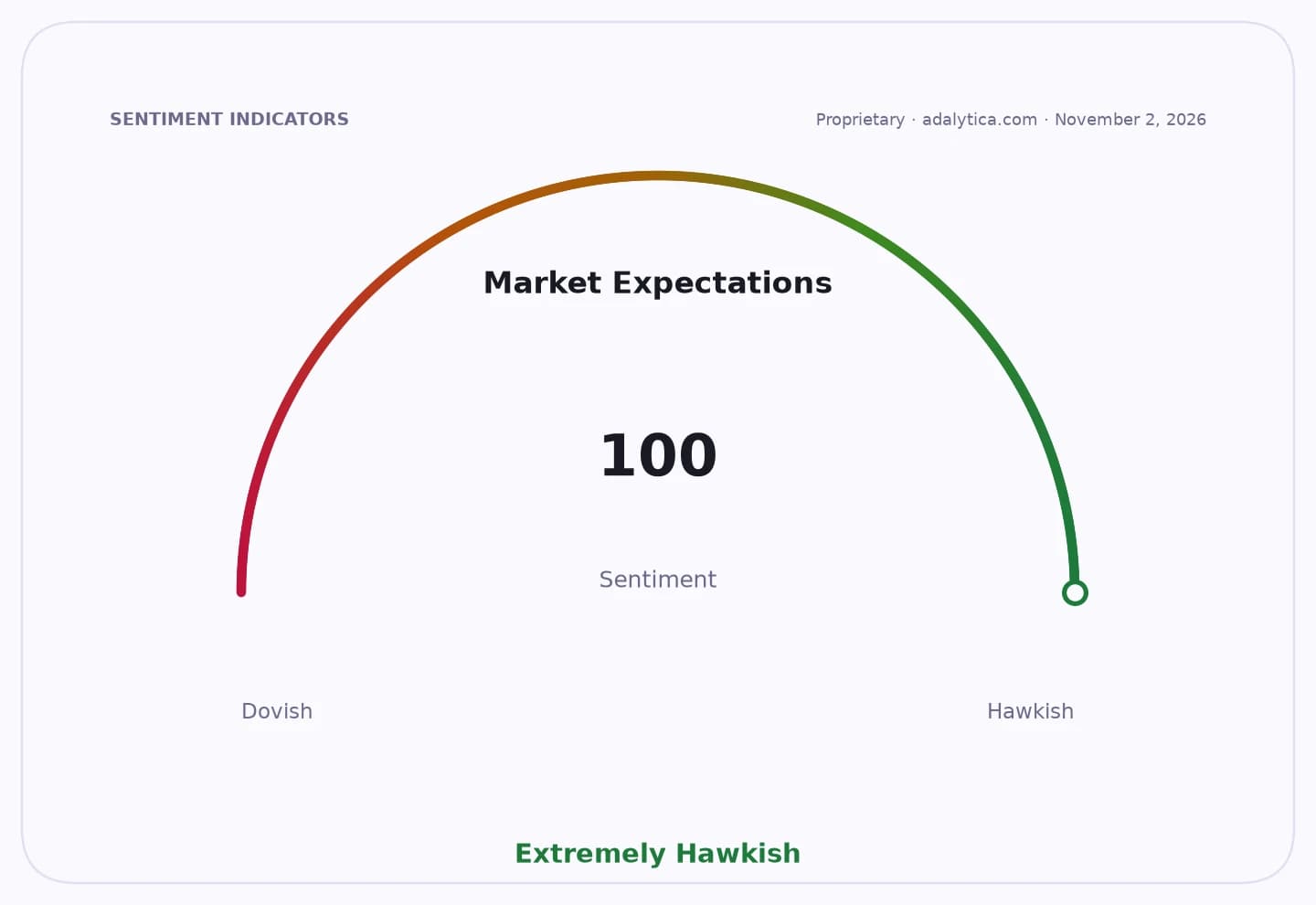
The macro backdrop is working against emerging markets more broadly. The U.S. 10-year Treasury yield is near 4.84%, the two-year at 4.46%, and the Fed funds rate is projected around 3.89% in November, keeping global fixed-income competition for capital intense. Adalytica’s Federal Reserve forward guidance gauge remains neutral, but its awareness reading points to elevated market focus on policy path risk, while U.S. Treasury bond sentiment is flashing extreme greed, a sign that some investors continue to favor duration and safety over risk assets.
For Indonesia, that matters because higher-for-longer U.S. rates can weaken flows into developing markets and pressure local currencies, financing costs and valuations. The MSCI angle adds a second layer of uncertainty: any change in index treatment can trigger benchmark-driven buying or selling from passive funds, which can be especially powerful in smaller or more concentrated markets. For domestic policymakers and companies, that can translate into a tougher funding environment just as growth needs steady capital inflows to sustain momentum.
Hawkish vs Dovish Sentiment vs EIDOadalytica.com
Explore this data interactively — full history, time series and cross-market comparisons.
The market action is already showing the strain. EIDO’s relative strength index fell to 17.4 on Oct. 19 and was still only 58.2 on Nov. 6 after a sharp recovery, while the ETF remains below its 50-day average of $11.62 and well under its 200-day average of $13.61. IDX shows a similar pattern, with the 50-day at 10.48 versus a close of 8.89, underscoring that the market is still in repair mode rather than in a confirmed uptrend.
The bull case for Indonesia is that the selloff has already priced in a lot of bad news. If U.S. yields stabilize and MSCI delivers no major adverse change, foreign buyers could return to a market with one of the region’s deeper liquid equity pools and long-term domestic growth potential. The bear case is that continued Fed restraint and an unfavorable MSCI outcome would reinforce outflows, keeping valuations compressed and making it harder for Indonesia’s growth narrative to translate into equity performance.
For investors, the key question is no longer whether Indonesia can grow, but whether that growth can overcome external capital-market headwinds. Until the Fed eases clearly and MSCI uncertainty is resolved, Indonesia’s market is likely to remain more a function of global portfolio allocation than of domestic fundamentals alone.
| Entity | Gains | Losses |
|---|---|---|
| U.S. Treasuries | ▲Safe-haven demand | ▼Emerging-market risk appetite |
| Indonesia exporters | ▲Weaker rupiah support | ▼Higher imported costs |
| Foreign portfolio investors | ▲Better entry prices | ▼Exposure to MSCI/Fed volatility |
| Indonesian equities | ▲Potential rebound if flows return | ▼Benchmark selling and valuation pressure |