Indonesia’s race to build a workable AI ecosystem is increasingly being shaped by a more basic problem: universities are teaching for a world that industry is already leaving behind. Korika, the country’s research and industry collaboration body for artificial intelligence, said campuses and companies need to be aligned on how AI is implemented if Indonesia wants to turn fast-growing use of the technology into a productivity gain rather than a widening talent gap.
Indonesia universities and AI adoption gap

That matters because AI adoption is no longer a theoretical debate for employers. Companies are moving to embed generative AI in workflows to avoid losing competitiveness, while many universities are still restricting its use over fears that students will lose critical thinking skills. Korika representative Even Alex Chandra said some professors are forcing students to write assignments by hand, a response he argued is creating an unhealthy divide between classroom practice and workplace demand.
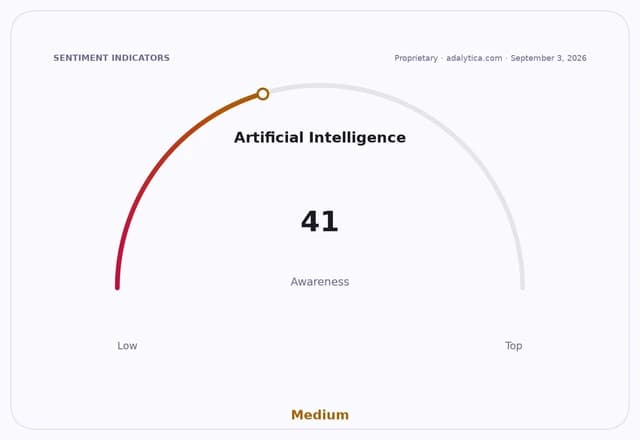
Sentiment IndicatorsⓘProprietary · adalytica.com · September 3, 2026
This is a snapshot — live sentiment, awareness and momentum for 130+ markets update continuously in the dashboard.Open AlphaPulse
The policy significance is larger than one education debate. If universities discourage the use of AI outright, Indonesia risks graduating workers who are unfamiliar with the very tools that global companies increasingly expect them to use. That would slow the country’s effort to deepen its digital talent base, limit productivity gains and make it harder for local firms to compete with peers already integrating AI into operations, content production and decision-making.
Alex argued the goal should not be blanket permission or blanket prohibition, but responsible use. He said students should be taught that AI is a support tool, not a replacement for human judgment, and that users remain accountable for what they publish or submit. He also called for a broader campaign to normalize generative AI use as long as it is accompanied by verification and responsibility.
For investors, the issue reaches beyond education policy and into the economics of AI adoption in Southeast Asia. A country that trains workers to use AI responsibly can accelerate deployment across industries, from services and software to manufacturing and logistics. That supports higher labor productivity and could broaden demand for cloud infrastructure, enterprise software and AI services. The opposite outcome — a skills pipeline that resists AI — would slow monetization for technology vendors and make corporate adoption more uneven.
The backdrop is already shifting in Indonesia, where policymakers have begun formalizing rules around AI in education and public institutions. That suggests a broader move from experimentation toward governance, a necessary step if companies are to scale usage without generating compliance and quality risks. The challenge is execution: curriculum changes, teacher training and clear standards for acceptable AI use will determine whether the country turns AI into a competitive advantage or a source of institutional friction.
For markets, the immediate implication is that AI demand in Indonesia will depend not just on software spending but on how quickly universities adapt. If campuses start producing graduates who can work with generative AI rather than avoid it, the benefit extends to employers, vendors and the wider economy. If not, the adoption curve will remain uneven, and the productivity dividend may take longer to arrive.
| Entity | Gains | Losses |
|---|---|---|
| Universities that adopt AI | ▲More relevant graduates | ▼Less resistance from faculty |
| Employers and tech firms | ▲AI-ready talent pipeline | ▼Training costs stay high |
| Students | ▲Better job-market skills | ▼Less use of AI in class |
| Universities that ban AI | ▲Short-term control over assignments | ▼Widening gap with industry |