Italy’s bond market ended the session without disruption, with the 10-year Btp-Bund spread holding at 81 basis points, a level that suggests investors are still comfortable holding Italian debt despite the wider global sell-off in sovereign bonds.
Italy 10-Year BTP-Bund Spread Holds at 81 bps

The narrow and unchanged spread matters because it is the market’s clearest real-time gauge of Italy’s sovereign risk premium versus Germany. At 81 bps, the gap remains well contained by Italian standards and points to steady demand for BTPs even as borrowing costs across developed markets remain elevated. For Rome, that supports debt-management flexibility. For investors, it reduces the immediate risk of a renewed repricing in one of the euro zone’s most closely watched sovereign markets.
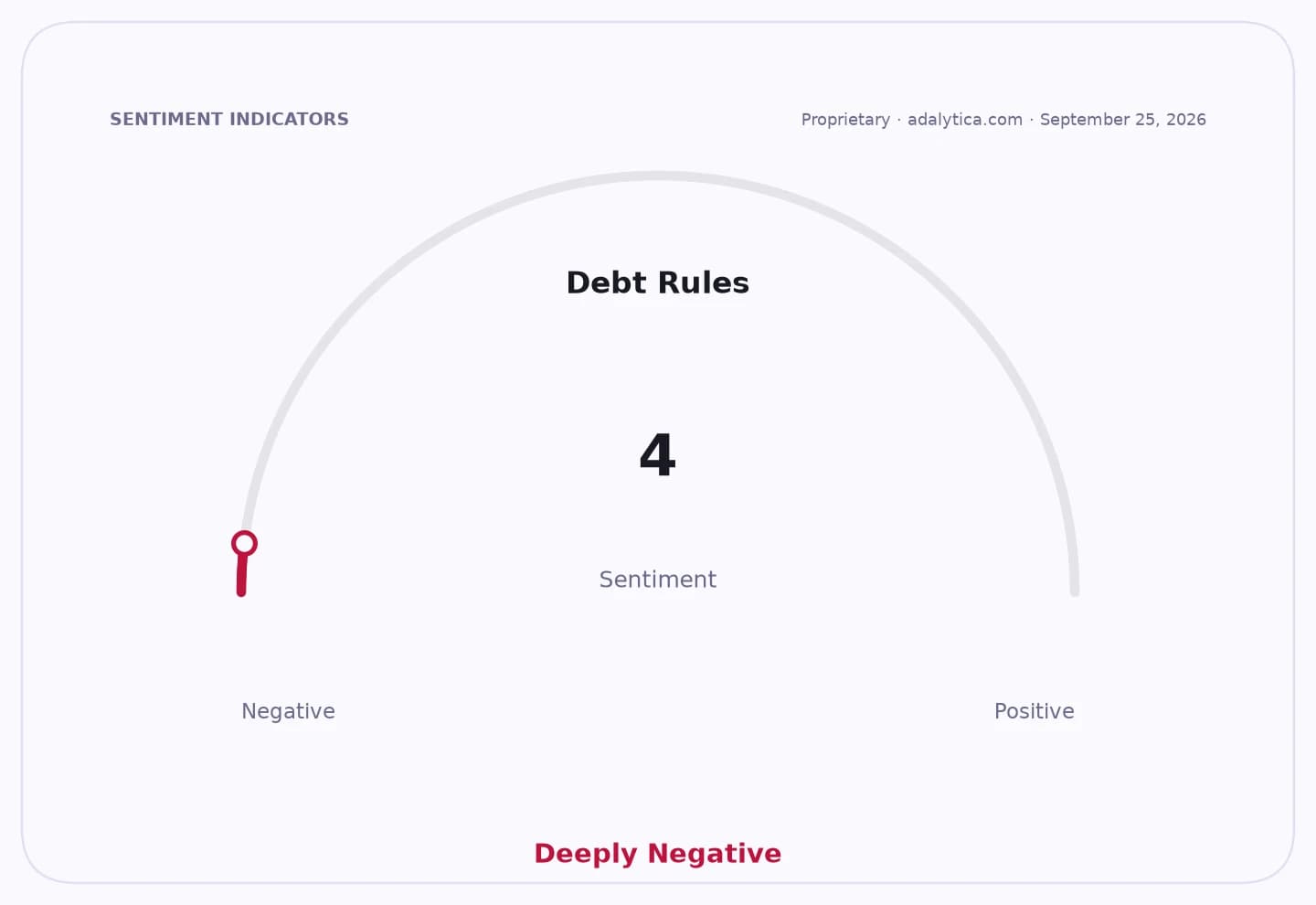
Sentiment IndicatorsⓘProprietary · adalytica.com · September 8, 2026
This is a snapshot — live sentiment, awareness and momentum for 130+ markets update continuously in the dashboard.Open AlphaPulse
The 10-year Italian yield was 4.14%, underscoring that financing costs remain high in absolute terms even if the relative spread is stable. That distinction is important: Italy is not under acute market stress, but it is still funding itself at levels that can weigh on debt-service costs over time. In a country with one of the euro zone’s heaviest debt loads, every move in long-term yields feeds into the budget outlook, the Treasury’s average funding cost and, eventually, the pricing of credit across the economy.
The move also fits a broader European pattern in which sovereign markets have been volatile but orderly. As yields eased, European equities found some support, while bond investors continued to reassess the balance between inflation risk, central-bank policy and growth. Italy’s stability stands out because it suggests domestic political and fiscal concerns are not, for now, translating into a fresh risk premium.
That relative calm is also reflected in fund flows and market positioning. Shares in EWI, the MSCI Italy ETF, and EUFN, the Europe financials ETF, both traded firmer in recent sessions, consistent with a market that is not pricing immediate stress in Italian sovereigns or the banking system. U.S. Treasuries also stabilized, with the 10-year note easing back only marginally after recent swings, reinforcing the view that this is a rates-driven market rather than an Italy-specific event.
For investors, the key question is whether the spread can remain anchored if global yields rise again. A wider gap would quickly raise scrutiny of Italy’s fiscal path and pressure domestic banks, which hold large amounts of government debt and use BTPs as a benchmark for funding conditions. For now, the message from the market is simpler: Italy is being funded at a cost, but not yet at a crisis premium.
| Entity | Gains | Losses |
|---|---|---|
| Italian Treasury | ▲stable market access | ▼lower room for fiscal slippage |
| BTP holders | ▲steady spread, carry income | ▼yield volatility risk |
| Italian banks | ▲calmer sovereign backdrop | ▼funding costs stay elevated |
| German Bunds | ▲safe-haven demand | ▼narrower relative appeal |