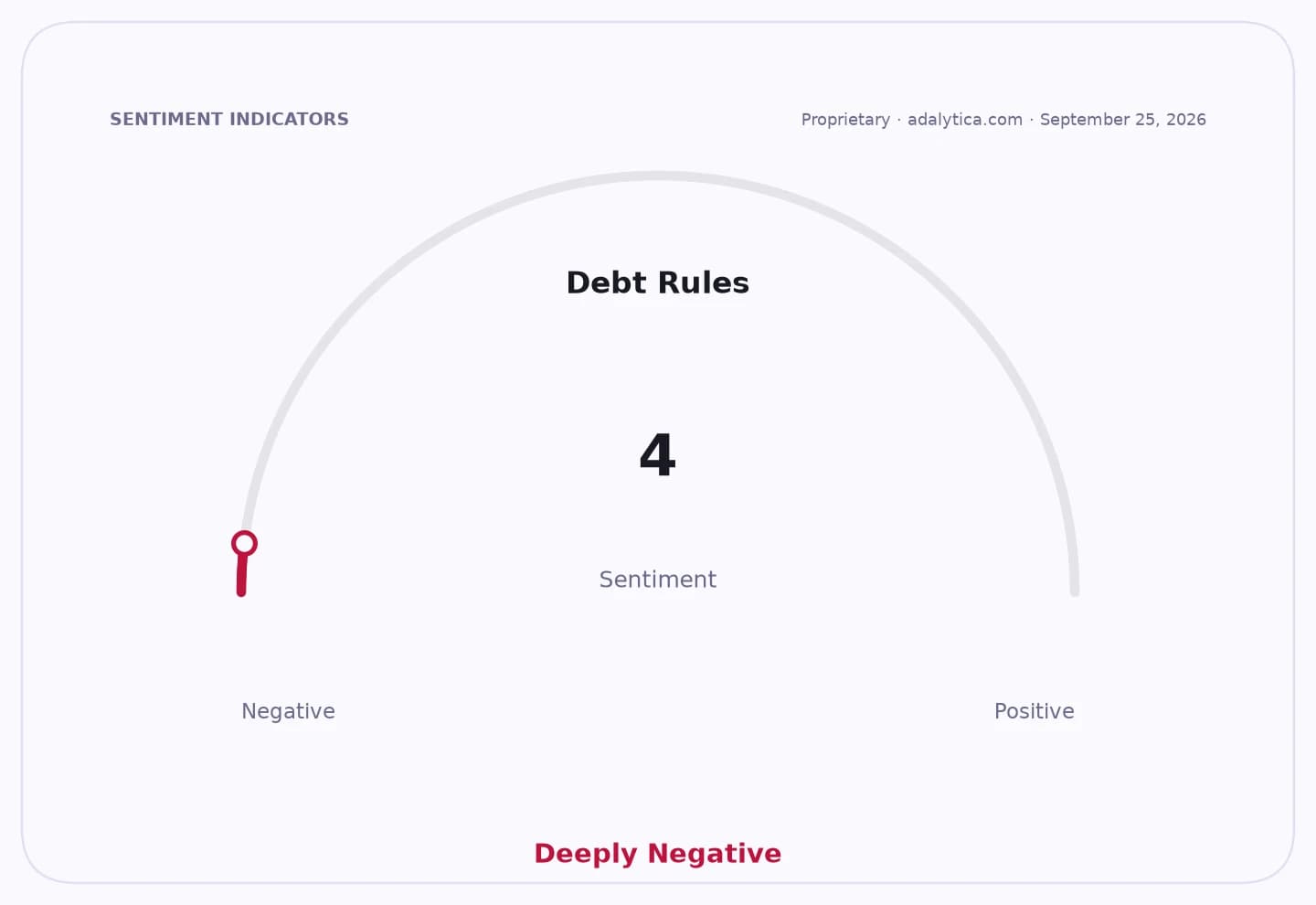
Italy’s public debt is heading toward 139% of GDP, with Economy Minister Giancarlo Giorgetti warning that the cost of servicing it is rising at a “horrific” pace as the wars in Ukraine and the Middle East keep fuel and financing pressures elevated.
Italy Debt Nears 139% of GDP as Yields Rise
That matters because Italy already carries the heaviest debt load in the euro zone, overtaking Greece on the latest budget path, and a further increase in borrowing costs leaves Rome with less room to support growth, absorb shocks or delay fiscal tightening. Giorgetti said inflation would likely climb if the conflicts persist, even as higher interest rates from the European Central Bank raise financing costs for households, companies and the state itself.
Sentiment IndicatorsⓘProprietary · adalytica.com · September 21, 2026
This is a snapshot — live sentiment, awareness and momentum for 130+ markets update continuously in the dashboard.Open AlphaPulse
The warning lands as Italian bond yields have moved higher in recent auctions, with the three-year yield climbing to 3.43%, the highest since June 2024, and the seven-year yield reaching 3.98%, the strongest since November 2023. Those levels suggest investors are demanding more compensation to hold Italian debt just as the government prepares to update its budget plans from 2027.
For investors, the setup is a familiar risk trade-off: Italy’s sovereign debt remains supported by the euro zone framework, but every increase in rates makes debt dynamics more fragile and raises the chance of tighter spending, slower growth or renewed market stress if inflation proves stickier than expected. Persistent geopolitical shocks would also keep pressure on European yields broadly, complicating the ECB’s effort to tame prices without worsening funding strains.
The next focus is Rome’s updated fiscal path and whether bond markets keep pushing Italy’s financing costs higher before the 2027 budget cycle. If inflation and energy prices re-accelerate, the government may face a harder choice between defending growth and preserving market confidence.
| Entity | Gains | Losses |
|---|---|---|
| Italian bondholders | ▲Higher yield pickup | ▼Greater fiscal risk |
| Italian government | ▲Possible longer-term budget reset | ▼Higher debt-service costs |
| ECB rate hawks | ▲Stronger anti-inflation case | ▼More stress on sovereign debt |
| Households and companies | ▲None | ▼Higher borrowing costs |