JPMorgan Chase has committed $5 billion in equity to companies tied to U.S. national security, turning a policy theme into a direct capital allocation strategy as banks compete to finance the reshoring, energy buildout and supply-chain hardening Washington wants to accelerate.
JPMorgan commits $5 billion to national security firms

The move matters because it shows the largest U.S. bank is not just lending against that transition but taking ownership stakes in the businesses most likely to benefit from it. That deepens JPMorgan’s exposure to sectors that could see sustained public and private spending over the next decade, from advanced manufacturing and defense technology to distributed energy storage and automated production.
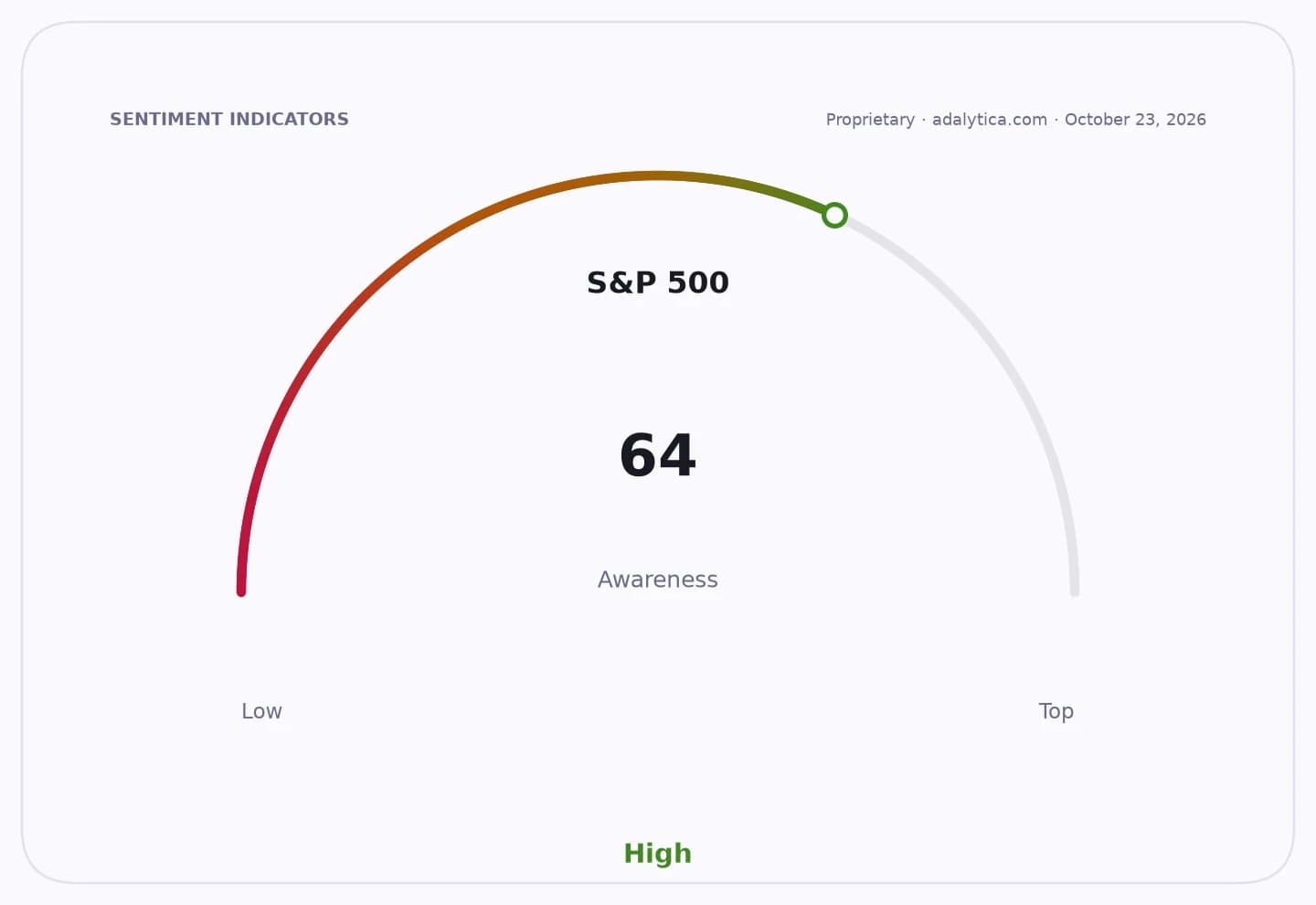
Sentiment IndicatorsⓘProprietary · adalytica.com · October 24, 2026
This is a snapshot — live sentiment, awareness and momentum for 130+ markets update continuously in the dashboard.Open AlphaPulse

The bank said the equity investments are part of its Security and Resiliency Initiative, launched a year ago, under which it has already extended about $230 billion in financing. JPMorgan had previously pledged to support $1.5 trillion of U.S. investment over 10 years, underscoring how the initiative has become a strategic pillar rather than a branding exercise.
The capital has gone into early-stage startups as well as growth and mature companies in areas JPMorgan says are critical to the country’s economic and national security. That includes next-generation defense systems, battery storage, supply-chain technologies and advanced manufacturing, all sectors that are likely to remain in favor if the U.S. continues to prioritize domestic industrial capacity and reduced reliance on foreign suppliers.
The timing is important. Demand for AI data centers, critical minerals and grid upgrades is already pushing investment into industrial and energy infrastructure, while the Trump administration has made domestic production and supply-chain resilience a policy priority. For lenders, the message is clear: the next phase of industrial policy is likely to be capital-intensive, and banks with balance-sheet flexibility can earn returns by underwriting it early.
JPMorgan is not alone. Bank of America has said it plans to invest $250 billion by July 2027 in U.S. digital and infrastructure projects, while Morgan Stanley has outlined plans to support roughly $1.5 trillion of investment over the next decade in technology and infrastructure. Together, the announcements point to a Wall Street race to capture fee income, lending growth and potential equity upside from sectors that are becoming strategically favored.
For investors, the implication is twofold. Bullishly, JPMorgan gains optionality on industries with long-duration demand drivers and closer alignment with federal priorities. Bearishly, equity stakes and mission-driven capital can be harder to value, may carry longer payback periods and could expose the bank to policy shifts if Washington’s industrial priorities change.
JPMorgan’s stock has already been trading near record highs, and the bank’s latest disclosure reinforces the view that its scale allows it to blend commercial banking, capital markets and strategic investing more aggressively than peers. The key question now is whether this becomes a durable profit engine and a broader model for U.S. banks, or whether it ends up tying capital to politically favored sectors whose returns take years to prove out.
| Entity | Gains | Losses |
|---|---|---|
| JPMorgan Chase | ▲Strategic equity upside | ▼Capital lockup risk |
| U.S. industrial suppliers | ▲New financing access | ▼Higher competition for funds |
| Defense and energy-tech firms | ▲Long-term capital | ▼Greater policy dependence |
| Smaller banks | ▲Less scale advantage | ▼Missed deal flow |