South Korean stocks opened lower on Wednesday, with the KOSPI slipping about 1% as investors locked in gains after a strong recent rally and the KOSDAQ, which had briefly pushed through 900, also struggling to hold its advance.
KOSPI Falls 1% as Korea Rally Pauses
The move matters because Korea’s market has become one of the clearest barometers of risk appetite in Asia, and a pullback after a sharp run-up often tells you more about positioning than fundamentals. The KOSPI’s latest drop comes even as the index still sits well above its 50-day and 200-day moving averages, suggesting the broader uptrend remains intact but stretched. The KOSDAQ, meanwhile, is still trading below its 200-day average even after crossing the 900 threshold, a reminder that the domestic growth trade has momentum but not yet full validation.
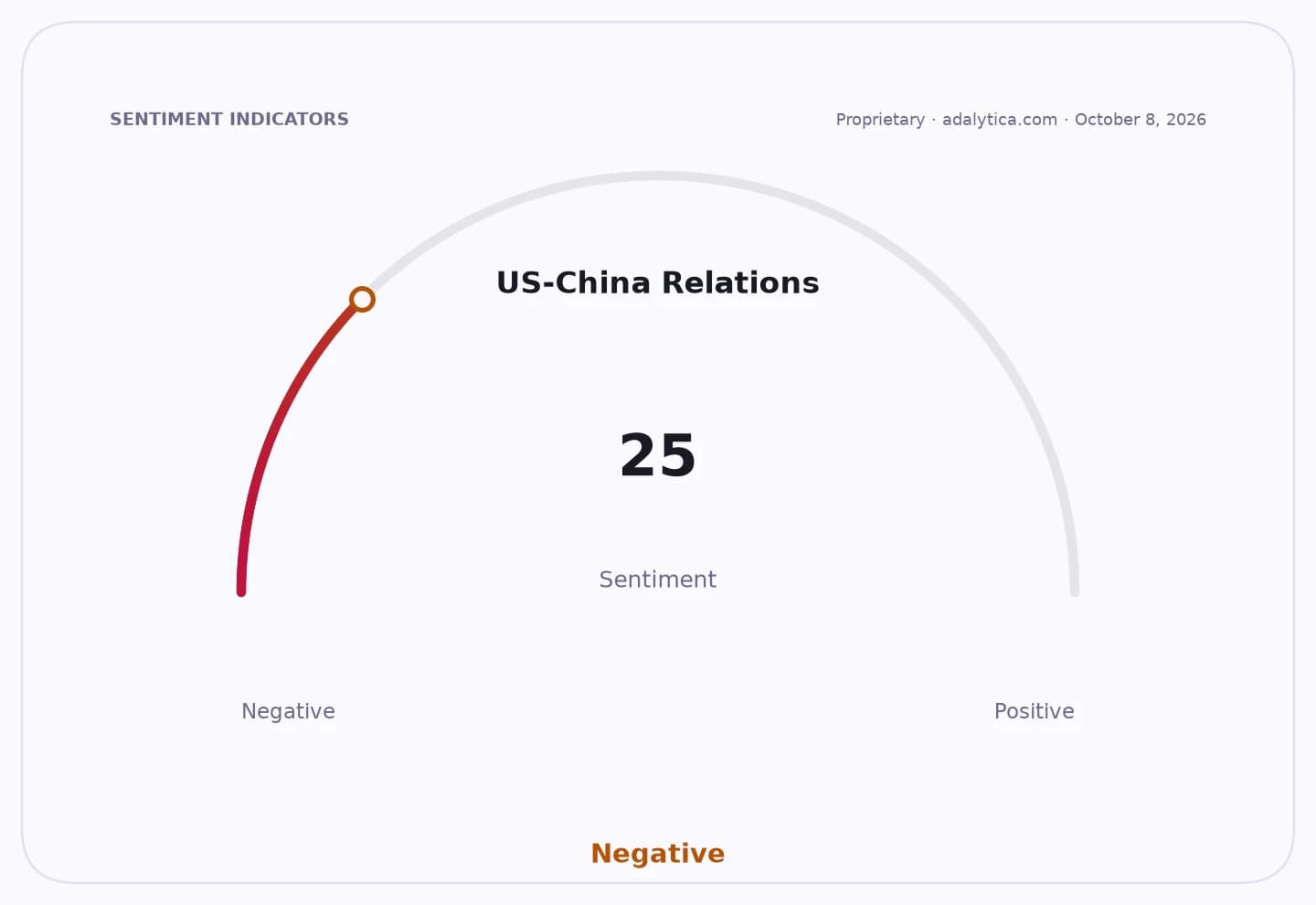
Sentiment IndicatorsⓘProprietary · adalytica.com · October 8, 2026
This is a snapshot — live sentiment, awareness and momentum for 130+ markets update continuously in the dashboard.Open AlphaPulse
Investors are watching whether the pause is a healthy consolidation or the start of a deeper unwind. Technical readings underscore that tension: the KOSPI’s relative strength index is back near neutral, while the KOSDAQ’s previously elevated RSI has cooled from overbought territory. That points to a market that may need time to digest its gains rather than one entering a major downtrend.
The backdrop is still supportive. U.S. Treasury yields are hovering around 4.8% on the 2-year and 5.3% on the 10-year, a level that keeps global discount rates high and makes equity valuations more vulnerable to any disappointment in earnings or policy. At the same time, market signals on U.S. equities show extreme greed in the S&P 500, while awareness remains low, a combination that often leaves Asia open to abrupt cross-asset rotations if Wall Street wobbles.
For investors, the lesson is that Korea remains a tradeable market but not a complacent one. The strongest names are still likely to be the ones tied to secular themes such as memory chips, AI infrastructure, and exporters that benefit from a firm dollar and global capex cycles. More domestically sensitive shares, especially in the KOSDAQ, may be more exposed if this becomes a broader de-risking phase.
The next catalyst will be whether foreign buyers use the dip to add exposure or whether recent momentum names see further profit-taking. If the KOSPI holds above key support and the KOSDAQ stabilizes above 900, this may prove to be nothing more than a reset. If not, Korea’s rally could be entering a more selective, stock-picking phase — and that is where the biggest opportunities usually emerge first.
| Entity | Gains | Losses |
|---|---|---|
| Exporters | ▲weaker-won tailwind | ▼import costs |
| AI / chip names | ▲structural capex demand | ▼valuation compression |
| KOSPI bulls | ▲buy-the-dip setup | ▼near-term momentum fade |
| KOSDAQ momentum traders | ▲breakout opportunity | ▼overbought pullback |