North Korea’s decision to publicly back Beijing’s “One China” policy while blaming the United States for instability is another reminder that Northeast Asia’s geopolitical fault lines are widening just as investors are trying to price a new era of strategic rivalry.
FXI, EWY and EWJ After North Korea Backing China
That matters because this is not just rhetoric from Pyongyang. It reinforces the bloc-like alignment taking shape around China, Russia and North Korea at a time when Washington is pressing allies in Asia to spend more, invest more and take clearer sides on security, trade and technology. For markets, those tensions can ripple through supply chains, defense spending, energy routes and the valuation of Asian equities.
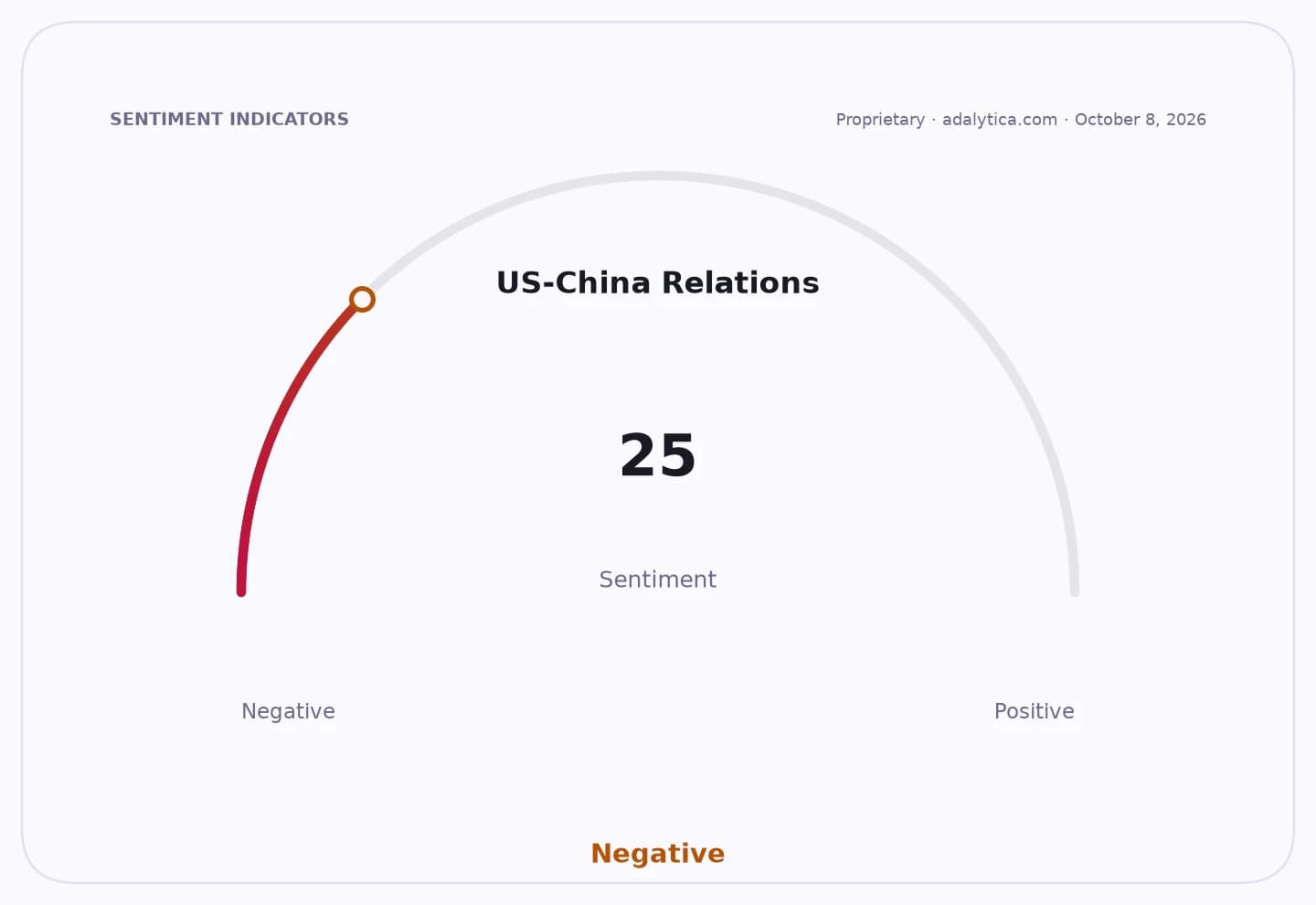
Sentiment IndicatorsⓘProprietary · adalytica.com · October 8, 2026
This is a snapshot — live sentiment, awareness and momentum for 130+ markets update continuously in the dashboard.Open AlphaPulse
The immediate investment angle is straightforward: geopolitical risk is no longer a background issue for Korea, China and Japan-focused funds. The iShares China Large-Cap ETF, FXI, has slid to $33.42, below its 50-day moving average of $35.04 and its 200-day average of $36.01, a sign the market is still treating Chinese equities cautiously. FXI’s RSI reading of 41.3 suggests the fund is not deeply oversold, but neither is it showing signs of strong momentum.
South Korea has been the clearest beneficiary of the region’s broader rally and repricing of strategic assets. The iShares MSCI South Korea ETF, EWY, closed at $183.69, holding above its 50-day average of $178.37 and far above its 200-day average of $157.71. That is a sign investors still see Korea as an important industrial and technology market, even with border tensions, alliance friction and shifting energy politics in the background.
Japan has held up as well, with the iShares MSCI Japan ETF, EWJ, finishing at $98.32, also above its 50-day and 200-day moving averages. That tells you global investors continue to favor Japan as a steadier way to own Asian growth and manufacturing exposure without taking the same level of direct geopolitical heat that hangs over the Korean Peninsula and mainland China.
The broader narrative is that Asian markets are increasingly being pulled by politics as much as by profits. North Korea’s messaging lines up with its deeper partnership with Russia and its reliance on China, while the U.S. keeps leaning on allies to support a more hardened regional security architecture. That creates winners and losers: defense contractors, energy infrastructure plays and some domestic manufacturers can benefit, while sectors tied to open trade and cross-border capital flows face more uncertainty.
Adalytica’s US–China Relations Sentiment gauge reflects that strain, sitting at 25 with a “Fear” reading and “Extreme Fear” awareness. Its Global Stability sentiment is still marked “Extreme Greed,” but the underlying awareness score is only 7, which suggests investors are paying more attention to geopolitical fragility even if markets have not fully repriced it yet.
For long-term investors, the message is not to trade every headline, but to respect how durable these tensions have become. North Korea’s stance is part of a bigger pattern: a more fragmented Asia, more defense spending, more industrial policy, and a market where country selection matters as much as sector selection. For diversified investors, funds like EWY, EWJ and FXI remain worth watching closely, especially if tensions keep feeding volatility rather than fading into the background.
| Entity | Gains | Losses |
|---|---|---|
| China, North Korea, Russia bloc | ▲stronger alignment | ▼diplomatic isolation |
| South Korea equities (EWY) | ▲strategic relevance | ▼border and alliance risk |
| Japan equities (EWJ) | ▲safe-haven regional exposure | ▼spillover from regional tension |
| China equities (FXI) | ▲policy support hopes | ▼geopolitical discount |