Sélestat’s L’Épicerie épicurienne has moved to rue des Clés and doubled its selling space, a small local expansion that reflects a wider retail test: whether independent food shops can win trade by turning grocery purchasing into an experience rather than a pure price comparison.
L’Épicerie épicurienne moves to larger Sélestat site
For owner Sandra Fricadel, the move from rue de la Poste into the former Pharmacie du Soleil was about visibility as much as square footage. The new site gives the shop room to broaden its fine-food range, add a café-style setting and seat 30 diners at lunch, a format that can generate higher-margin foodservice income on top of retail sales. In a market where consumers remain cautious and grocery affordability is still under pressure, that mix is a way to defend traffic without relying solely on product turnover.
Sentiment IndicatorsⓘProprietary · adalytica.com · September 4, 2026
This is a snapshot — live sentiment, awareness and momentum for 130+ markets update continuously in the dashboard.Open AlphaPulse
The offer is intentionally wider than a traditional épicerie fine. At lunchtime the shop serves homemade focaccias, arancini and sharing boards built around cheeses and charcuterie from Corsica, Italy and Spain. From October it will add Savoyard fondue and raclette at midday, leaning into comfort-food demand as temperatures fall. The store also sells about 80 wines and 30 spirits, and can be privatized in the evening for groups of at least 10 people, extending revenue beyond the lunchtime crowd.
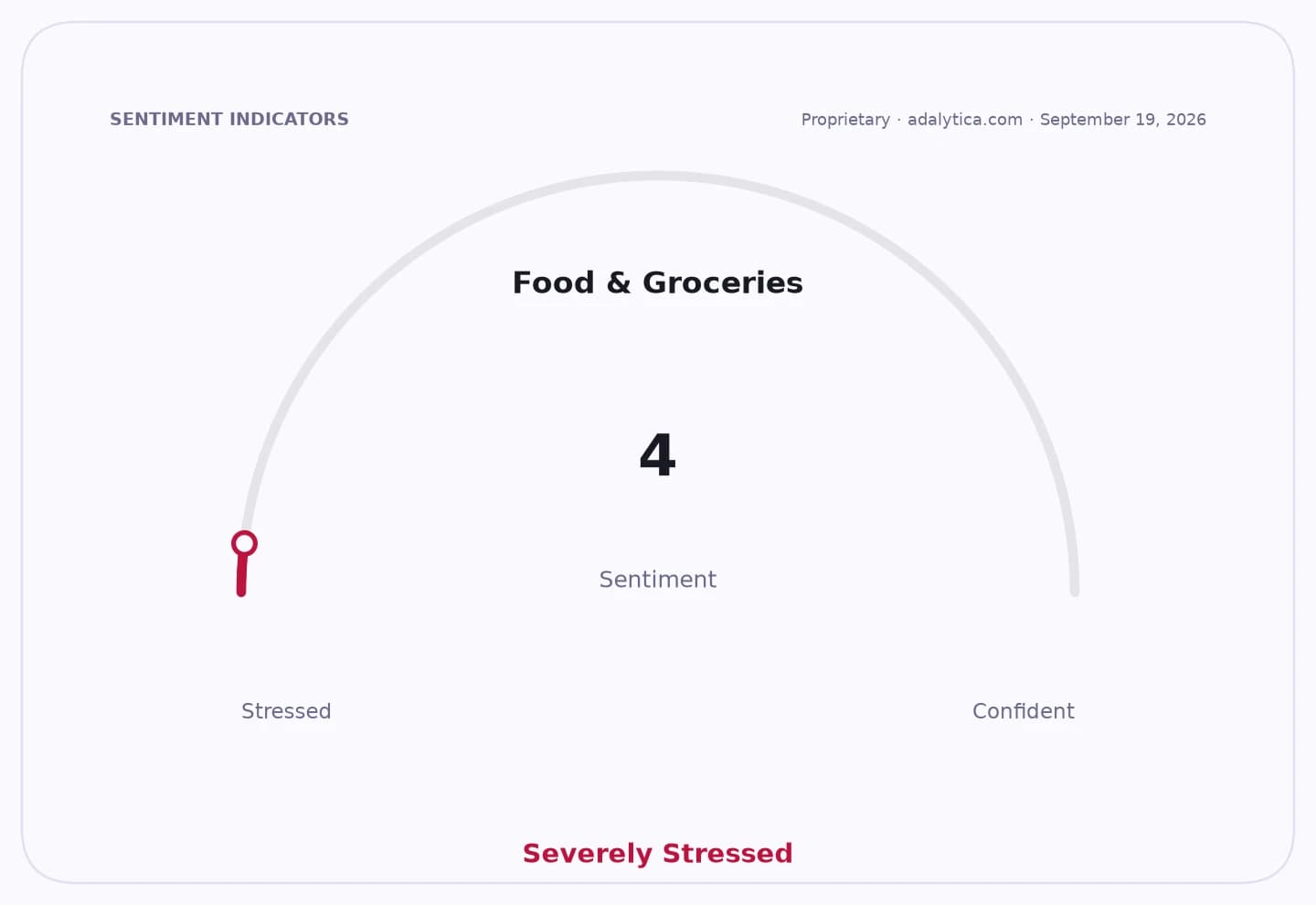
That matters because food retail is being squeezed from both sides. Consumers are still trading down, watching promotions and skipping indulgent purchases, while retailers are trying to preserve margins in a low-growth environment. Adalytica’s Consumer Spending Sentiment gauge is in “Extreme Fear,” underscoring how fragile discretionary demand remains. At the same time, Food and Grocery Spending Sentiment is only neutral, suggesting households are still buying essentials but are selective about where and how they spend.
The strategic logic behind L’Épicerie épicurienne’s relocation is therefore clear. Bigger premises can support more assortment, better accessibility and a more social format, including wider aisles for people with reduced mobility and pushchairs. That should help widen the customer base beyond a quick grocery run and make the shop relevant for lunch, private events and corporate buffets of up to 200 people. For a small independent operator, those uses are not just incremental; they are a hedge against thin retail margins.
Investors do not have direct exposure to this local shop, but the story is relevant to the broader grocery and specialty food trade. It points to a consumer market where value and experience are diverging: discount-led chains can win on price, while independents try to justify higher tickets through service, curation and hospitality. That dynamic is visible across grocery markets in Europe and the US, where shoppers remain cost-conscious but still spend on small luxuries when the setting feels worth it.
The risk is execution. A larger site raises fixed costs, and a hospitality-led model depends on consistent footfall, strong lunchtime demand and event bookings. But if the new address succeeds, it shows how independent grocers can carve out a defensible niche even when consumers are under pressure and the grocery category as a whole remains highly price-sensitive.
| Entity | Gains | Losses |
|---|---|---|
| L’Épicerie épicurienne | ▲More space and visibility | ▼Higher fixed costs |
| Customers seeking lunch and events | ▲Broader offer and seating | ▼Higher prices than mass retail |
| Discount grocers | ▲Price-conscious traffic | ▼Premium spend |
| Independent food retailers | ▲Experience-led differentiation | ▼Pure volume-led model |