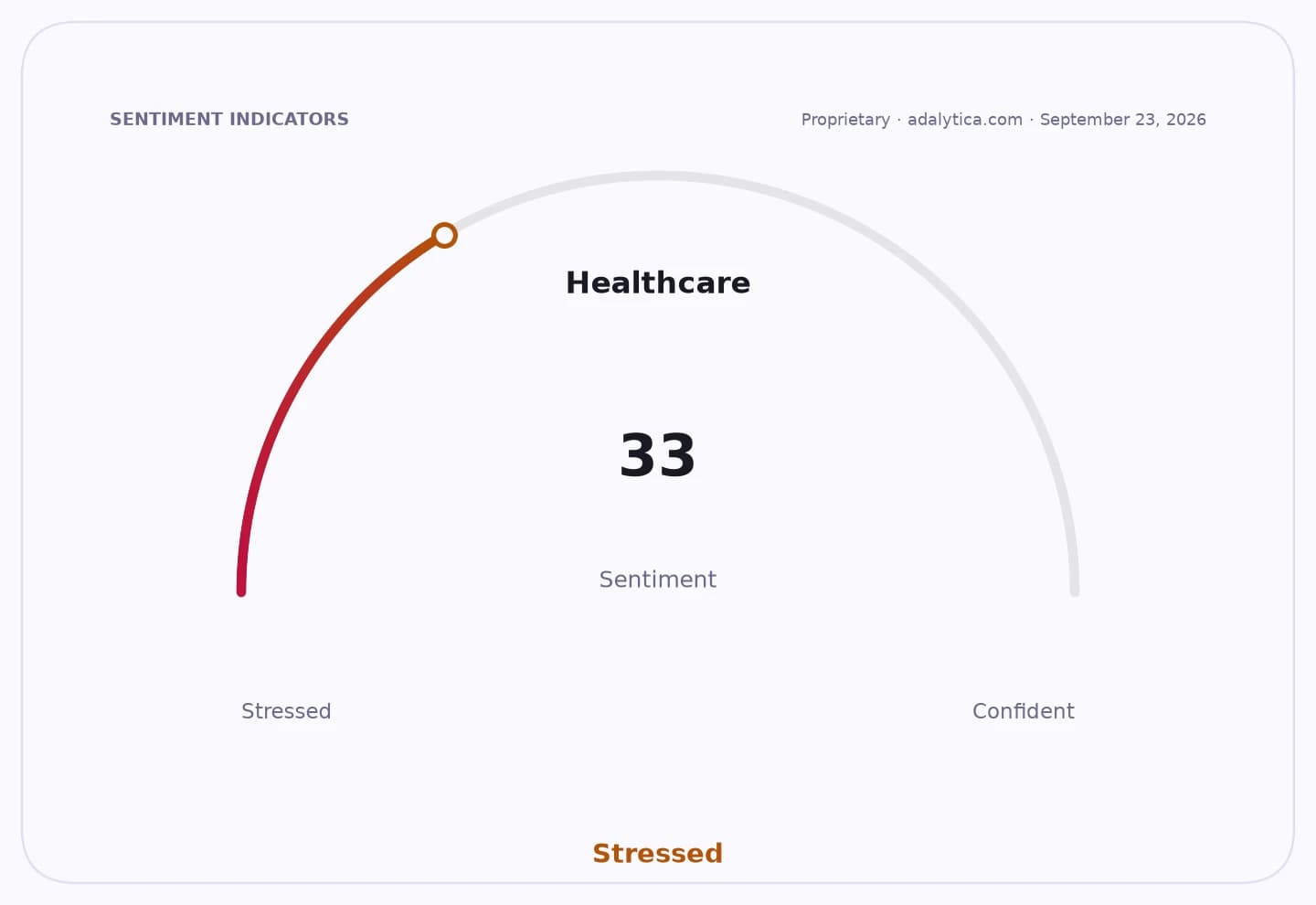
Libya’s health system is being choked less by the size of its budget than by the way money is delayed, spent and converted into medicines, equipment and staff pay, according to Tripoli University Hospital chief Nabil Al-Ajili.
Libya health system budget delays raise hospital shortages
That distinction matters because it goes straight to the heart of why bigger health allocations have not translated into better care. For investors, policymakers and suppliers, the message is simple: in Libya, funding risk is not just a public-sector accounting issue, it is an operating risk that keeps hospitals understocked, staff underpaid and patients pushed into the private sector.
Sentiment IndicatorsⓘProprietary · adalytica.com · September 22, 2026
This is a snapshot — live sentiment, awareness and momentum for 130+ markets update continuously in the dashboard.Open AlphaPulse
Al-Ajili’s comments, aired on Libya Alhadath, point to a health system where most of the money is absorbed by salaries, while hospitals lack the operating cash needed for drugs, food, cleaning and medical supplies. He said even basic items such as needles are not made locally, forcing the country to import almost everything in dollars. That leaves hospitals exposed to foreign exchange swings, which erode the real value of dinar-denominated budgets the moment prices move.
He also said budget approvals often arrive on paper months before cash actually shows up. In his telling, a hospital budget may be approved in March or April, while disbursements do not begin until June or July. In a sector where “the patient does not wait,” that lag turns routine financing into a crisis of continuity. The result is a familiar but economically damaging pattern: care is interrupted, procurement is improvised and managers are forced to patch one hole by creating another.
The numbers he cited show why the problem is structural rather than anecdotal. A hospital operating budget that was set at 30 million dinars delivered only 14 million dinars in practice, he said. For a system that needs uninterrupted spending on medications, sanitation, nutrition and waste removal, those shortfalls quickly become service cuts. When a hospital cannot reliably fund operating needs, the private sector picks up the bill — and the patient pays more.
The pressure is especially acute in high-cost specialties such as oncology. Al-Ajili said cancer drugs alone may require $500 million to $600 million, while a 900 million dinar allocation for medical supply likely covers only a fraction of the dollar value needed after exchange-rate conversion. That is the real economic pinch: nominal spending can rise, but imported medical inflation and currency weakness can still leave hospitals short of essentials.
His remarks also highlight a second-order problem investors should not ignore: health systems are labor-intensive, and Libya is struggling to keep its clinicians. Al-Ajili described a workforce crisis driven by low pay, delayed incentives and uneven allowances. That is the kind of failure that erodes capacity over time. Once doctors, technicians and nurses migrate to private hospitals or leave the country, a budget increase cannot quickly rebuild the lost expertise.
There is an important long-term lesson here for anyone looking at health-care exposure in emerging markets. Money alone does not fix a hospital network if procurement is weak, payroll is slow and financing is not predictable. Al-Ajili argued that Libya needs a broader model that includes social participation, insurance funding and a clearer relationship between public and private providers. He pointed to an earlier heart-care arrangement that produced strong results only when equipment, incentives and supply contracts were all in place — and then stopped once payments lagged.
That is why this story matters beyond Libya. The same mix of delayed budgets, imported inputs and workforce leakage can undermine health spending in any country that relies heavily on the state to finance care. For investors, it is a reminder that the winners are not necessarily the systems with the largest line items, but the ones that can convert spending into reliable service delivery.
For now, Libya’s health challenge looks less like a shortage of money than a shortage of execution. Until funding is timely, salaries are stable and supply chains are dependable, bigger budgets will keep producing disappointing results. That makes reform worth watching closely, but it also argues for patience: in health care, the compounding effect of better governance can be powerful, but only if the basics are fixed first.
| Entity | Gains | Losses |
|---|---|---|
| Patients | ▲More reliable care if reforms work | ▼Delays, shortages, higher private costs |
| Public hospitals | ▲Stable funding and supplies | ▼Budget gaps and service interruptions |
| Private clinics | ▲More spillover demand | ▼Less traffic if public care improves |
| Government budget planners | ▲Better efficiency and credibility | ▼Pressure to fix payroll and procurement |