Luxembourg’s labor market is no longer being held back by weak demand so much as by a lack of people with the right skills, and that is becoming an economic bottleneck for the state itself.
Luxembourg labor shortages boost automation demand
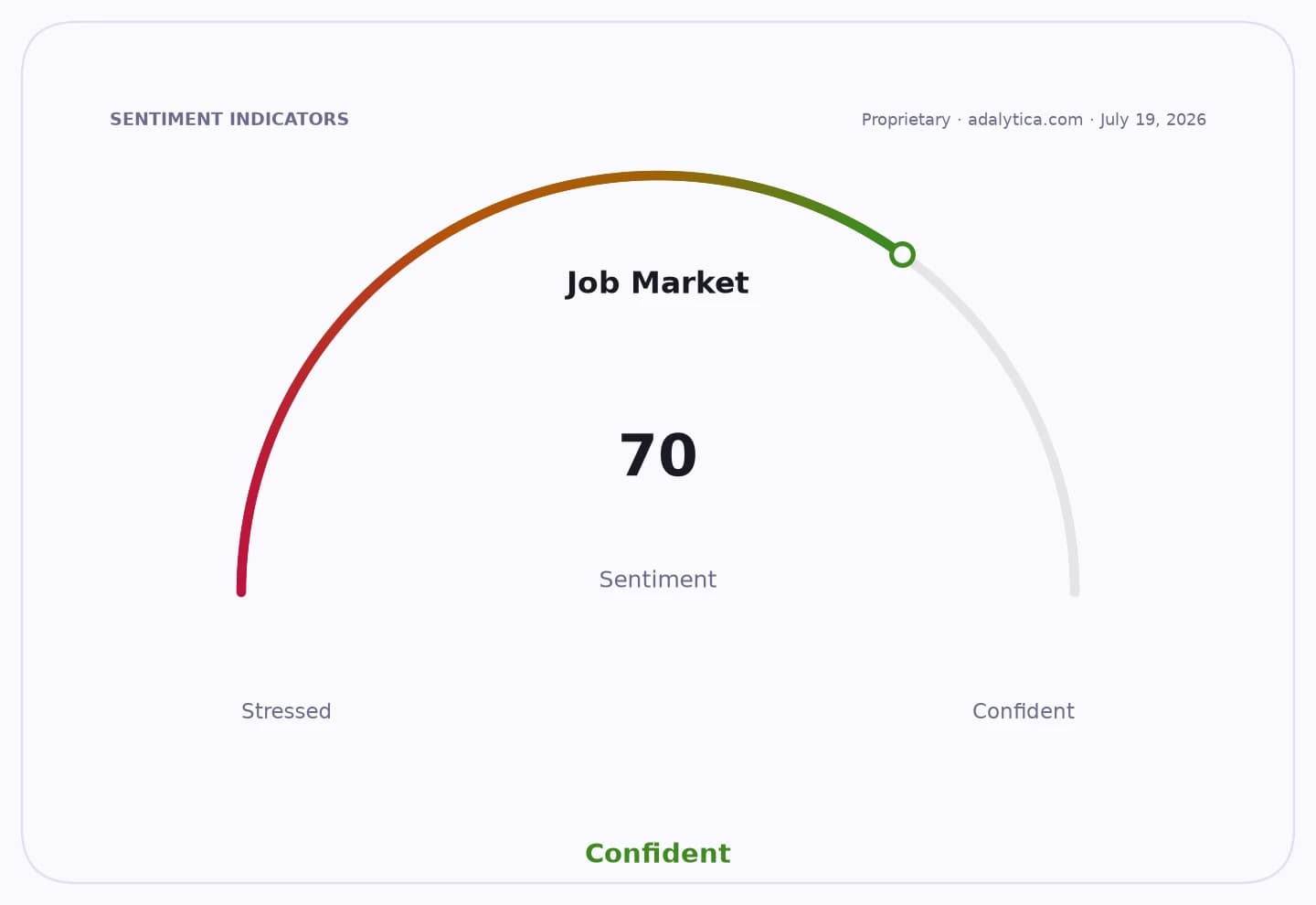
The most important signal in the seed headline is not just that employers are struggling to hire. It is that even public institutions are being forced into the same battle for qualified and experienced profiles that private companies have been fighting for years. In a small, high-wage economy built on finance, logistics, public administration and cross-border services, a shortage of experienced workers quickly turns into a constraint on output, service delivery and wage inflation.
Sentiment IndicatorsⓘProprietary · adalytica.com · July 19, 2026
This is a snapshot — live sentiment, awareness and momentum for 130+ markets update continuously in the dashboard.Open AlphaPulse
That matters because Luxembourg’s model depends on efficient labor allocation. When the state cannot recruit, public projects slow, administration becomes more expensive and private employers face longer vacancies, higher pay demands and more pressure to import talent. The economic effect is a classic supply-side squeeze: growth does not collapse, but it becomes harder to expand without running into labor scarcity. For investors, that means the real story is not cyclical employment weakness, but structural labor tightness that can support wages while limiting margins for domestically exposed businesses.
The broader backdrop reinforces that view. Job-market sentiment in the data has stayed volatile, while consumer-confidence and payroll indicators point to a fragile labor environment rather than one with abundant slack. In a market where the conventional technicals on LUXE show a stock attempting to stabilize above its 50-day and 200-day moving averages after sharp swings, investors appear to be pricing in some resilience — but not yet the full cost of a persistently tight labor pool.
The implications extend beyond Luxembourg’s borders. The country relies heavily on cross-border workers and imported expertise, which means any mismatch between training, mobility and qualification standards becomes an immediate competitiveness issue. The news context around aging workforces, tighter rules on overtime in logistics and efforts to recruit foreign drivers points to the same macro theme: developed economies are entering a prolonged phase where labor scarcity, not labor excess, shapes policy and profit pools.
That creates a clear investment map. Companies that reduce dependence on scarce labor — through automation, AI-enabled workflow tools, logistics software, and workforce-training platforms — gain leverage. Employers tied to manual staffing, public-service delivery or cross-border recruitment face rising costs and execution risk. The market underestimates how quickly a labor shortage in a small economy can ripple into capex priorities, public spending and sector valuation.
I believe this is the kind of slow-burn constraint investors should treat as an inflection point, not a headline nuisance. If Luxembourg cannot easily find qualified and experienced workers, the winners will be the firms that help it do more with fewer people. That is where the asymmetric opportunity sits: pick-and-shovel beneficiaries of labor automation, not the labor-constrained incumbents.
| Entity | Gains | Losses |
|---|---|---|
| Automation and AI software vendors | ▲Higher demand for productivity tools | ▼ |
| Foreign recruiters and staffing firms | ▲More hiring flows | ▼ |
| Labor-intensive local employers | ▲ | ▼Rising wage and vacancy pressure |
| Luxembourg state institutions | ▲ | ▼Slower hiring and higher operating costs |