Corn is rapidly gaining a third major buyer in Mato Grosso do Sul as the state’s ethanol industry expands from zero operating plants four harvests ago to three at full capacity, with a fourth under construction.
Mato Grosso do Sul corn ethanol capacity expands
That matters because the new plants are changing how one of Brazil’s biggest second-crop corn states moves grain, sets prices and captures value. Instead of relying mainly on exports and feed mills, producers now have a local industrial customer that can absorb more of the crop, reduce haulage costs and turn a larger share of output into higher-value fuel and coproducts.
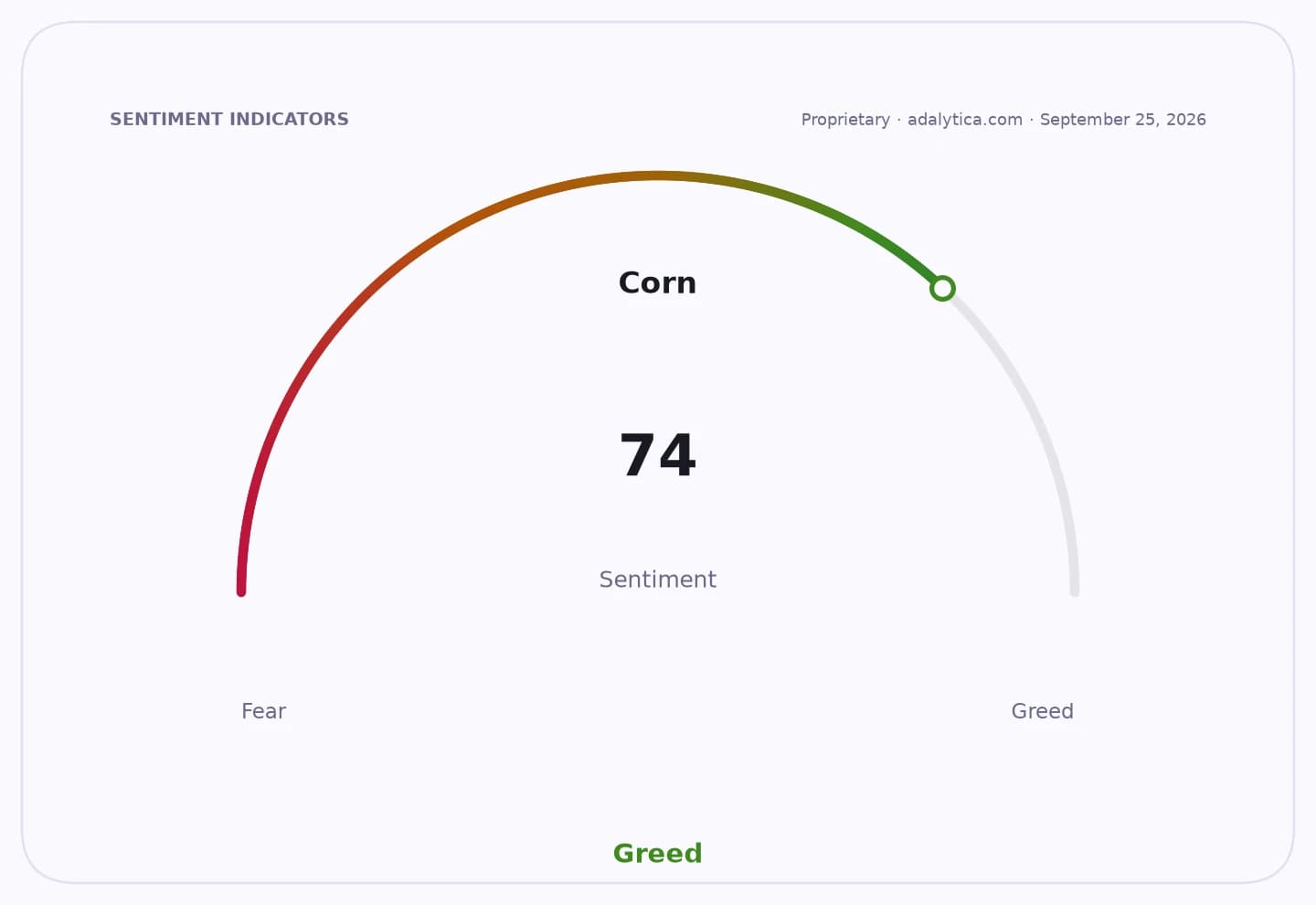
Sentiment IndicatorsⓘProprietary · adalytica.com · September 25, 2026
This is a snapshot — live sentiment, awareness and momentum for 130+ markets update continuously in the dashboard.Open AlphaPulse
The shift is sizable. Mato Grosso do Sul harvested more than 2 million hectares of corn in the 2024/25 crop and produced 13.9 million tonnes, of which about 2 million tonnes were exported. The state’s three operating plants — Inpasa in Dourados and Sidrolândia, plus Neomille CerradinhoBio in Maracaju — produced 1.6 billion litres of ethanol in 2024/25, according to BioSul, with output seen rising to roughly 2.1 billion litres in 2025/26. A fourth facility, Atvos Santa Luzia in Nova Alvorada do Sul, is being built as a hybrid cane-and-corn plant and is expected to add about 273 million litres of corn ethanol capacity.
For farmers, the attraction is straightforward: a local buyer with scale. The Aprosoja/MS study cited in the report says the plants create a third sales channel for corn, alongside exports and feed. That can matter even more in a state where about 80% of agricultural production moves by road and freight can reach as much as 60% of corn’s value on some export routes. Proximity to processing also helps insulate growers from long-distance logistics and, by extension, from the volatility of transport costs.
The industrial buildout is also pulling more of the corn chain inside the state. Dry-mill ethanol plants produce not just fuel but DDG or DDGS, corn oil and industrial CO₂, with DDG already emerging as a meaningful export item. Mato Grosso do Sul shipped 1.15 million tonnes of DDG in 2025 to markets including New Zealand, Turkey and Vietnam, with first sales to China as part of a joint operation with Mato Grosso. That creates a second revenue stream for processors and a new feed ingredient supply for livestock producers, while also broadening the state’s export mix beyond raw grain.
The macro backdrop is supportive. The state now accounts for about 20.9% of Brazil’s corn-ethanol output and is the country’s second-largest producer after Mato Grosso. The industry’s investment tally in the state has topped R$4.5 billion since the first plant opened in 2022, underscoring how quickly corn is becoming a more industrial crop rather than just an exported commodity.
Investors should also watch the competitive tension this creates. More ethanol capacity means more demand for local corn, which is constructive for growers and processors but could squeeze feed manufacturers if supply does not keep pace. That raises the stakes for yields, storage and transport infrastructure, as well as for companies tied to animal protein margins that depend on affordable corn.
The longer-term narrative is a regional industrial pivot: Mato Grosso do Sul is evolving from a grain supplier into a processing hub, with corn at the center of the transition. If the current expansion continues, the state could tighten local basis, strengthen ethanol margins through shorter supply chains and deepen demand for a broader set of agribusiness assets — from logistics and storage to livestock feed and biofuels.
| Entity | Gains | Losses |
|---|---|---|
| Corn growers in MS | ▲More local buyers | ▼Less reliance on exports |
| Ethanol plants | ▲Cheaper nearby feedstock | ▼Higher competition for corn |
| Feed mills and protein producers | ▲Access to DDG supplies | ▼Potentially tighter corn costs |
| Export shippers | ▲Some grain volumes remain | ▼Smaller share of local corn flows |