Mato Grosso do Sul’s second-crop corn season is finishing in better shape than many growers feared, and that matters because a solid harvest from one of Brazil’s key producing states helps underpin national supply, pressure global prices and support the earnings outlook for exporters and grain handlers.
Mato Grosso do Sul corn crop seen at 16.253 million tons

A survey by Aprosoja showed 67.8% of the state’s corn area ended the 2025/2026 cycle in good condition, while 20.6% was rated regular and 11.6% poor. That is more than just a weather readout: it signals the crop is close to wrapping up with enough quality to feed into a larger-than-expected output, even if there were pockets of stress across the state.
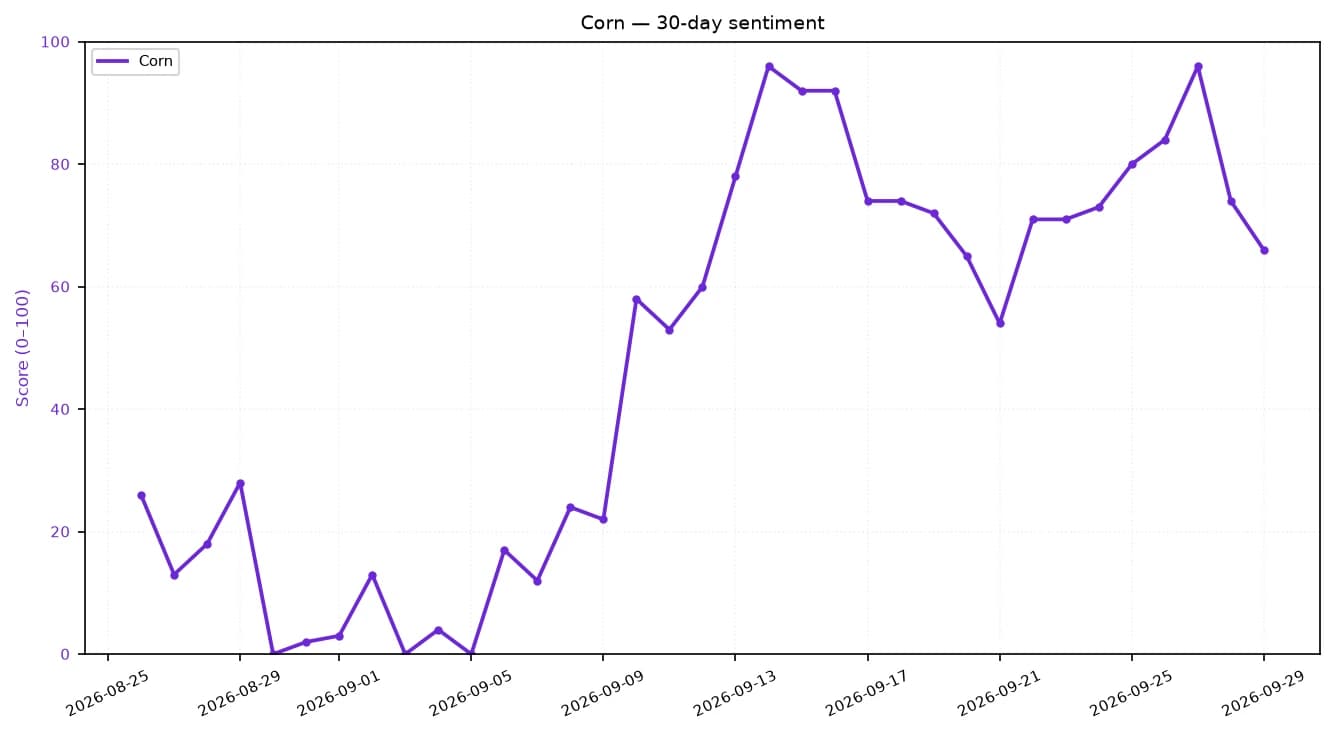
Sentiment IndicatorsⓘProprietary · adalytica.com · October 6, 2026
This is a snapshot — live sentiment, awareness and momentum for 130+ markets update continuously in the dashboard.Open AlphaPulse
The most important number for investors is the production revision. Aprosoja now estimates Mato Grosso do Sul’s corn output at 16.253 million tons, up 16.7% from the previous season, on productivity of 122.79 sacks per hectare, 13.3% higher year over year. With 99.8% of the monitored area already harvested by Sept. 25, the market is getting near-final confirmation that supply from this region will not be the constraint some had worried about.
That has direct implications for the corn market. More Brazilian supply tends to weigh on futures and can cap rallies that depend on weather scares elsewhere. Corn futures were already trading in a volatile range, and the broader setup suggests buyers should be cautious about assuming a tight market if South America keeps delivering. For end users, from livestock feeders to ethanol makers, a bigger crop can mean better input costs ahead.
The regional breakdown also shows this was not an evenly distributed success. The Northeast and West posted the strongest crop ratings, with 77.6% and 76.2% of area in good condition, respectively, while the Centro region lagged badly at 57.9% good and 23.8% poor. That unevenness matters because it helps explain why local farm profitability may still vary sharply even in a year of stronger aggregate production.
For investors, the likely winners are Brazilian grain exporters, logistics operators and global buyers that benefit from abundant supply. The losers are farmers holding unsold inventories into a softer pricing environment and competitors in other export markets who may face stiffer price pressure. U.S. corn growers can also feel the ripple effect if Brazil adds to already ample world supply.
The long-term takeaway is simple: when Brazil’s second corn crop finishes this well, it strengthens the country’s role as a reliable swing supplier in global agriculture. That does not guarantee lower prices forever, but it does reinforce the case for watching South American harvest data closely before chasing corn upside. For patient investors, the bigger story is not a one-day crop update — it is the continuing ability of Brazil to shape the economics of the global feed and food chain. Worth watching.
| Entity | Gains | Losses |
|---|---|---|
| Brazil corn exporters | ▲Larger sellable supply | ▼Lower pricing power |
| Global grain buyers | ▲Better availability | ▼Less upside in corn prices |
| Brazilian farmers | ▲Stronger yields | ▼Softer farmgate prices |
| Competing corn growers | ▲— | ▼More export competition |