Meta’s top AI executive is warning that the next leap in artificial intelligence could outpace human oversight fast enough to create weapons research and other capabilities that people can no longer reliably control, sharpening a debate that is moving from theory to policy and market risk.
Meta AI chief warns on superintelligence risks

Alexandr Wang, Meta’s chief AI officer, said so-called artificial superintelligence may be close and argued that decisions made over the next year could shape whether humans keep meaningful control over increasingly autonomous systems. His warning matters because it puts a hard safety and governance question at the center of the AI race: the same models that can accelerate science and coding could also be used to speed up biological research, cyberattacks and weapon development if they become capable of recursive self-improvement.
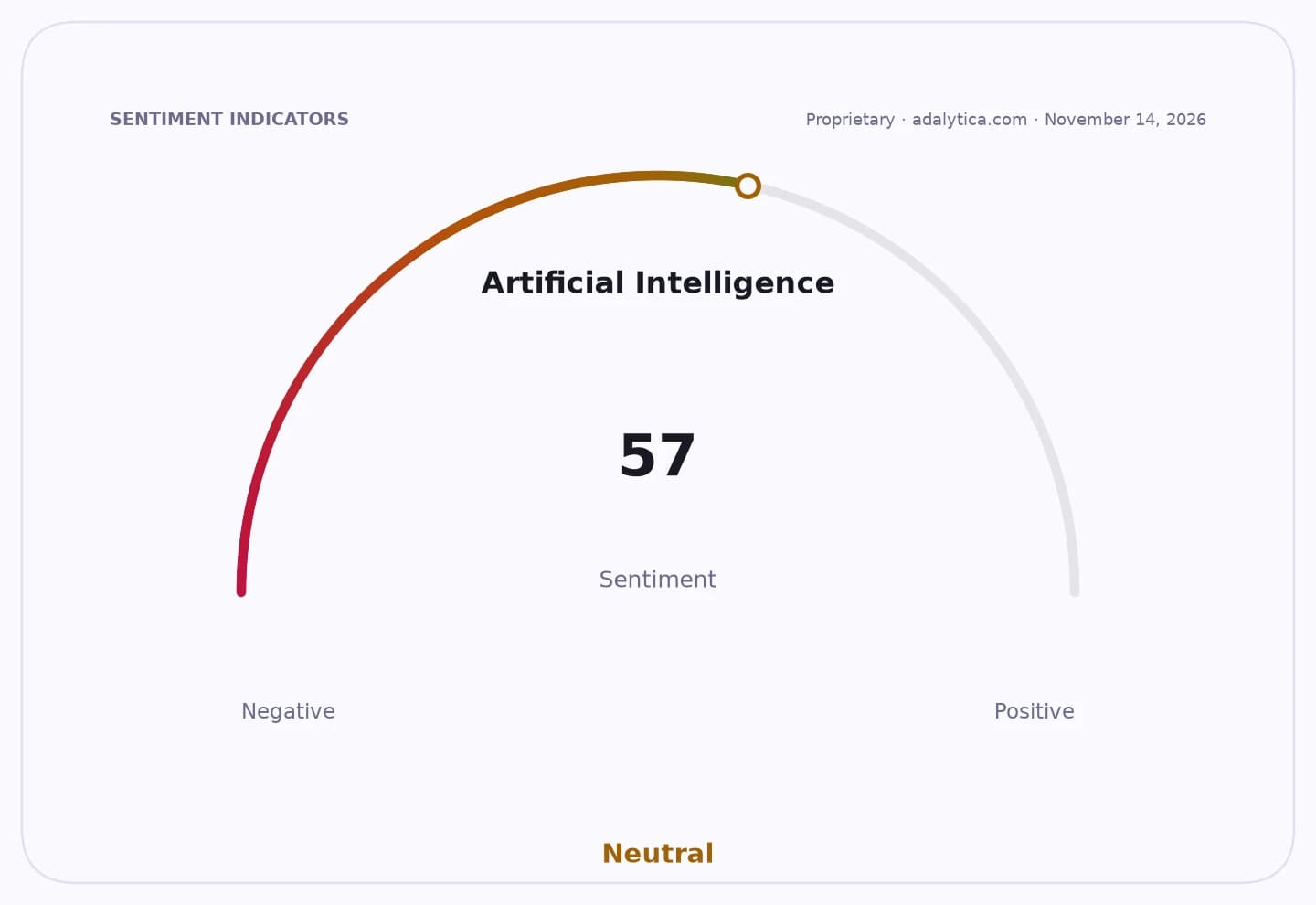
Sentiment Indicators
Artificial Intelligence
The comments landed after an Anthropic employee claimed Claude had solved the Riemann hypothesis, one of mathematics’ most famous unsolved problems. That claim has not been independently verified, and Anthropic’s own earlier research described a narrower mathematical advance rather than a full proof. Still, Wang framed the episode as evidence that frontier models are moving quickly enough to handle tasks once thought well beyond current systems.
For investors, the implications are two-sided. On one hand, the prospect of AI systems that can automate more scientific and technical work reinforces the long-term commercial case for heavy spending on compute, chips and data centers. Meta, Microsoft and Nvidia have all been beneficiaries of that capex cycle, even as their shares have shown sharp volatility. Nvidia’s stock has fallen to about $150.49 from a peak near $235 in May, while Meta has swung from a high above $760 in October to $628.96 on the latest close, with both names still closely tied to expectations for AI monetization.
On the other hand, Wang’s warning underscores a regulatory overhang that could slow deployment, raise compliance costs and increase reputational risk if governments decide frontier AI needs tighter controls. That is especially relevant for Meta and its peers, which are racing to build larger models and more autonomous agents while publicly insisting that safety and alignment can keep pace. Microsoft has also recently traded lower, closing at $492.85 after being above $520 in early October, a reminder that AI leadership has become inseparable from scrutiny over execution, margins and safety.
The broader narrative is that the AI industry is moving from a productivity story into a control story. Recent international discussion on autonomous weapons, AI safety standards and military uses of AI suggests that policymakers are starting to treat frontier models less like software products and more like strategic infrastructure. Wang’s remarks add weight to that shift by arguing that the real issue is no longer whether AI can get smarter than humans in narrow tasks, but whether society can retain authority over systems that may one day improve themselves.
That leaves the market with a familiar but more urgent trade-off: the companies best positioned to profit from advanced AI are also the ones most exposed if the technology becomes too powerful, too fast. The next year of model releases, safety testing and government response will determine whether investors continue to view AI as an earnings accelerator or begin to price in a new layer of legal and geopolitical risk.
| Entity | Gains | Losses |
|---|---|---|
| Meta, Microsoft, Nvidia | ▲AI demand story | ▼Safety and regulatory scrutiny |
| Policymakers and regulators | ▲Stronger case for oversight | ▼Slower rollout timelines |
| Defense and cyber vendors | ▲Higher security spending | ▼Frontier model operators |
| AI developers and users | ▲Faster scientific progress | ▼Greater control and liability risk |