Meta Platforms is testing an AI app that can generate bedtime stories for children, a small product move that points to a much bigger ambition: turning generative AI from a back-end efficiency tool into a daily consumer habit that could deepen engagement, widen the company’s data advantage and eventually create new advertising or subscription revenue streams.
Meta AI App Signals Consumer Monetization Push

That matters because the market still tends to think about Meta’s AI strategy mostly through the lens of ad targeting and infrastructure spend. The real opportunity is larger. If Meta can make AI feel indispensable inside family-friendly, sticky use cases, it strengthens the moat around its ecosystem at a time when the next phase of AI competition is shifting from model quality alone to distribution, retention and product pull.
Sentiment IndicatorsⓘProprietary · adalytica.com · July 22, 2026
This is a snapshot — live sentiment, awareness and momentum for 130+ markets update continuously in the dashboard.Open AlphaPulse
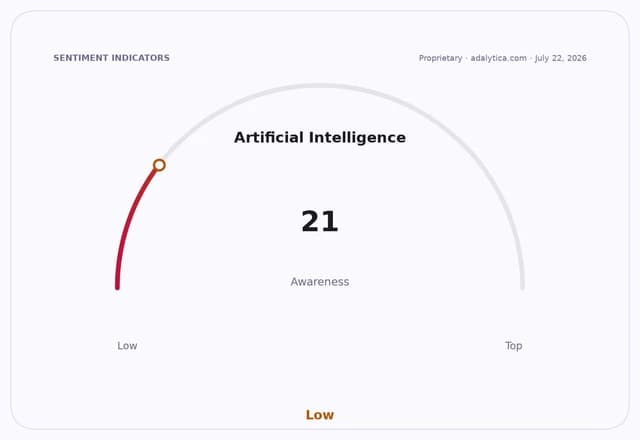
The investment case is increasingly about who owns the interface to everyday AI behavior. A bedtime-story app may sound whimsical, but it is exactly the kind of low-friction consumer surface that can normalize AI use for millions of households. That creates an asymmetric setup for Meta: a new category of engagement on top of an already massive social graph, with the potential to bundle AI features across Instagram, WhatsApp, Messenger and future standalone apps.
Meta’s own filings show the stakes are not trivial. The company has warned that its AI initiatives may not succeed and that changing laws around data collection and AI use could hurt results. Those risks are real, but they are also part of the reason the upside can be underestimated. If Meta can convert AI into higher time spent, better personalization and eventually paid premium features, the revenue impact could outpace the current cost burden from its AI buildout.
The broader read-through is important for the rest of the AI trade. Alphabet is also showing that AI can drive strong performance, reinforcing the idea that consumer-facing AI products are moving from experiment to earnings lever. Meanwhile, Microsoft remains heavily exposed to the capital-intensive buildout underpinning the AI economy, even as investor sentiment has been more mixed. That leaves Meta as a compelling middle ground: less dependent on enterprise cycles than Microsoft, less infrastructure-heavy than Nvidia, and increasingly focused on product-level monetization.
Technically, Meta’s shares have been resilient. The stock is trading above its 50-day and 200-day moving averages, while RSI readings remain elevated but not extreme, suggesting the market is still willing to pay for the AI story even after a strong run. That is important: investors are not waiting for proof of concept, they are already paying for the possibility that Meta’s AI stack becomes a consumer habit-forming machine.
I believe the market underestimates how fast this can compound. The real catalyst is not a single bedtime-story feature, but the accumulation of small, habitual AI interactions that give Meta more data, more engagement and more pricing power over time. If the company can layer monetization onto that behavior, the upside is much bigger than a novelty app would suggest.
For investors, the message is clear: Meta remains one of the best large-cap ways to own the shift from AI infrastructure to AI consumption. The near-term story is product testing, but the multi-year thesis is platform control. Buy the companies that sit closest to recurring human behavior, because that is where the next AI winners will be made.
| Entity | Gains | Losses |
|---|---|---|
| Meta | ▲More engagement and data | ▼Product execution risk |
| Alphabet | ▲Validation of consumer AI demand | ▼Share of mind in AI apps |
| Microsoft | ▲AI demand tailwind via cloud | ▼Slower consumer monetization |
| OpenAI/standalone AI apps | ▲Bigger category awareness | ▼Meta’s distribution advantage |