Meta’s launch of Muse, a 30-billion-parameter AI model designed to run on personal computers without the cloud, is a material shift in how the company wants to compete in consumer AI: by making advanced tools cheaper to run, easier to distribute and less dependent on external infrastructure.
Meta Muse on-device AI model launch

That matters economically because local AI reduces the cost of inference, lowers bandwidth requirements and broadens the set of devices that can support agent-like software. For Meta, which has spent heavily on AI infrastructure while facing investors’ scrutiny over returns, an on-device model is a way to extend its AI reach beyond data centers and into the installed base of PCs with 24GB or 32GB of memory. It also fits a broader industry push to move more workloads to the edge, where latency is lower and privacy concerns are easier to manage.
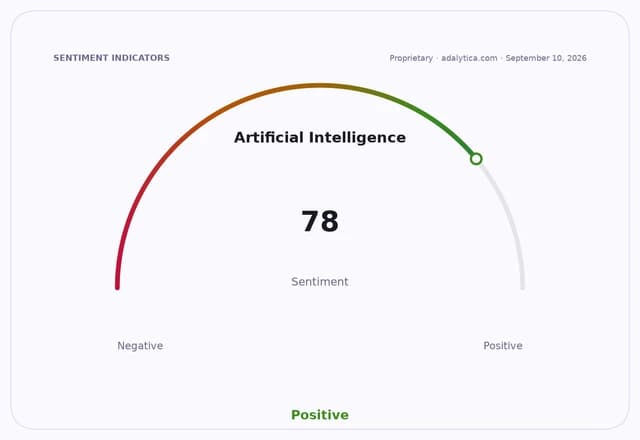
Sentiment IndicatorsⓘProprietary · adalytica.com · September 10, 2026
This is a snapshot — live sentiment, awareness and momentum for 130+ markets update continuously in the dashboard.Open AlphaPulse

Muse is open source, meaning developers can download and adapt it, which could accelerate adoption and push Meta’s technology deeper into third-party apps. The model can write code, analyze images and documents, and handle multi-step tasks, positioning it as more than a chatbot and closer to the autonomous agents that major technology firms are racing to build. That raises the competitive stakes against Microsoft, OpenAI and Google, all of which are trying to turn AI into a daily interface layer across productivity and consumer software.
The timing is notable for Meta investors because the stock has been volatile even as it trades well above its 50-day and 200-day moving averages, reflecting a market that still rewards AI capability but is sensitive to execution risk and the cost of scaling it. Meta’s move into local AI may appeal to bulls who argue the company can monetize AI without relying solely on expensive cloud-style deployment. Bears will note that open-sourcing a model can also commoditize parts of the stack and make it harder to defend pricing power.
The launch also lands in a wider capital-intensive AI cycle. Nvidia’s effort to marshal more than $500 billion for AI infrastructure underlines how much of the industry’s current economics still depend on data-center buildout, chips and power. Meta’s on-device approach offers a partial counterpoint: if more useful AI can run locally, the market may eventually reward software efficiency as much as raw compute spending.
For investors, the key question is whether Muse becomes a practical distribution tool that expands Meta’s AI usage at lower marginal cost, or another demonstration in a fast-moving field where technical novelty is quickly absorbed by rivals. The next catalyst is whether developers actually build on the open model and whether Meta can turn local AI into measurable engagement, ad-productivity gains or enterprise adoption.
| Entity | Gains | Losses |
|---|---|---|
| Meta | ▲Lower inference costs | ▼Cloud-compute dependence |
| Developers | ▲Open-source model access | ▼Closed AI ecosystems |
| Nvidia | ▲Infrastructure demand | ▼Some edge-compute share |
| Microsoft/OpenAI | ▲AI adoption tailwind | ▼Consumer interface competition |