Meta’s release of Muse Spark 1.2 as an open-source AI model is another reminder that the company wants to be more than a social network — it wants to own the tools people use to create, communicate and spend time online.
Meta shares near $595 after Muse Spark 1.2 open-source release

That matters because the biggest long-term question for Meta is not whether it can keep selling ads today, but whether it can keep its apps indispensable as AI changes how people make and consume content. If Meta can position its models as a default layer for creative and personal computing, it could deepen engagement across Facebook, Instagram and WhatsApp while also shaping the next generation of ad products. For investors, that makes Meta’s AI strategy more than a branding exercise. It is about protecting a business that still generates almost all of its revenue from advertising.
Sentiment IndicatorsⓘProprietary · adalytica.com · August 11, 2026
This is a snapshot — live sentiment, awareness and momentum for 130+ markets update continuously in the dashboard.Open AlphaPulse
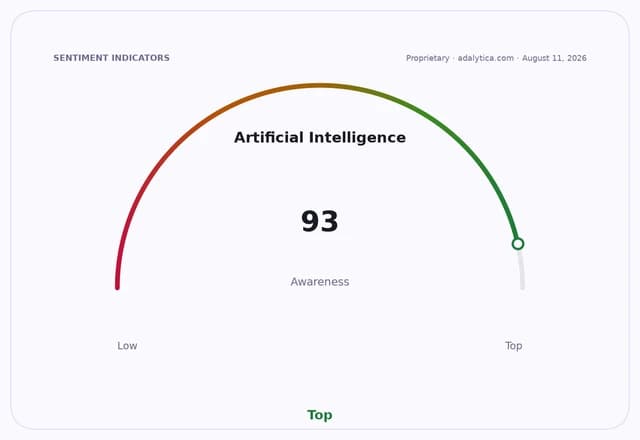
The open-source move also fits a broader industry trend. Google and smaller creative-tech companies are rolling out free or discounted AI video and content tools, which is accelerating the democratization of creation. That is good for users and creators, but it raises the stakes for platforms. Whoever provides the easiest and most useful AI workflow could end up capturing more attention, more data and ultimately more monetization. For Meta, opening the door wider may be a way to seed adoption now and harvest ecosystem value later.
The stock has reflected that tug-of-war. Meta shares have been volatile, with a sharp drop from above $680 in mid-July to around $595 in the latest session, even as the 50-day moving average sits near $599 and the 200-day average is around $630. The technical backdrop suggests the market is trying to decide whether recent weakness is a reset or a warning sign. Adalytica’s proprietary AI sentiment snapshot also shows neutral sentiment but extreme awareness, a classic setup for a name that remains central to the AI trade even when traders are unsure about the near-term path.
That uncertainty is understandable. Meta’s business still depends on advertising, so any AI initiative has to eventually support monetization, not just usage. The risk for investors is that generous AI investment and open-source distribution could pressure margins before the payoff becomes visible. But for long-term investors, the more important point is that Meta is still investing from a position of strength. It has the cash flow, the scale and the user base to keep experimenting while smaller rivals struggle to fund the same level of innovation.
What should investors do with that? Think in years, not weeks. Open-source AI may not show up immediately in earnings, but it can widen Meta’s moat if it helps lock in creators, improve ad tools and make its apps harder to dislodge. For patient investors, Meta remains a stock worth watching and, on weakness, one to consider for a diversified long-term portfolio.
| Entity | Gains | Losses |
|---|---|---|
| Meta | ▲Wider AI reach | ▼Short-term margin pressure |
| Creators and users | ▲Free AI tools | ▼Dependence on platform ecosystems |
| Advertisers | ▲Better ad-targeting tools | ▼More competition for attention |
| Smaller AI rivals | ▲Open ecosystem adoption | ▼Harder to charge premium prices |