Microsoft’s latest trading action says the market is still underestimating how quickly AI-powered workplace training can become a monetizable enterprise wedge, even as the broader software sector remains under pressure.
Microsoft AI Training Seen Driving Enterprise Demand

That matters because the next phase of AI adoption is no longer just about flashy copilots or model benchmarks. It is about whether companies can turn millions of workers into competent users of modern productivity tools fast enough to justify higher software spend, lower training costs and better labor efficiency. A promise to help employees “practically apply Excel skills on the job in just 3 months” is exactly the kind of packaged outcome enterprises buy when they are trying to do more with fewer people.
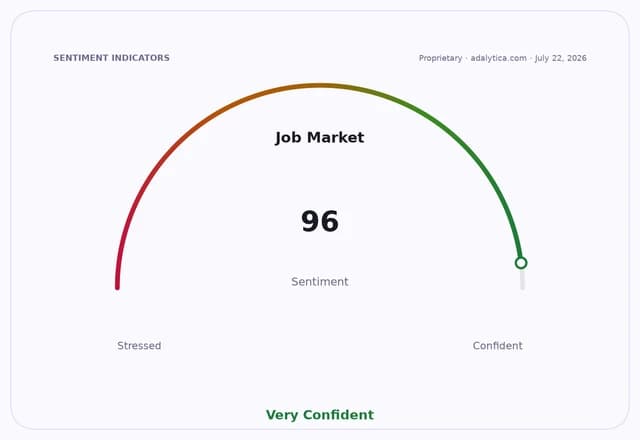
Sentiment IndicatorsⓘProprietary · adalytica.com · July 22, 2026
This is a snapshot — live sentiment, awareness and momentum for 130+ markets update continuously in the dashboard.Open AlphaPulse
Microsoft remains the clearest beneficiary of that shift. Its stock has clawed back from a steep selloff, but it still trades below its 200-day moving average, showing the market has not fully priced in a sustained re-acceleration in AI-driven commercial demand. The shares closed at $397.75 on July 21, up from a June low near $352.83, while the 50-day average sits around $400.66. Momentum has improved, with RSI back in the mid-60s and MACD turning positive, but the larger message is that the rebound is still early relative to the company’s strategic positioning.
The bigger story is not just Microsoft’s stock. It is the capex-and-skills flywheel forming around AI infrastructure, enterprise software and job training. If companies are serious about deploying AI across finance, operations and sales, they need employees who can use Excel, Power BI, Teams and related tools more effectively. That creates a durable pull-through effect for Microsoft 365 subscriptions, cloud services and adjacent learning products. In other words, the value chain is expanding from software licensing into workforce transformation.
Investors should see the opportunity in the second-order winners. Microsoft is the platform play, but the broader ecosystem includes employers spending on upskilling, staffing firms that can place digitally fluent workers, and software names tied to workflow automation. By contrast, vendors that depend on outdated training models or fail to embed AI into everyday business tasks risk being squeezed as enterprises demand measurable productivity gains, not abstract “digital transformation” language.
The market is also sending a broader labor signal. Adalytica’s Job Market Sentiment gauge is in “Extreme Greed” at 96, while consumer confidence remains fearful, suggesting companies may be more aggressive than households in pushing productivity initiatives and workforce optimization. That combination favors employers investing in training and automation over businesses tied to discretionary consumer demand.
Microsoft’s next catalyst is execution: if it can keep converting AI enthusiasm into enterprise adoption, the stock should eventually reclaim its higher multiples. For investors, the actionable thesis is straightforward: own the platforms that teach, automate and monetize work itself. That means Microsoft first, with selective exposure to enterprise software and workflow automation names that ride the same secular wave.
| Entity | Gains | Losses |
|---|---|---|
| Microsoft | ▲AI training pull-through | ▼Legacy software complacency |
| Enterprise customers | ▲Faster worker productivity | ▼Old training budgets |
| Staffing/workforce firms | ▲Demand for digital skills | ▼Low-skill labor models |
| Legacy software vendors | ▲— | ▼Share to AI platforms |
