Wall Street closed sharply higher as Microsoft and semiconductor shares powered a broad tech-led advance, lifting the Dow Jones Industrial Average 613.92 points and signaling that investors are still willing to pay for growth despite lingering macro uncertainty.
Microsoft, Nvidia, AMD lift Dow 613.92 points
The move mattered because it was not a defensive relief rally but a risk-on rotation into the market’s highest-quality growth franchises. When megacap software and chipmakers lead, they tend to pull the major indexes with them, and on this session that strength overwhelmed weaker pockets elsewhere. The result was a powerful contribution from a narrow set of large technology names to a wider market bid, the kind of action that can improve index performance even when the broader economy remains mixed.
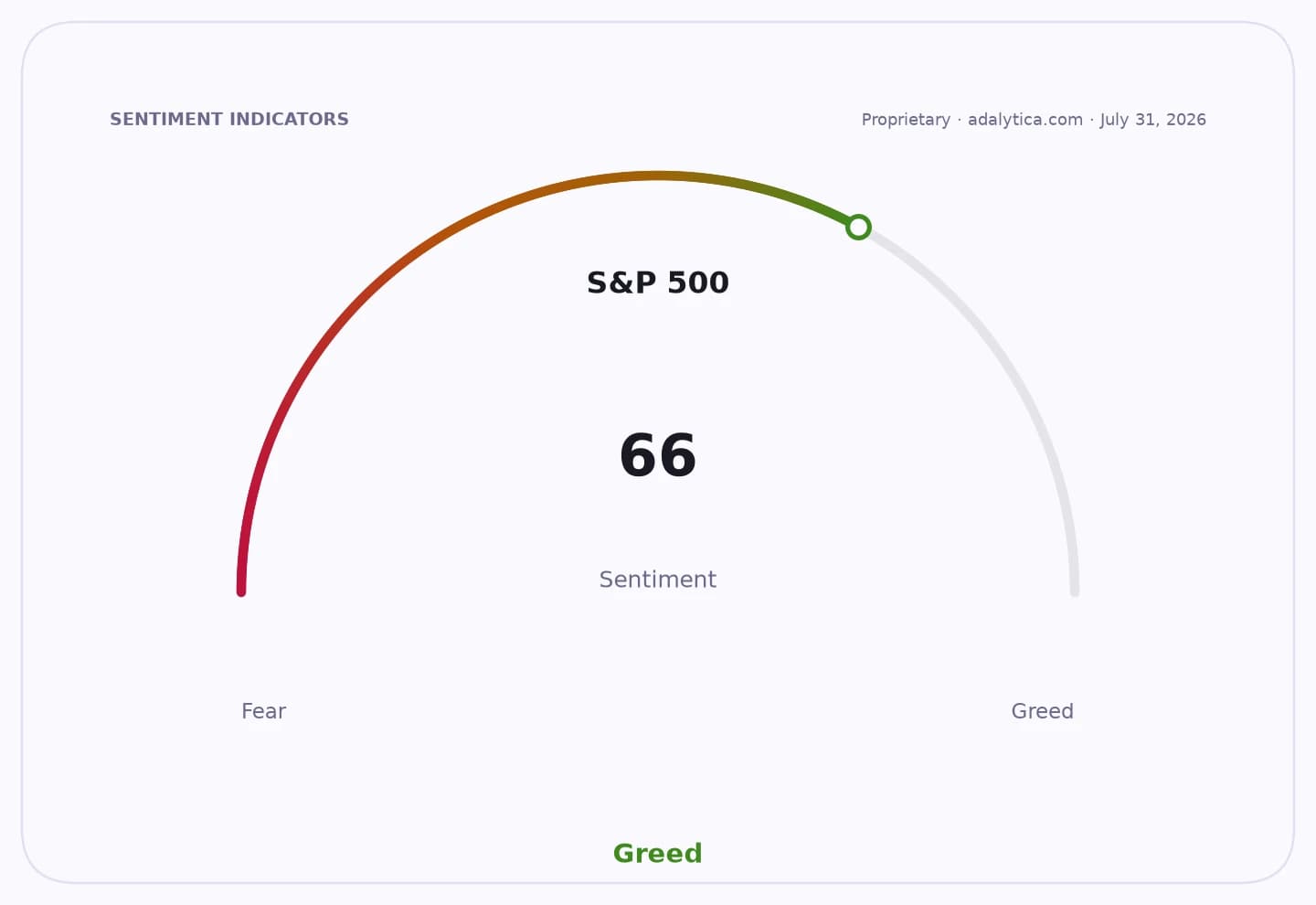
Sentiment IndicatorsⓘProprietary · adalytica.com · July 31, 2026
This is a snapshot — live sentiment, awareness and momentum for 130+ markets update continuously in the dashboard.Open AlphaPulse
Microsoft was central to that tone. Its shares rose to 462.83 on July 31 after a 451.10 close the prior session, extending a sharp rebound from 390.54 on July 29. That two-day jump left the stock well above its 50-day moving average of 399.35 and pushed RSI readings to 74.7, a level that typically indicates overbought momentum in conventional technical analysis. The rebound also reversed a stretch of weakness earlier in the summer, when the stock had been trading below its 200-day moving average, underscoring how quickly sentiment can change around a mega-cap leader.
The chip complex reinforced the rally. Nvidia added to its recovery, closing at 197.86 after 195.04 the previous day, while AMD finished at 490.74 after a violent rebound from 429.56 on July 29. AMD’s bounce came after it had fallen sharply from June highs above 580, highlighting both the sector’s volatility and the appetite for semiconductors when investors regain confidence in AI-linked demand. Even so, the technical backdrop remains uneven: Nvidia is still below its 50-day average of 206.07, and AMD is trading beneath its 50-day line of 512.5, suggesting the sector is recovering but not fully repaired.
For investors, the key issue is whether the rally reflects improved earnings visibility or simply a momentum chase into the market’s most liquid winners. The bullish case is that Microsoft and leading chipmakers remain the clearest beneficiaries of AI capital spending and still command the market’s strongest balance-sheet and cash-flow profiles. The bearish case is that a concentrated bid in a handful of names can leave indexes vulnerable if rates rise again, earnings disappoint, or the recent technical bounce fades.
Adalytica’s S&P 500 trade signals also point to a market that is still in an elevated-awareness state, with “Extreme Greed” on awareness even as sentiment sits in neutral territory. That combination usually describes a market where participation is strong but conviction is fragile, especially after a month in which the benchmark’s broader trend has been mixed. In that setting, the Dow’s 613.92-point gain is less about one day’s move than about the market’s dependence on a small group of large-cap technology names to sustain the rally.
What happens next will depend on whether Microsoft, Nvidia and AMD can hold these gains and translate them into cleaner trend signals on the 50-day and 200-day moving averages. If they do, the rally could broaden and support the case for a more durable advance in equities. If they fail, the day’s jump may end up looking like another sharp but narrow burst of AI-driven enthusiasm.
| Entity | Gains | Losses |
|---|---|---|
| Microsoft, Nvidia, AMD | ▲Index support; momentum recovery | ▼Overbought positioning risk |
| Dow Jones / S&P 500 bulls | ▲Stronger major-index performance | ▼Narrow leadership concern |
| Short sellers in megacap tech | ▲Near-term squeeze risk | ▼Losses on rapid rebound |
| Broader market laggards | ▲Spillover if rally broadens | ▼Outperformed by tech leaders |