Corporate AI projects are colliding with a simple problem: most companies can buy software, but few can redesign workflows fast enough to turn AI into durable profit. That gap is showing up in the market now, with Microsoft and Nvidia under pressure on how quickly AI spending converts into returns, while smaller software names like C3.ai still trade on whether customers actually expand deployments.
Microsoft, Nvidia, C3.ai face AI spending concerns
The economics matter because AI is no longer just a technology line item. It has become a capital-allocation test for software, cloud and consulting groups that are spending heavily on models, data centers and integration services before clients prove the payoff. When enterprise adoption stalls, margins get squeezed, renewal rates weaken and investors stop paying for “AI transformation” stories.
Sentiment Indicators
Microsoft’s stock rose to $555.80 on Nov. 4 after a volatile stretch, but the broader trend in the data shows how quickly sentiment can reverse when investors question execution. Its 50-day moving average sits at $515.34 and the shares remain well above the 200-day average of $437.96, yet the swing in the stock has been sharp enough to show that even the market’s AI favorite is not immune to margin and rollout concerns.
Nvidia is telling a different but related story. The chipmaker’s shares closed at $200.13 on Nov. 4, down from $221.97 two weeks earlier and below the 50-day moving average of $221.15, even as it remains above the 200-day average of $204.39. Adalytica’s NVIDIA earnings sentiment reads “Extreme Fear,” underscoring how investors are looking past AI demand headlines and focusing on whether hyperscaler spending and export constraints can keep supporting growth at the same pace.
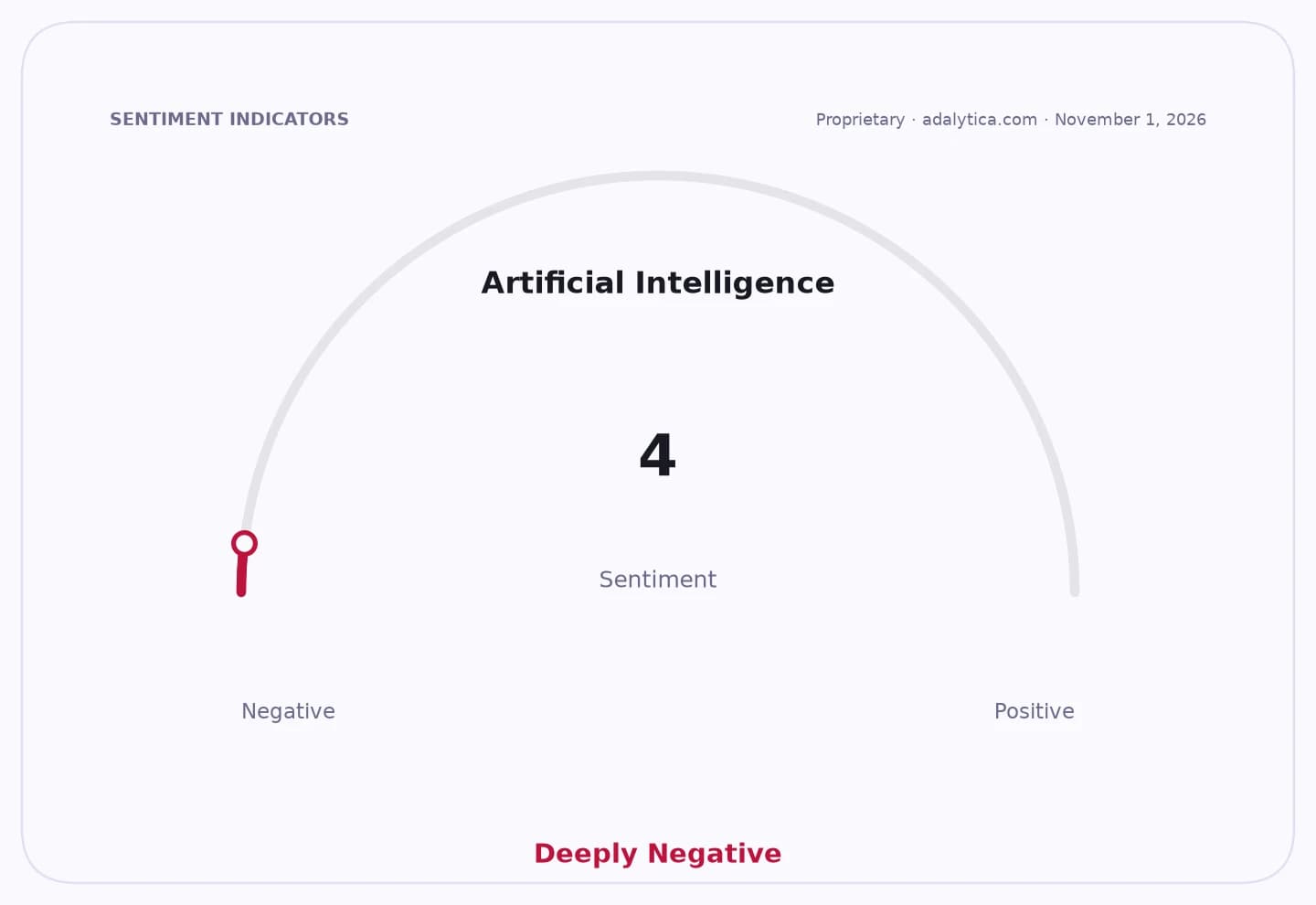
Artificial Intelligence — 30-day sentimentadalytica.com
Explore this data interactively — full history, time series and cross-market comparisons.
For C3.ai, the narrative is even more direct. The stock ended at $11.96 on Nov. 4, up modestly on the day but still far below its 2026 high, while Adalytica’s AI sentiment sat at 21, labeled “Fear,” with awareness at just 4, or “Extreme Fear.” That combination points to a market that has not yet bought the idea that enterprise AI software vendors can reliably scale beyond pilot programs into full production budgets.
The core reason these transformations fail is that the technology is easier to demo than to operationalize. Companies often buy AI to improve productivity, customer service or coding, but then run into data quality issues, compliance risks, workflow disruption and a lack of internal ownership. Microsoft’s own filing says AI solutions can produce unintended consequences and be used in unforeseen ways, a reminder that governance and liability now sit alongside adoption as major cost centers.
That is why the investor question is shifting from “who has AI?” to “who can turn AI into recurring revenue without wrecking returns?” Big platform names still have balance-sheet strength and distribution advantages, but consultants, software vendors and infrastructure suppliers are all exposed if corporate customers slow spending or fail to expand usage after initial deployments. Even firms like Accenture, IBM and other enterprise implementation players are investing heavily while warning that success depends on secure, scalable deployment rather than more model launches.
The next catalyst is not another AI announcement but proof of conversion: enterprise renewals, cloud consumption, margin trends and guidance from the companies selling the picks and shovels. Until then, the market is likely to keep rewarding the few firms that can show measurable productivity gains and punishing the many that can only promise transformation.
| Entity | Gains | Losses |
|---|---|---|
| Microsoft | ▲AI platform revenue growth | ▼Margin pressure from heavy spending |
| Nvidia | ▲Data-center demand momentum | ▼Valuation support if spending slows |
| C3.ai | ▲Pilot-to-production conversions | ▼Buyers skeptical of scale-up claims |
| Enterprise customers | ▲Productivity gains if AI works | ▼Implementation costs and execution risk |