U.S. natural gas inventories rose by 32 billion cubic feet in the week ended July 23, but the bigger story is that storage is still only one part of a market being pulled in opposite directions by supply disruptions, export demand and geopolitical risk.
Natural Gas Still Priced for Volatility

For investors, that matters because gas is no longer trading on storage builds alone. A modest injection at this point in the summer would normally point to comfortable supply, yet the market is being forced to balance weaker domestic pricing signals against a global backdrop that remains structurally tight. LNG outages in South Asia are cutting supply by roughly 450 million cubic feet a day at Maheshkhali, while Europe is heading into winter with inventories short of its 80% target and buyers facing higher costs to secure cargoes. That means any surplus in the U.S. can be absorbed quickly if export flows stay strong or if overseas supply fears intensify.
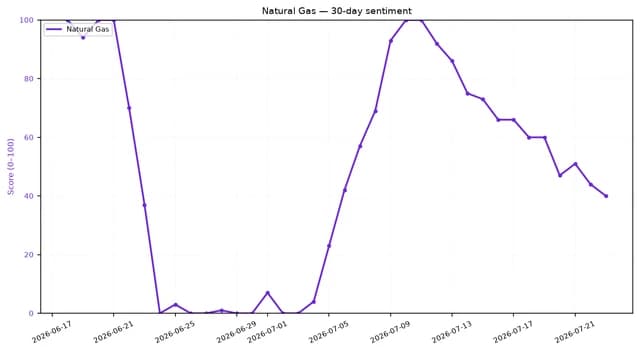
Sentiment IndicatorsⓘProprietary · adalytica.com · July 23, 2026
This is a snapshot — live sentiment, awareness and momentum for 130+ markets update continuously in the dashboard.Open AlphaPulse
The price action in UNG shows how fragile the setup is. The fund closed at $10.63 on July 23, well below its 50-day moving average of $11.30 and its 200-day average of $12.21, with RSI readings around 31 suggesting the market is oversold but not yet confirmed to have turned. That is the kind of technical backdrop that often precedes a sharp repricing when fundamentals tighten again. In other words, the market may be discounting too much near-term weakness and too little winter optionality.
Adalytica’s natural gas trade signals also point to a market lacking conviction, with sentiment at 40 and 30-day change still negative. But neutral sentiment in a commodity tied to weather, exports and geopolitics is rarely the point at which a major move starts to look obvious. It is usually when the market is least interested that the asymmetry improves.
The investable takeaway is straightforward: the weekly storage build is not a bear case by itself. It is a reminder that gas remains a volatility trade with a powerful second-order setup. Producers, LNG exporters and leveraged gas vehicles such as UNG can all re-rate quickly if European storage anxiety worsens, Middle East risk pushes crude and gas sentiment higher, or U.S. exports stay elevated into peak winter positioning. For investors looking for asymmetric exposure, the market underestimates how fast a “comfortable” storage report can turn into a supply scare.
| Entity | Gains | Losses |
|---|---|---|
| LNG exporters | ▲Higher global margins | ▼Domestic buyers |
| U.S. gas producers | ▲Better winter pricing | ▼Short-term bears |
| UNG bulls | ▲Rebound from oversold levels | ▼Momentum shorts |
| Europe and South Asian importers | ▲None | ▼Higher energy costs |