NVIDIA shares slid after US officials and reports said Chinese artificial intelligence systems, including Kimi K3, may be relying on restricted NVIDIA products, sharpening the risk that Washington could tighten enforcement of semiconductor export controls.
NVIDIA Falls to $190.01 on China Export-Control Risk
The allegations matter because they put NVIDIA at the center of the US-China technology fight again, just as investors are watching whether demand from China can be sustained without triggering more policy backlash. Any wider crackdown on chip flows would hit a market that still matters for data-center revenue, even as Washington tries to block advanced US hardware from powering Chinese AI development.
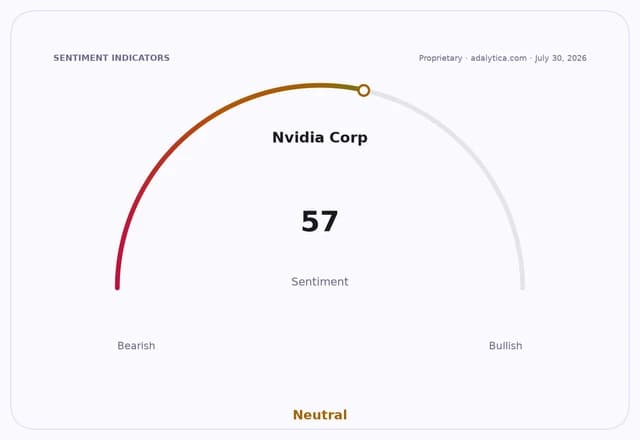
Sentiment IndicatorsⓘProprietary · adalytica.com · July 30, 2026
This is a snapshot — live sentiment, awareness and momentum for 130+ markets update continuously in the dashboard.Open AlphaPulse

NVIDIA closed at $190.01 on July 29, down from $196.51 two sessions earlier, with volume of 146.96 million shares. The stock is trading below its 50-day moving average of $207.06 and its 200-day average of $192.80, while the RSI reading of 40.4 points to weakening momentum after a sharp run earlier in the quarter.
The report lands against a backdrop of already tense semiconductor supply chains and export-control scrutiny, with investors closely parsing whether Chinese firms are circumventing restrictions through third-party channels or older inventory. That keeps NVIDIA exposed not just to direct sales limits, but to the broader risk that regulators may widen the net to distributors, cloud providers and overseas partners.
The concern is also sector-wide. Taiwan Semiconductor Manufacturing Co., NVIDIA’s key foundry partner, fell to $374.67 from $399.09 in two sessions, underscoring how trade and policy headlines can quickly pressure the wider AI hardware complex.
For investors, the key issue is whether the headline becomes a one-off enforcement story or the prelude to tougher US action that could complicate NVIDIA’s China exposure and cloud near-term sentiment. The next catalyst is any formal response from US officials or NVIDIA, along with fresh signs that export-control enforcement is broadening.
| Entity | Gains | Losses |
|---|---|---|
| US regulators | ▲Stronger leverage on export controls | ▼Need for tougher enforcement proof |
| NVIDIA competitors outside US control | ▲Potential share gains in China | ▼Slower AI hardware trade overall |
| NVIDIA | ▲None immediate | ▼Policy risk, China scrutiny |
| TSMC and chip suppliers | ▲Steady AI demand if trade stays open | ▼Spillover selling on controls fears |