Nvidia’s latest pullback may be noisy, but the bigger story for investors is that the AI spending race between the U.S. and China is still driving enormous demand for the hardware that powers it.
Nvidia at $198.99 After July 31 Pullback

That matters because AI is no longer just a software story or a near-term sentiment trade. It is becoming a strategic arms race in compute, networking and advanced chips, with governments and companies on both sides treating AI infrastructure as a matter of national competitiveness. Even as smaller players struggle to prove the economics of AI, the largest suppliers are still benefiting from a cycle that looks increasingly secular.
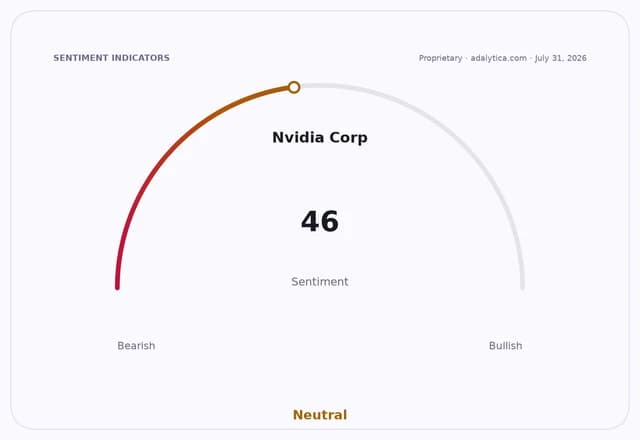
Sentiment IndicatorsⓘProprietary · adalytica.com · July 31, 2026
This is a snapshot — live sentiment, awareness and momentum for 130+ markets update continuously in the dashboard.Open AlphaPulse

Nvidia shares rose to $198.99 on July 31 after a sharp slide from a recent peak above $235, while the stock remained well above its 200-day moving average of about $192.9. The 50-day average sat around $206.1, showing the shares were still digesting a run-up rather than breaking the longer-term trend. The 46 reading on the relative strength index suggests the stock is neither deeply oversold nor overheated, which fits a market that is trying to decide whether the AI boom is merely pausing or resetting for another leg higher.
The same pattern shows up across the semiconductor complex. AMD finished July 31 at $487.32, far above its 200-day average near $311.9, even after a pullback from a 52-week-style surge that took the stock above $580 in June. TSMC ended at $405.48, also comfortably above its 200-day average of roughly $356.0. That is not the profile of a sector losing relevance. It is the profile of a group that remains central to the buildout, even after some investors got ahead of themselves.
For long-term investors, the economic significance is straightforward: AI infrastructure is still attracting capital because the payoff is not limited to one company or one country. U.S. chipmakers and Taiwan’s TSMC are the picks and shovels of that contest, and the customer base is broadening beyond the first wave of hyperscalers. At the same time, the arms race creates durable risk. Export controls, security concerns, model vulnerabilities and supply-chain pressure can all distort demand and margins, especially for firms with exposure to China.
Adalytica’s NVIDIA Earnings Sentiment snapshot shows sentiment at 46, neutral, but awareness at 89, in “Extreme Greed,” which is a reminder that attention remains intense even when near-term conviction cools. That combination usually means investors are watching closely for the next catalyst rather than abandoning the theme.
The key takeaway is that AI’s profitability debate matters most for the smaller names trying to monetize the hype. The leaders, by contrast, are being pulled by a geopolitical spending cycle that is still very much alive. If you are building a portfolio for the next three to five years, this is less a reason to chase every AI stock than a reason to stay focused on the companies with the strongest moats, the most pricing power and the clearest role in the global AI supply chain.
For investors, Nvidia, AMD and TSMC remain worth watching — and for patient long-term holders, they still look like core beneficiaries of one of the defining industrial buildouts of this decade.
| Entity | Gains | Losses |
|---|---|---|
| Nvidia | ▲AI accelerator demand | ▼Near-term volatility |
| AMD | ▲Share in AI compute spending | ▼Overheated expectations |
| TSMC | ▲Foundry utilization | ▼Geopolitical headline risk |
| Smaller AI firms | ▲Attention from the boom | ▼Monetization pressure |