Nvidia and Advanced Micro Devices are facing a renewed China risk that could hit sales, inventories and margins just as the two chipmakers are trying to monetize surging demand for AI accelerators.
Nvidia, AMD face renewed China export risk
The threat matters because China remains one of the biggest end markets for high-performance semiconductors, and tighter U.S. export controls can quickly turn into lost revenue, stranded inventory and compliance costs. AMD said in its latest 10-Q that if new export controls cover more of its products, it may be unable to sell inventory and could incur additional charges, while acknowledging that evolving China-related rules may force redesigns, customer limits or supply-chain changes.
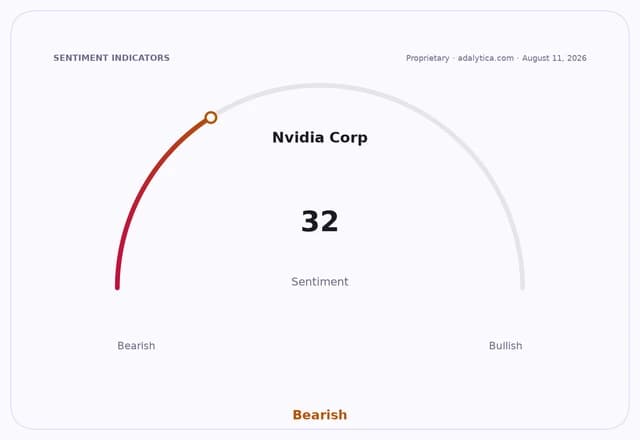
Sentiment IndicatorsⓘProprietary · adalytica.com · August 11, 2026
This is a snapshot — live sentiment, awareness and momentum for 130+ markets update continuously in the dashboard.Open AlphaPulse

For investors, that puts a ceiling on how much of the current AI boom can be converted into earnings. Nvidia shares closed at $217.55 on Aug. 10, below their recent high of $223.96 on Aug. 7, while AMD fell to $469.56 on Aug. 10 from $483.36 the prior session and is far below its late-June peak above $580. Both stocks remain tied to the same question: how much of the global AI buildout can stay insulated from geopolitics.
The risk is sharpened by the broader semiconductor race around China. TSMC, the world’s most important contract chipmaker and a key supplier across the AI ecosystem, is still posting strong demand — July revenue rose 44.7% from a year earlier — but the industry is also fragmenting as Japan, Vietnam and others push subsidies and capacity plans to reduce dependence on concentrated supply chains.
That makes the China issue more than a bilateral trade story. If Washington broadens restrictions, Nvidia and AMD could see weaker sales in a market that helps absorb supply, while TSMC and other foundry partners are forced to keep balancing U.S. policy, customer demand and manufacturing allocation. The result is a more expensive, less predictable AI supply chain, even as investors continue to reward the companies most exposed to it.
The near-term catalyst is whether U.S. officials tighten China rules further and whether chipmakers have to update guidance on inventory, licensing and regional demand.
| Entity | Gains | Losses |
|---|---|---|
| TSMC | ▲Strong AI foundry demand | ▼Export-policy uncertainty |
| Nvidia | ▲Global AI demand outside China | ▼China sales risk |
| AMD | ▲AI chip growth in open markets | ▼Inventory and compliance charges |
| U.S. regulators | ▲Leverage over tech controls | ▼Higher pressure from industry |