Nvidia Chief Executive Jensen Huang’s black leather jacket selling for Rs 9.4 crore, or about $1.1 million, is more than a headline-grabbing charity lot — it is a vivid symbol of how the AI boom has turned Nvidia into one of the world’s most valuable cultural and financial brands, with the proceeds set to fund fellowships and research that can reinforce the next wave of compute demand.
Nvidia Auction Fuels AI Brand Narrative

The significance goes beyond memorabilia. A jacket that fetched 16 times the expected price reflects the scale of investor and public fascination surrounding Nvidia, whose chips sit at the center of the AI buildout. When a CEO’s clothing commands auction-house pricing usually reserved for art or blue-chip collectibles, it underscores how deeply Nvidia has penetrated the market’s imagination — and how much optionality investors are still assigning to the company’s long runway in AI infrastructure.
Sentiment IndicatorsⓘProprietary · adalytica.com · July 19, 2026
This is a snapshot — live sentiment, awareness and momentum for 130+ markets update continuously in the dashboard.Open AlphaPulse
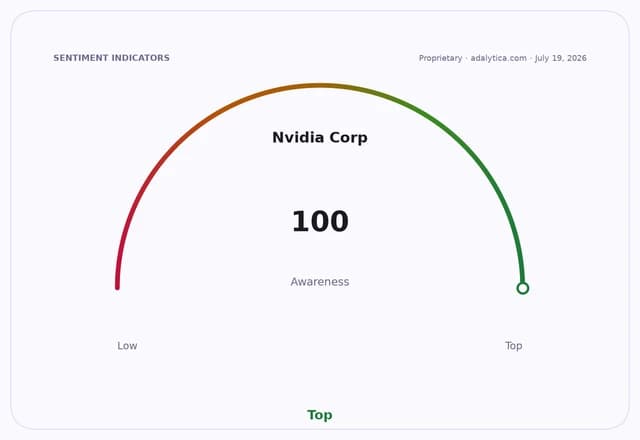
For shareholders, that matters because brand power is not just vanity. It helps Nvidia sustain pricing authority, talent magnetism and ecosystem control at a time when hyperscalers, governments and enterprises are still in the early innings of spending on accelerated computing. Nvidia shares have also shown the kind of volatility that usually accompanies dominant growth stories: the stock has climbed sharply from earlier lows, but recent trading has been choppy, with the shares slipping below the 50-day moving average in mid-July after a powerful run. That kind of consolidation often signals a market deciding whether to take profits or prepare for the next leg higher.
The technical picture suggests the debate is still live. Nvidia’s 200-day moving average remains well below the current share price, a sign the longer-term trend is intact, even as recent price action cooled from overbought levels. RSI readings have moved down from overheated territory, while momentum indicators have flattened, pointing to a stock that may be digesting gains rather than losing its strategic advantage. In other words, the market is no longer pricing Nvidia as a pure momentum trade, but as an infrastructure monopoly with repeated catalysts ahead.
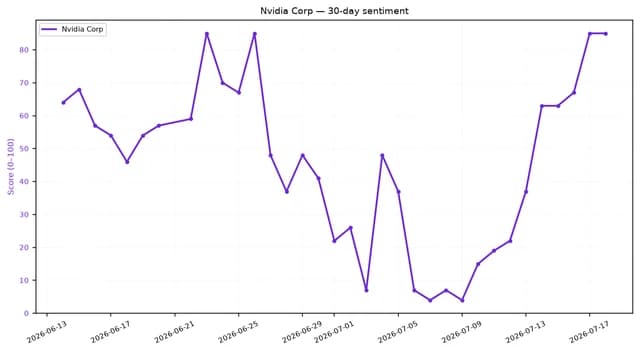
That is why the auction matters in a broader investing sense. The money going to fellowships and research feeds the same talent and innovation pipeline that keeps the AI cycle alive. Research funding, even when indirect, can deepen the ecosystem Nvidia depends on: model development, academic partnerships, algorithmic breakthroughs and the next generation of engineers who will design, buy and deploy more chips. For investors looking for asymmetric exposure, the lesson is to stay focused on the toll roads around AI — semiconductors, networking, power, data-center buildout and software tools — rather than chase short-term noise around a single auction lot.
The market underestimates how much this story is still about capex. As long as AI spending remains a strategic priority for the biggest technology buyers and sovereign backers, Nvidia’s brand, balance-sheet strength and platform lock-in should continue to compound. The jacket sale is a novelty on the surface; underneath, it is another reminder that Nvidia has become the emblem of the AI era — and that the real investment opportunity lies in owning the infrastructure that era still needs to build.
| Entity | Gains | Losses |
|---|---|---|
| Nvidia | ▲Brand power and halo effect | ▼Little direct cost |
| AI ecosystem | ▲More research funding | ▼None material |
| Investors long NVDA | ▲Reinforced dominance narrative | ▼Near-term volatility |
| Short sellers | ▲— | ▼Stronger bullish sentiment |