Nvidia is back in the crosshairs of retail traders after a sharp pullback from its recent highs revived memories of crowded bets, leverage and painful capital losses in one of Wall Street’s most watched AI names.
Nvidia Falls to $200.75 After July 31 Pullback

The stock closed at $200.75 on July 31, down 3.2% from the prior session and well below its 2026 peak of $235.47 set in May, when the shares were trading more than 28% above that level. The retreat matters because Nvidia sits at the center of the AI spending boom and remains a major driver of index performance, semiconductor sentiment and retail speculation.
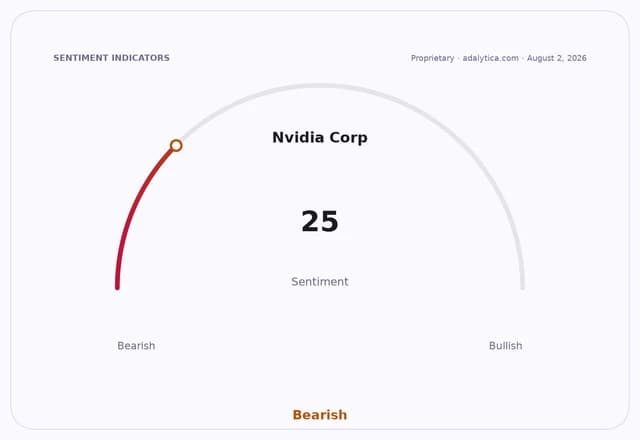
Sentiment IndicatorsⓘProprietary · adalytica.com · August 2, 2026
This is a snapshot — live sentiment, awareness and momentum for 130+ markets update continuously in the dashboard.Open AlphaPulse
The latest slide also comes with market internals flashing caution. Nvidia’s 50-day moving average is at $206.12, above the latest close, while the RSI was 47.7, down from overbought levels earlier in the year and far from the feverish readings seen when momentum was strongest. The stock’s MACD has also stayed negative, suggesting the rebound has lost some of its earlier force even after the shares bounced from the low-$190s.
That leaves investors weighing whether the pullback is a pause in a longer AI uptrend or the start of a bigger unwind after a period of heavy enthusiasm. Adalytica’s NVIDIA Earnings Sentiment snapshot shows fear at 25, even as awareness remains high at 82, a combination that points to elevated attention but weaker conviction after a 7-point drop in one day and a 54-point slide over the past week.
For broader markets, Nvidia’s tone matters because it influences risk appetite across chipmakers, megacap tech and the S&P 500, which itself finished July 31 at 747.03 after recovering from a brief late-July wobble. When Nvidia weakens, it tends to hit both momentum traders and index funds that have crowded into AI exposure; when it steadies, it often helps calm the entire growth complex.
The next catalyst is the company’s ability to keep revenue growth and AI demand expectations ahead of the stock’s still-rich valuation. Traders will also watch whether Nvidia can reclaim its 50-day average and whether the current dip turns into a deeper correction ahead of the next earnings cycle.
| Entity | Gains | Losses |
|---|---|---|
| Nvidia bulls | ▲Buy-the-dip setup | ▼Momentum fading |
| Retail option traders | ▲Volatility opportunity | ▼Leverage risk |
| Semiconductor peers | ▲Sentiment spillover if Nvidia stabilizes | ▼Pressure if Nvidia keeps slipping |
| S&P 500 holders | ▲Index support from Nvidia rebound | ▼Benchmark drag from a weaker megacap |