When companies figure out how to fully monetize artificial intelligence, the winners stop being the chip makers and software sellers alone and start being the businesses that turn AI into higher sales, fatter margins and real productivity gains.
Nvidia, Microsoft, Alphabet Near Key AI Levels

That is the big investing lesson running through Nvidia, Microsoft and Alphabet right now. The AI buildout is no longer just a story about spending. It is becoming a story about capture: who gets paid, how much, and how quickly the value of AI moves from experimental budgets into recurring cash flow.
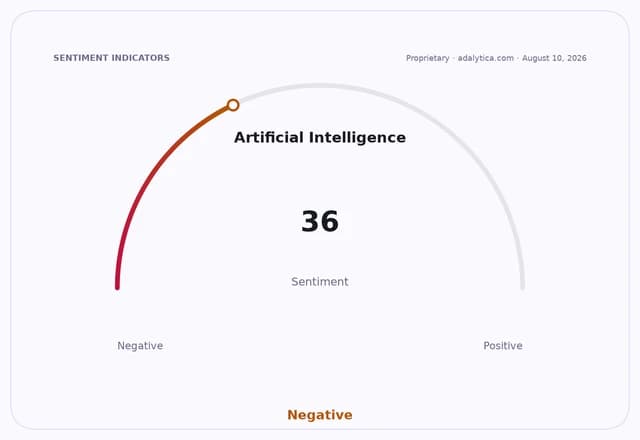
Sentiment IndicatorsⓘProprietary · adalytica.com · August 10, 2026
This is a snapshot — live sentiment, awareness and momentum for 130+ markets update continuously in the dashboard.Open AlphaPulse
Nvidia remains the clearest barometer of that transition. The stock has rebounded sharply to $219.65, well above its 50-day moving average of $206.16 and its 200-day average of $193.99, after a volatile year that saw it swing from a $235.47 peak down to $176.97 before climbing back again. That kind of price action tells investors two things at once: demand for AI infrastructure is still powerful, and expectations are already enormous. With the RSI at 59.3 and the MACD still positive, the market is saying the AI trade is alive — but not cheap.
For long-term investors, that matters because monetization is what separates a technology wave from a durable earnings machine. Nvidia’s role is obvious: it sells the picks and shovels. But the next phase of the story is whether customers can turn those chips, models and data centers into measurable business value. If they can, spending stays high. If they cannot, AI capital budgets eventually slow.

Microsoft is the strongest evidence that monetization can show up in the numbers. The stock is back near $509.86, above its 50-day moving average of $408.67 and its 200-day average of $431.81, after a brutal selloff earlier this year. That recovery is not just about sentiment. It reflects investors’ willingness to pay for a company that can push AI into products customers already use, from cloud services to workplace software, and collect revenue repeatedly rather than once.
Alphabet, meanwhile, shows the other side of the same equation. Shares at $353.64 are well above the 50-day moving average of $355.75 and the 200-day average of $329.35, suggesting the market is still rewarding the company’s ability to commercialize AI inside search, advertising and cloud. Alphabet’s challenge is simpler to describe and harder to solve: it must prove AI improves engagement and monetization without eroding the economics of its core search franchise. That is where the real value will be created or destroyed.
The broader economic case is compelling. The World Bank’s push for rapid AI adoption, especially for small and midsize businesses, speaks to why this matters beyond the stock market. If AI helps firms access capital, automate work and lift productivity, it can support growth even in slower economies. That is the kind of payoff policymakers want and investors should want too, because it expands the addressable market for AI tools well beyond a handful of mega-cap spenders.
But investors should not confuse enthusiasm with inevitability. Adalytica’s AI awareness gauge sits at 93 out of 100, a sign that attention is intense even though sentiment has cooled to neutral. Nvidia’s own earnings sentiment score is still in “extreme fear” territory despite extreme awareness, a reminder that the market is wrestling with how much of the AI boom is already priced in. In other words, the question is no longer whether AI matters. It is who will actually earn the returns.
That is why the most important investing takeaway is simple: in AI, monetization is the moat. Companies that can convert compute into recurring revenue, better margins and sticky customer relationships deserve the premium valuations. Companies that only spend on AI, without proving a return, will eventually disappoint.
For investors building wealth over the next 3 to 10 years, this is not a reason to chase the hottest name blindly. It is a reason to own the platforms with the deepest customer bases, the strongest balance sheets and the best chance of compounding through multiple AI cycles. Nvidia, Microsoft and Alphabet remain worth watching closely — and for patient investors, they all belong on the long-term radar.
| Entity | Gains | Losses |
|---|---|---|
| Nvidia | ▲More AI infrastructure demand | ▼Valuation if spending slows |
| Microsoft | ▲Higher cloud and software monetization | ▼Investors if AI payback lags |
| Alphabet | ▲Better AI-driven search and cloud revenue | ▼Core margins if AI costs outrun returns |
| Enterprise AI adopters | ▲Higher productivity and efficiency | ▼Companies that fail to adapt |