NVIDIA has pushed deeper into the fast-growing AI-agent market with three new Nemotron 3.5 open-weight models, including a 120-billion-parameter flagship aimed at always-on enterprise agents.
NVIDIA releases Nemotron 3.5 open-weight models
That matters because the next phase of AI is shifting from chatbots that answer questions to software agents that can carry out multi-step work, use tools, read documents and handle visual inputs. If that transition sticks, the economic prize is bigger than a single model release: it broadens the market for NVIDIA’s chips, software stack and cloud ecosystem, while giving companies another reason to spend on AI infrastructure.
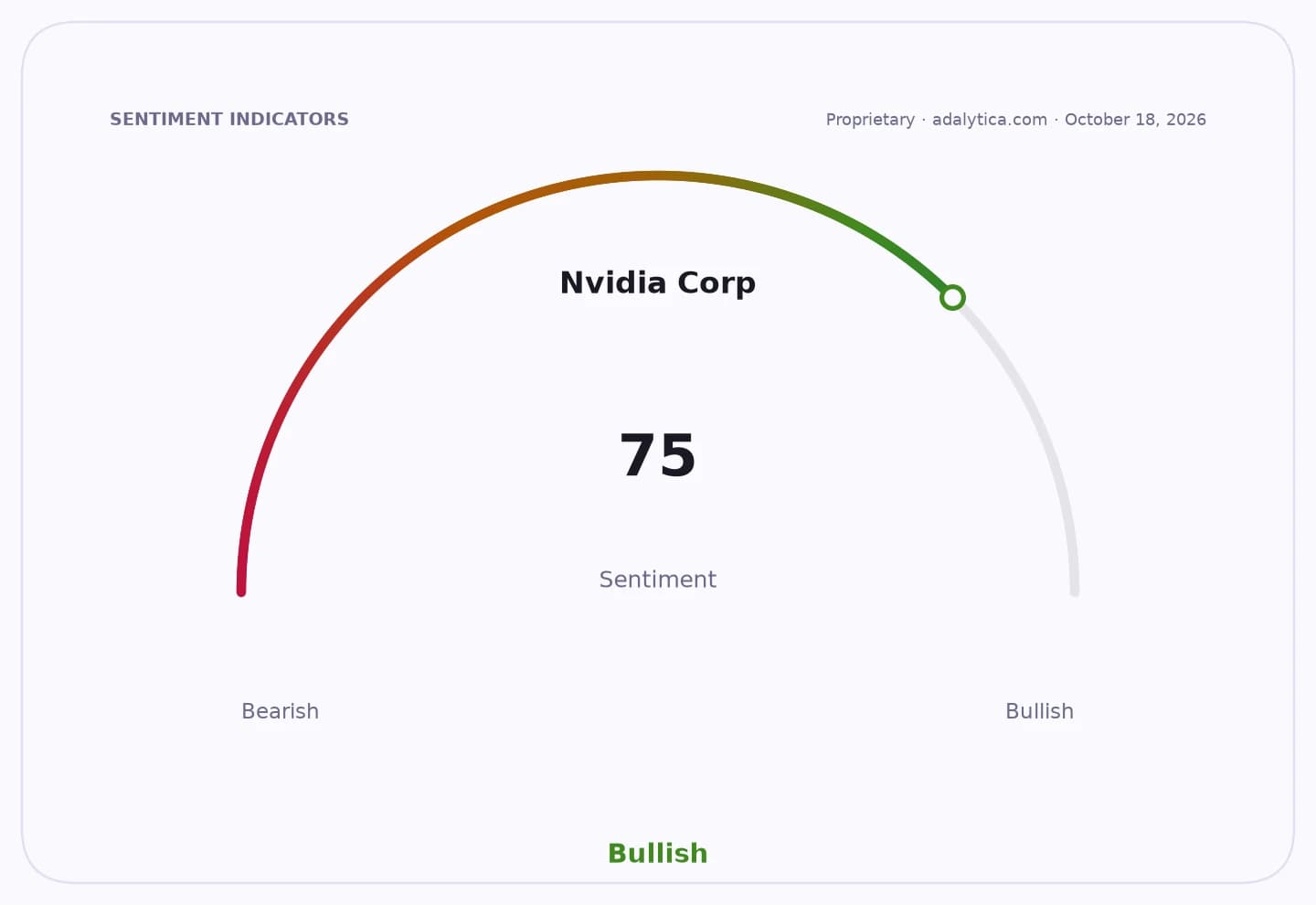
Sentiment IndicatorsⓘProprietary · adalytica.com · October 18, 2026
This is a snapshot — live sentiment, awareness and momentum for 130+ markets update continuously in the dashboard.Open AlphaPulse
The headline model, Nemotron 3.5 Super VL, is designed for business workflows that never sleep. NVIDIA says it matches the performance of its largest reasoning model while using about five times fewer parameters, and that it runs about five times faster than its closest competitor in the class. It also handles multimodal tasks such as instruction following, tool use, visual understanding and OCR, which are the kinds of capabilities enterprises need if they want AI to sit inside real back-office and customer-service processes.
For investors, the important point is not just that NVIDIA keeps shipping new models. It is that the company is reinforcing the same circular advantage that has made it the dominant name in AI: better models encourage more developers and enterprises to build on its platform, which in turn supports more demand for the GPUs and systems that power those models. That is especially relevant as the industry moves toward agentic computing, where inference workloads can become more persistent and more economically valuable than one-off prompts.
The timing also fits a market that is still trying to separate durable AI winners from short-lived hype. NVIDIA shares have been volatile, but the stock remains well above its 200-day moving average, and the broader AI trade continues to attract heavy attention. Microsoft, one of NVIDIA’s most important customers and ecosystem partners, has also been leaning harder into agentic AI, underscoring how central this next wave has become for enterprise software.
There are still risks. Competition in open-weight models is intense, and the market is unlikely to reward every new release equally. If enterprise adoption takes longer than expected, the payoff could be more gradual than bulls want. But the strategic direction is clear: AI is moving from demonstrations to workflows, and NVIDIA is trying to own as much of that stack as possible.
For long-term investors, that makes Nemotron 3.5 worth watching as more than a product announcement. It is another sign that NVIDIA intends to stay at the center of AI infrastructure, and that the opportunity may be measured in years of compounding demand, not quarters. Diversified investors can keep it on the watchlist, and existing shareholders have another reason to remain patient.
| Entity | Gains | Losses |
|---|---|---|
| NVIDIA | ▲More enterprise AI demand | ▼Less platform control for rivals |
| Enterprise customers | ▲Faster agentic workflows | ▼Higher AI deployment complexity |
| Microsoft | ▲Stronger AI ecosystem | ▼More pressure to match capabilities |
| Competing model makers | ▲Open ecosystem access | ▼Margin pressure and tougher differentiation |