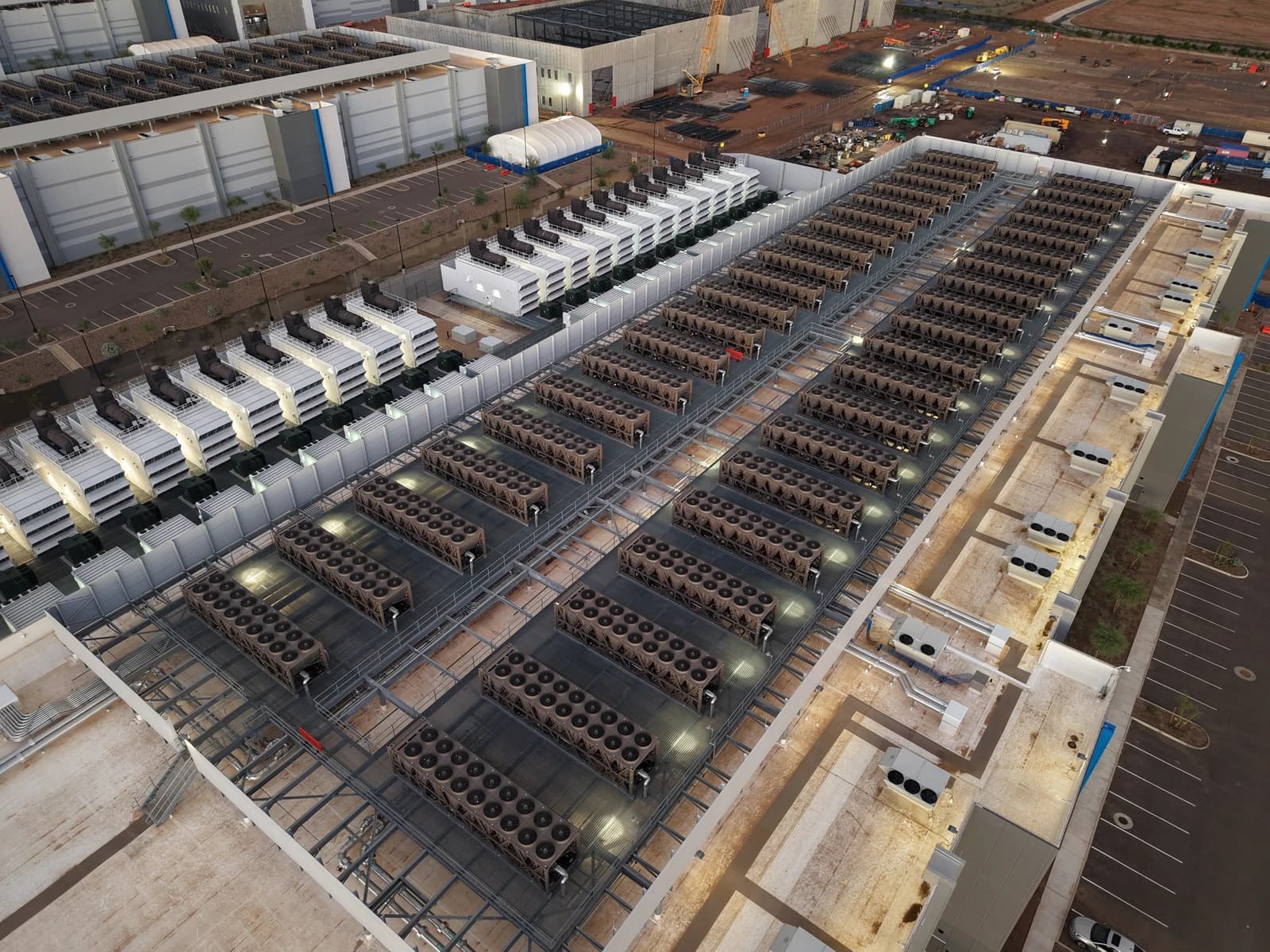
Nvidia’s sharp slide and a recent Microsoft data center failure are forcing investors to confront the most overlooked risk in the AI boom: the infrastructure behind the chips is becoming a single point of failure.
Nvidia Slide Highlights AI Data Center Risk
Nvidia Corp
That matters because the market has spent two years pricing AI as a straight-line story of ever-rising compute demand, yet the real bottleneck is now shifting to power, land, cooling and operational resilience. When data centers go down, customers do not just lose uptime; they reassess concentration risk across the entire AI stack, from chip suppliers and cloud operators to the landlords and utilities that support them.
Sentiment Indicators
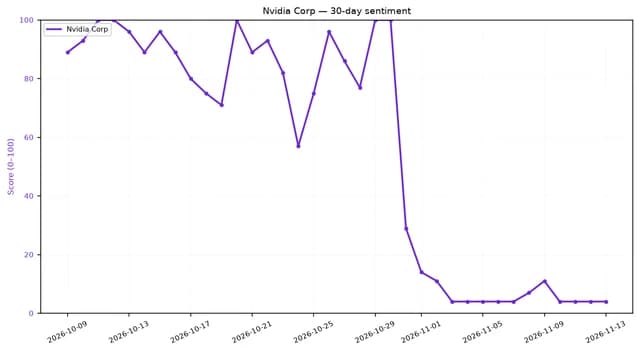
Nvidia, the market’s favorite AI bellwether, has fallen to $160.98 from $235.20 in May, a drop of more than 31%, while its relative strength index has sunk to 18.7, a level that typically reflects deeply oversold conditions. Microsoft has been steadier at $523.56, but its recent volatility underscores the strain on hyperscale operators whose businesses increasingly depend on massive, centralized digital estates. Amazon, another key cloud player, has held up better at $265.24, yet its exposure to data center execution risk remains material.
The macro backdrop is not helping. The 10-year Treasury yield has climbed to 4.98%, tightening the discount rate on long-duration growth assets just as AI capex keeps rising. That combination makes the current reset in Nvidia especially important for investors trying to separate cyclical drawdowns from structural demand. Industrial production, meanwhile, is still expected to edge up to 104.0484 in October, suggesting the real economy is not rolling over — but capital is becoming choosier, and the market is demanding proof that AI spending can translate into durable returns.
The deeper story is that AI is moving from an era of scarcity to an era of operational complexity. Nvidia itself has disclosed that it is securing and guaranteeing land, power, shell and capacity for select data center infrastructure, a sign the company knows the bottleneck is no longer just silicon. That opens a new investable lane: the picks-and-shovels around AI infrastructure. Think utilities, grid equipment, electrical gear, cooling, interconnection and colocation names that benefit when hyperscalers diversify away from brittle, single-site architectures.
This is where the market may be missing the asymmetry. The headline risk is negative for centralized platforms if outages and geopolitical tensions keep exposing concentration risk. But the second-order winner is the broader infrastructure buildout. If every AI cluster needs more redundancy, more distributed capacity and more power, then the next leg of spending flows not just to Nvidia, Microsoft and Amazon, but to the industrial and real-assets ecosystem beneath them.
Adalytica’s proprietary earnings sentiment on Nvidia sits at 4, or “Extreme Fear,” even as awareness remains at 100, highlighting how fast enthusiasm has turned into anxiety. That is often when opportunity emerges. I believe investors should stop treating the current selloff as a verdict on AI demand and start viewing it as a repricing of infrastructure fragility. The best way to play the next phase of the megatrend is not to chase the most crowded names, but to own the enablers that make AI durable, distributed and resilient.
| Entity | Gains | Losses |
|---|---|---|
| Utilities and grid suppliers | ▲Higher power demand | ▼Capex strain and delays |
| Cooling and electrical gear makers | ▲More data center buildout | ▼Supply bottlenecks |
| Colocation and interconnection firms | ▲Demand for redundancy | ▼Pricing pressure from hyperscalers |
| Nvidia and cloud giants | ▲Long-term AI demand | ▼Near-term margin and outage risk |