Google’s plan to roll out two new AI chip variants intensifies the most consequential challenge yet to Nvidia’s near-monopoly on the highest-end artificial intelligence hardware, coming as Nvidia’s shares have slid sharply and investors reassess how durable its pricing power really is.
Nvidia Faces Pressure From Google's New AI Chips

The strategic importance is straightforward: every credible in-house accelerator threatens to trim the addressable market for Nvidia’s data-center GPUs, even if only at the margins at first. Google is already among the biggest buyers of AI compute in the world, and a broader internal deployment of custom silicon would mean more workload shifting away from merchant chips and toward lower-cost, vertically integrated infrastructure. For hyperscalers, that is a path to better unit economics. For Nvidia, it is a direct test of whether its software ecosystem and performance lead can withstand customer self-sufficiency.
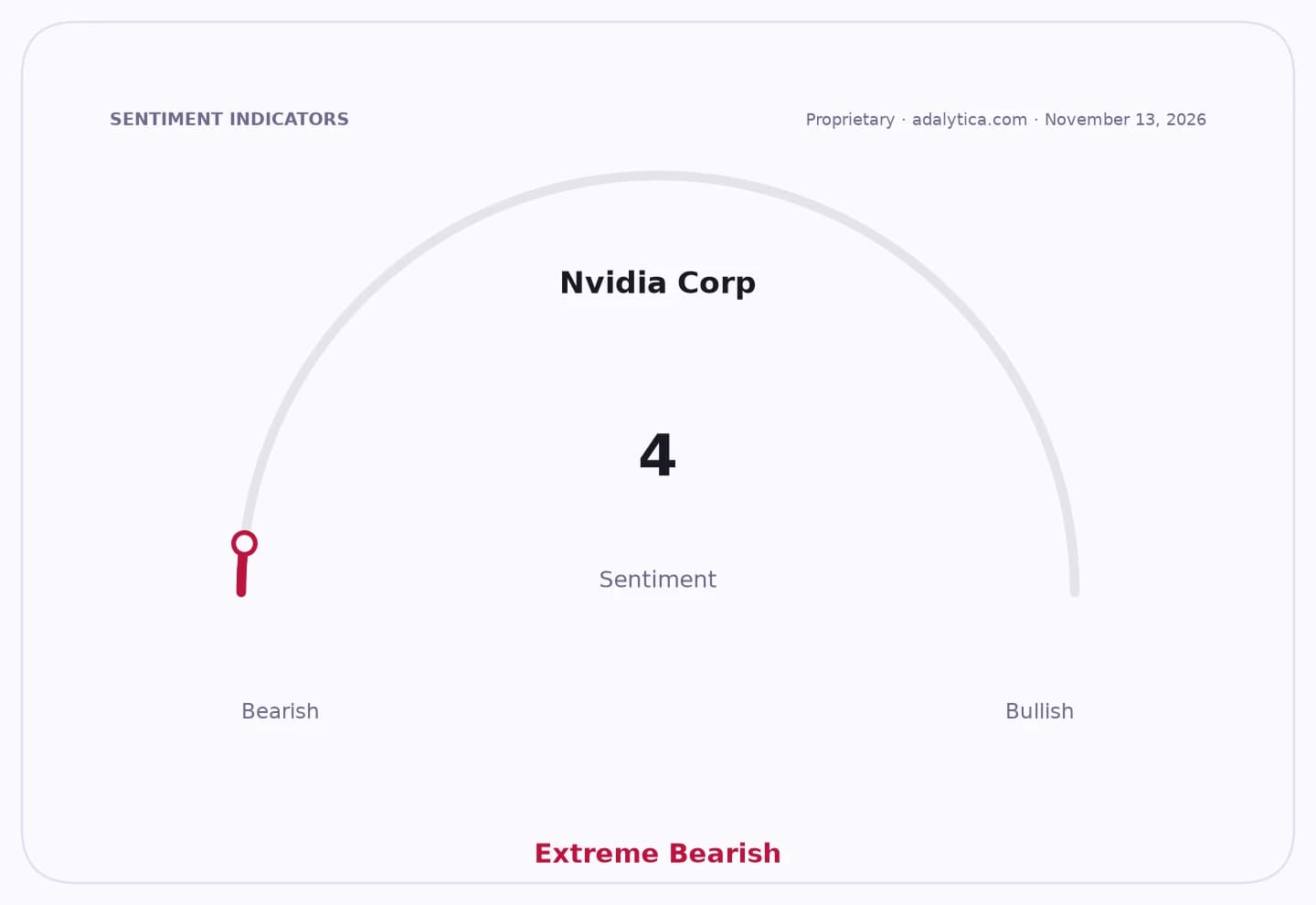
Sentiment Indicators
Nvidia Corp
The market is already pricing in that pressure. Nvidia closed at $162.85 on Nov. 13, down about 28% from its May 14 peak of $235.20, while the stock’s 50-day moving average sits at $214.63, well above the current price, a technical gap that underscores how quickly momentum has reversed. The relative strength index was 19.1 on the latest reading, deep in oversold territory, and the MACD remained negative, reflecting the severity of the selloff rather than an isolated pullback. Adalytica’s NVIDIA Earnings Sentiment gauge was in “Extreme Fear” at 4, even as awareness remained elevated, a sign that the market is highly focused on the stock but sharply more cautious about its outlook.
Google’s move also matters because it validates a broader industry shift: the largest buyers of AI infrastructure no longer want to be pure customers. Microsoft, Amazon and Meta have all expanded custom chip efforts to reduce dependence on Nvidia, cut cloud costs and secure supply. If Google’s next-generation variants deliver a meaningful efficiency gain, it could strengthen the case that hyperscale AI demand will increasingly be met by proprietary silicon rather than off-the-shelf accelerators.
That does not mean Nvidia loses the battle outright. Its strongest defense remains the breadth of its CUDA software stack, developer lock-in and a performance lead that rivals still have to prove at scale. AMD, meanwhile, is trying to position itself as the main merchant alternative, but its latest price action shows investors are treating the AI chip trade as volatile, not linear. AMD shares surged to $585.30 on Nov. 12 before slipping to $534.06 the next day, illustrating how quickly expectations can reset in a market still dominated by headline risk around AI spending and competition.
The other layer is geopolitical. Tighter U.S. export controls and Washington’s scrutiny of advanced AI chips create an environment in which U.S. hyperscalers may accelerate domestic chip design while global customers face more uncertainty over supply and compliance. That combination can protect the U.S. ecosystem in one sense, but it also increases fragmentation and raises the risk that the biggest buyers will increasingly design around Nvidia rather than through it.
For investors, the key question is no longer whether demand for AI compute remains strong. It is whether that demand accrues to Nvidia at the same margins and with the same pricing power. Google’s new chip variants suggest the answer may be no, or at least not forever. The next catalysts are adoption rates, performance disclosures and whether more cloud operators follow Google’s lead with chips that are good enough to take share from Nvidia without sacrificing the economics of the AI buildout.
| Entity | Gains | Losses |
|---|---|---|
| ▲Lower AI compute costs | ▼Nvidia dependency | |
| Nvidia | ▲Continued AI demand growth | ▼Custom chip substitution |
| AMD | ▲Potential share gains from Nvidia | ▼Competitive pressure from hyperscalers |
| Hyperscalers | ▲Better infrastructure economics | ▼Upfront chip-design costs |